
Brain
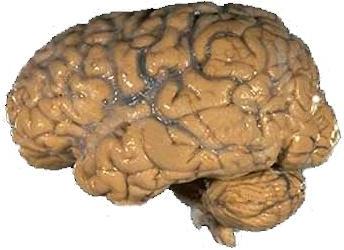
Credit: Wikimedia Commons · Public domain
The brain is the organ inside your head that controls your body and lets you think. It is the most complex organ humans have. The brain handles everything you do on purpose, like throwing a ball or solving a math problem. It also runs everything your body does without you noticing, like keeping your heart beating and your lungs breathing. An adult brain weighs about three pounds, roughly the same as a small melon.
The brain is made of soft, pinkish-gray tissue. It feels a bit like firm jelly. To keep it safe, the brain sits inside the bony skull and floats in a clear liquid called cerebrospinal fluid. The fluid acts like a cushion. If you bump your head, it helps stop the brain from slamming into the bone.
What the brain is made of
The brain is built from billions of tiny cells called neurons. Scientists think the human brain has about 86 billion of them. Each neuron can connect to thousands of others. The connections form a giant web that passes signals around at high speed. These signals are how you see, hear, feel, remember, and move.
Neurons send messages using small bursts of electricity and chemicals. A signal can travel from your brain to your foot in less than a tenth of a second. That is why you can pull your hand away from a hot pan before you even realize it hurts.
The main parts
The brain has three main parts. Each part does different jobs.
The cerebrum is the biggest part. It sits on top and takes up most of the space inside your skull. The cerebrum handles thinking, learning, memory, language, and choices. It also controls movement you decide to do, like waving or kicking. The cerebrum is split into two halves called hemispheres. The left half mostly controls the right side of your body, and the right half mostly controls the left side. People sometimes say the left brain is for math and the right brain is for art, but that idea is mostly a myth. Both halves work together on almost every task.
The cerebellum is a smaller, wrinkled part tucked under the back of the cerebrum. It helps you balance and move smoothly. When you ride a bike, catch a ball, or stand on one foot, your cerebellum is doing the math.
The brainstem connects the brain to the spinal cord. It controls the things your body does without thinking: breathing, heartbeat, swallowing, and digestion. If the cerebrum is the busy office, the brainstem is the building's electricity and plumbing.
How the brain talks to the body
Your brain is connected to the rest of you by the spinal cord, a thick bundle of nerves that runs down inside your backbone. Nerves branch out from the spinal cord to every part of the body. Together, the brain, spinal cord, and nerves make up the nervous system.
When you touch something cold, nerves in your skin send a signal up to your brain. Your brain reads the signal and tells you, "that is cold." If you decide to move your hand, your brain sends a signal back down to your muscles. All of this happens in a tiny fraction of a second.
Sleep, memory, and learning
Your brain never fully stops, even when you sleep. During sleep, the brain sorts through what happened during the day. It strengthens important memories and trims away things you do not need. This is one reason kids and teenagers need so much sleep. A growing brain does a lot of building at night.
Learning works by changing the connections between neurons. The first time you try a hard piece on the piano, the connections are weak. Each time you practice, the connections grow stronger. After enough practice, your fingers seem to know the notes on their own. Scientists call this ability to change "neuroplasticity."
What we still don't know
The brain is the least understood organ in the human body. Scientists can map its parts and watch which areas light up during different tasks. But the biggest question is still open: how does a three-pound lump of cells produce thoughts, feelings, and the feeling of being you? This question is called the problem of consciousness. Nobody has solved it. Some scientists think we will figure it out within a hundred years. Others think the human brain may not be able to fully understand itself.
For now, what we know is enough to amaze us. The same organ that lets you read this sentence also wrote it, in someone else's head, before you were ever born.
Related
Last updated 2026-04-25