
Touch
Credit: US-Gov · Public domain
Touch is the sense that lets you feel things through your skin. It is one of your five main senses, along with sight, hearing, smell, and taste. Through touch, you can feel pressure, heat, cold, pain, and the texture of things. Unlike the other senses, touch works all over your body, not just in one spot.
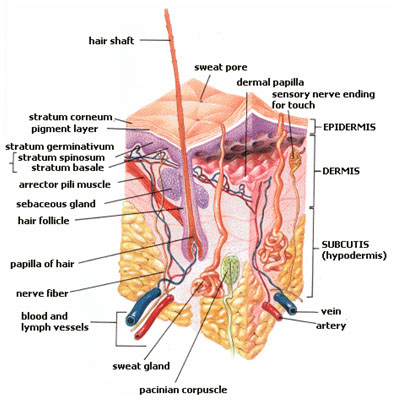
Your skin is the largest organ in your body. An adult's skin would cover about 20 square feet if you laid it flat, roughly the size of a small bedroom rug. Inside your skin are millions of tiny sensors called receptors. Each receptor has a special job. Some sense gentle pressure, like a feather brushing your arm. Some sense strong pressure, like a tight hug. Others sense temperature, vibration, or pain.
When something touches you, the receptors send a signal up through your nerves. The signal travels to your spinal cord and then to your brain. Your brain reads the signal and tells you what you are feeling. All of this happens in less than a tenth of a second. That is faster than you can blink.
Some parts of your body have many more touch receptors than others. Your fingertips, lips, and the tip of your tongue are packed with them. Your back has far fewer. That is why you can read tiny bumps with your fingers but probably could not read them with your elbow. The system that lets blind people read, called Braille, depends on this. Braille uses small raised dots that fingertips can easily tell apart.
Pain is part of touch, even though it does not feel pleasant. Pain receptors warn you when something might harm your body. If you touch a hot stove, pain pulls your hand back before you even think about it. People who are born unable to feel pain often get hurt without knowing it. Doctors say pain, as much as we hate it, helps keep us alive.
Touch matters for more than just safety. Studies show that babies who are held and cuddled grow better and feel calmer. A hug from a friend can lower your heart rate. Even petting a dog can make people feel less stressed. Scientists are still learning how touch shapes feelings, memory, and health.
The next time you pick up a pencil or feel a cold breeze, remember that millions of tiny sensors are working together to tell your brain about the world.
Last updated 2026-04-25