
Angle
Credit: Wikimedia Commons · Public domain
An angle is the space between two lines or edges that meet at a single point. The point where the lines meet is called the vertex. The two lines are called the sides or rays of the angle. Angles are everywhere. You make one when you open a book, bend your elbow, or turn the hands of a clock.
Angles are measured in units called degrees. The symbol for degrees is a tiny circle, like this: 90°. A full turn all the way around is 360 degrees. That comes from a very old idea. Ancient Babylonians, who lived in what is now Iraq about 4,000 years ago, used a number system based on 60. They split a full circle into 360 equal slices. We still use their number today.
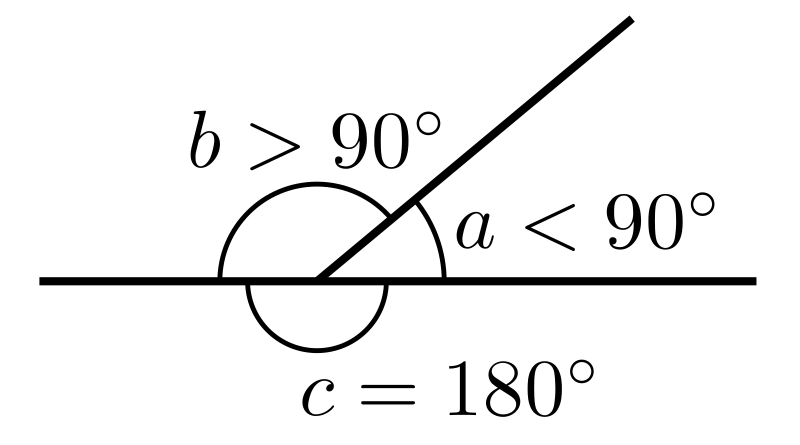
Angles have names based on their size. A right angle is exactly 90 degrees. It looks like the corner of a square or a piece of paper. An acute angle is smaller than 90 degrees, like the sharp tip of a slice of pizza. An obtuse angle is bigger than 90 degrees but smaller than 180. A straight angle is exactly 180 degrees, which is just a flat line. A reflex angle is bigger than 180 degrees, almost a full turn.
People use a tool called a protractor to measure angles. A protractor is a flat half-circle, usually clear plastic, with degree marks from 0 to 180 along its curved edge. You line up the bottom of the protractor with one side of the angle, and you read the number where the other side crosses.
Angles matter far beyond math class. Builders use right angles to keep walls standing straight. If a house's corners are off by even a few degrees, the floors slope and doors stop closing. Pilots steer planes by changing angles. Skateboarders talk about a "360" or a "180," meaning a full or half turn in the air. Pool players aim by guessing the angle a ball will bounce off a cushion.
Some of the deepest ideas in math come from angles. Around 300 BCE, a Greek mathematician named Euclid wrote a book called the Elements. In it, he proved that the three angles inside any triangle always add up to 180 degrees. That rule is still true today, in every triangle ever drawn.
Last updated 2026-04-26