
Square
Credit: Johannes Rössel (talk) · Public domain
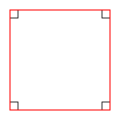
A square is a flat shape with four straight sides that are all the same length. All four corners of a square are right angles, which means each corner is exactly 90 degrees. A square is a kind of rectangle, but it has the extra rule that every side must match. It is one of the simplest and most useful shapes in math.
Squares are everywhere in daily life. The face of a die is a square. So is a slice of cheese, a checkerboard space, a window pane, and the screen of many old televisions. Most floor tiles are squares. Builders like squares because they fit together with no gaps and no overlaps. This is called tiling.
To find the perimeter of a square, you add up the length of all four sides. Since the sides are equal, you can just multiply one side by four. A square with sides of 5 inches has a perimeter of 20 inches. To find the area, the space inside the shape, you multiply the length of one side by itself. A square with sides of 5 inches has an area of 25 square inches.
This idea of multiplying a number by itself is so connected to squares that it got its own name. When you multiply a number by itself, you "square" it. Five squared is 25. Ten squared is 100. The word "square" in math comes straight from the shape, because the answer is the area of a square with that side length.
Squares have a lot of symmetry. You can fold a square in half four different ways and the two halves will match up perfectly. You can also turn a square a quarter of the way around, and it looks exactly the same as before. Few shapes are this balanced.
Ancient builders used squares long before they had calculators or computers. The Egyptians used knotted ropes to lay out perfect squares for the bases of their pyramids. The Romans used square stones to build straight roads across Europe. Today, graph paper, pixels on a screen, and the grid of city blocks all rely on the same simple idea: four equal sides and four right angles.
Last updated 2026-04-26