
Symmetry
Credit: Scott Foresman - publishing company specializing in educational material · Public domain
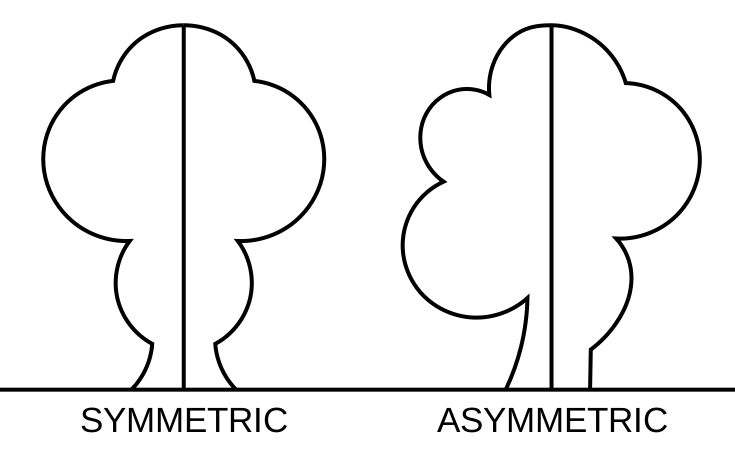
Symmetry is when one part of a shape or object matches another part in a balanced way. If you can fold a shape in half and both sides line up exactly, that shape has symmetry. Symmetry shows up everywhere in math, in nature, and in art. It is one of the first ideas kids learn in geometry.
The most common kind is called line symmetry. A shape has line symmetry if you can draw a straight line through it that splits it into two matching halves. The line is called a line of symmetry, or sometimes a mirror line. A square has four lines of symmetry. A rectangle has two. A circle has so many you cannot count them all.
Another kind is rotational symmetry. A shape has rotational symmetry if you can spin it around a center point and it looks the same before you finish a full turn. A starfish has rotational symmetry. Spin it one-fifth of the way around and it looks the same as before. A pinwheel has rotational symmetry too, even though it has no line symmetry.
Nature uses symmetry constantly. Most animals, including people, have what is called bilateral symmetry. Your left side roughly matches your right side. Your two eyes, two ears, two arms, and two legs are mirror images. Butterflies and moths show this clearly. The patterns on their left wings match the patterns on their right wings. Flowers often have rotational symmetry, with petals arranged evenly around the center. Snowflakes always have six matching arms.
Symmetry is not just pretty. It is useful. Engineers use it to design cars, planes, and bridges that balance properly. Architects use it to make buildings feel steady and grand. The Taj Mahal in India is one of the most symmetrical buildings ever built. Even tiny things show symmetry. The atoms inside a salt crystal line up in a perfect cube pattern, which is why salt crystals look like little cubes under a microscope.
Not everything in nature is perfectly symmetrical, though. Most human faces are slightly uneven. One ear sits a bit higher, or one eye is a bit smaller. Scientists have found that people often think faces look more attractive when they are closer to symmetrical, but no real face matches up exactly. Look in a mirror and check.
Last updated 2026-04-26