
Laboratory
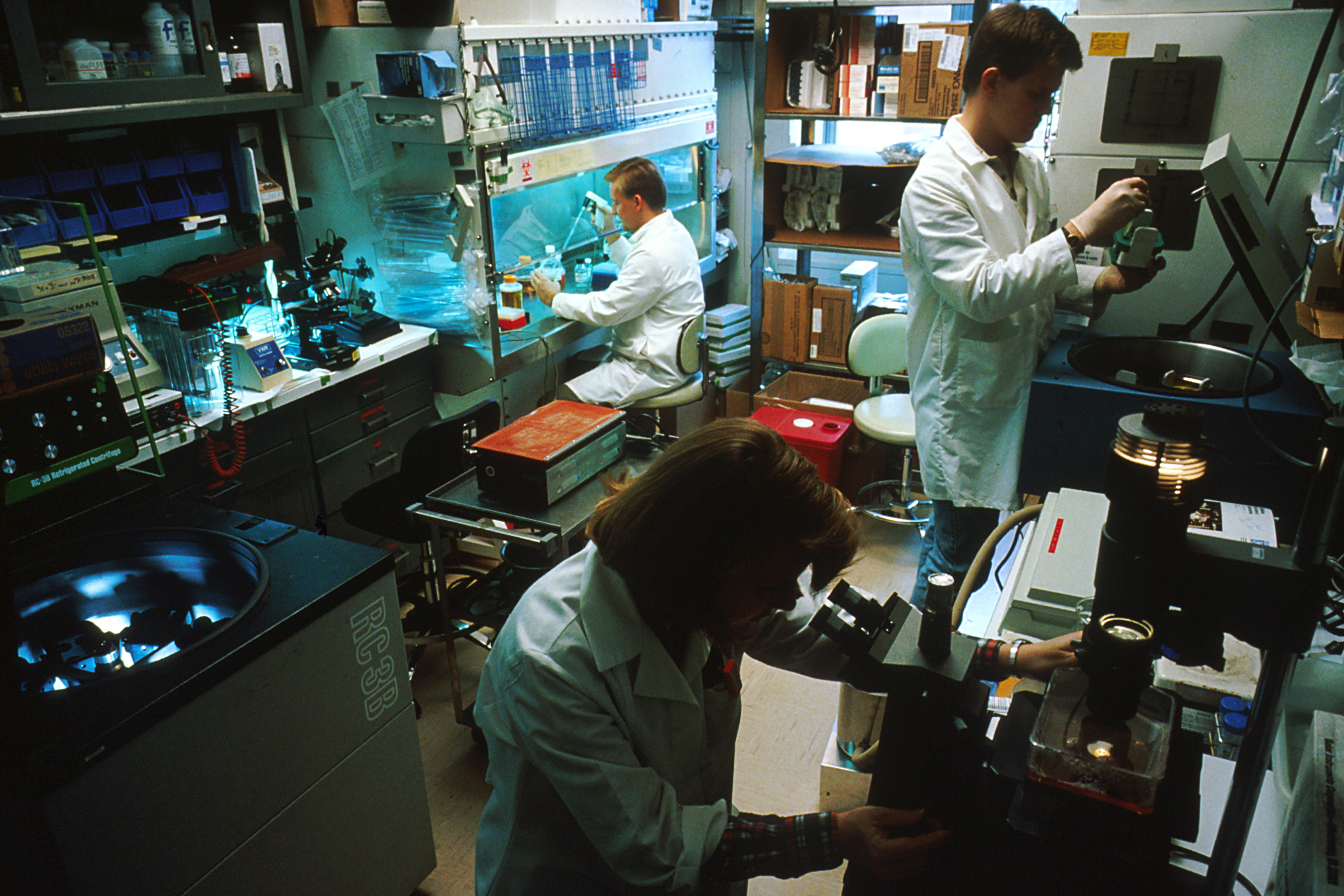
Credit: Bill Branson (Photographer) · Public domain
A laboratory is a place built for doing science. Scientists use labs to run experiments, study samples, and test ideas. The word is often shortened to "lab." Labs are found in schools, hospitals, factories, universities, and even on space stations.
A lab is set up to make careful work possible. It usually has strong tables called benches, bright lights, and sinks with running water. Shelves hold tools like microscopes, beakers, test tubes, and thermometers. Chemicals are kept in locked cabinets. Many labs also have computers to record what happens during each test.
Different kinds of science need different kinds of labs. A biology lab might have live plants, cell samples, or small animals. A chemistry lab has bottles of liquids and powders that can mix to form new substances. A physics lab might hold lasers, magnets, and machines that measure tiny forces. Some labs are huge. The Large Hadron Collider in Europe is a physics lab buried underground in a tunnel 17 miles around.
Safety matters in every lab. Scientists wear goggles to protect their eyes, gloves to protect their hands, and coats to protect their clothes. They follow strict rules because some chemicals burn skin, and some germs can make people sick.
The next time you mix baking soda and vinegar in the kitchen, you are doing what scientists do every day in labs around the world.
Related
Last updated 2026-04-23