
Motion
Credit: DemonDeLuxe (Dominique Toussaint) · CC BY-SA 3.0
Motion is a change in the position of an object over time. If a thing is in one place now and a different place a moment later, it is in motion. A car driving down the street is in motion. So is a falling leaf, a running dog, and a planet orbiting the Sun. Motion is one of the most basic ideas in physics.
To describe motion, scientists use a few key words. Speed tells how fast something is going. Velocity tells speed plus direction. Acceleration tells how quickly the speed or direction is changing. A bike going 10 miles per hour is moving at a certain speed. A bike going 10 miles per hour south has a velocity. A bike that speeds up from 10 to 15 miles per hour is accelerating.
Nothing moves on its own. To start, stop, or change direction, an object needs a push or a pull. This push or pull is called a force. Gravity is a force that pulls things down toward Earth. Friction is a force that slows things down when they rub against something else. A soccer ball rolling on grass slows and stops because friction is acting on it.
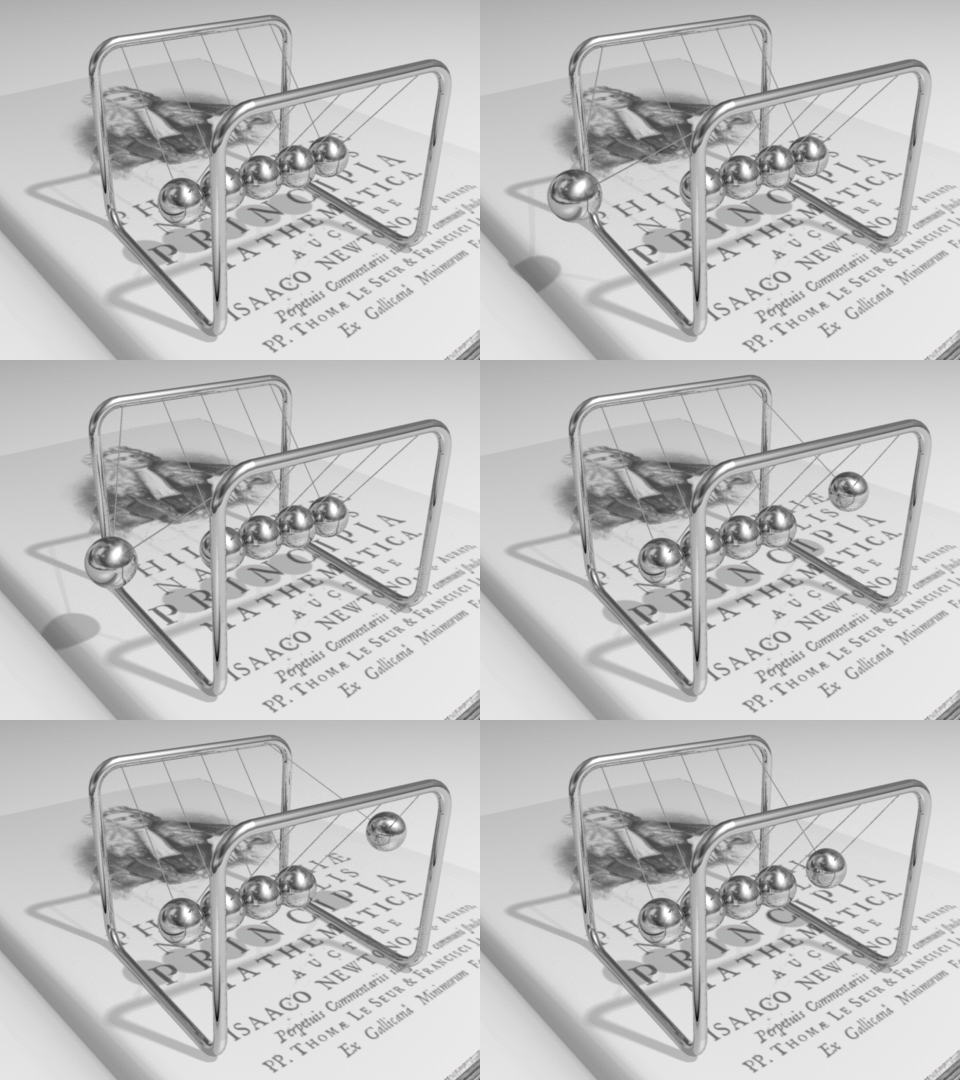
In the late 1600s, an English scientist named Isaac Newton wrote three rules that explain how motion works. These are called Newton's laws of motion. The first law says an object at rest stays at rest, and a moving object keeps moving in a straight line, unless a force acts on it. The second law says a bigger force makes a bigger change in motion, and heavier objects are harder to move. The third law says for every action, there is an equal and opposite reaction. When you jump, your feet push down on the ground, and the ground pushes you back up.
Motion can be tricky to measure because it depends on your point of view. If you are sitting in a moving train and drop a coin, the coin falls straight down from your view. But to someone standing outside watching the train go by, the coin moves forward as it falls. Scientists call this idea relative motion.
Motion happens at every size. Tiny atoms vibrate inside every solid object, even ice. Huge galaxies drift through space at millions of miles per hour. The rules Newton wrote still describe almost all of it, from a bouncing basketball to the orbit of the Moon.
Related
Last updated 2026-04-23