
Asteroid Belt
Credit: Wikimedia Commons · Public domain
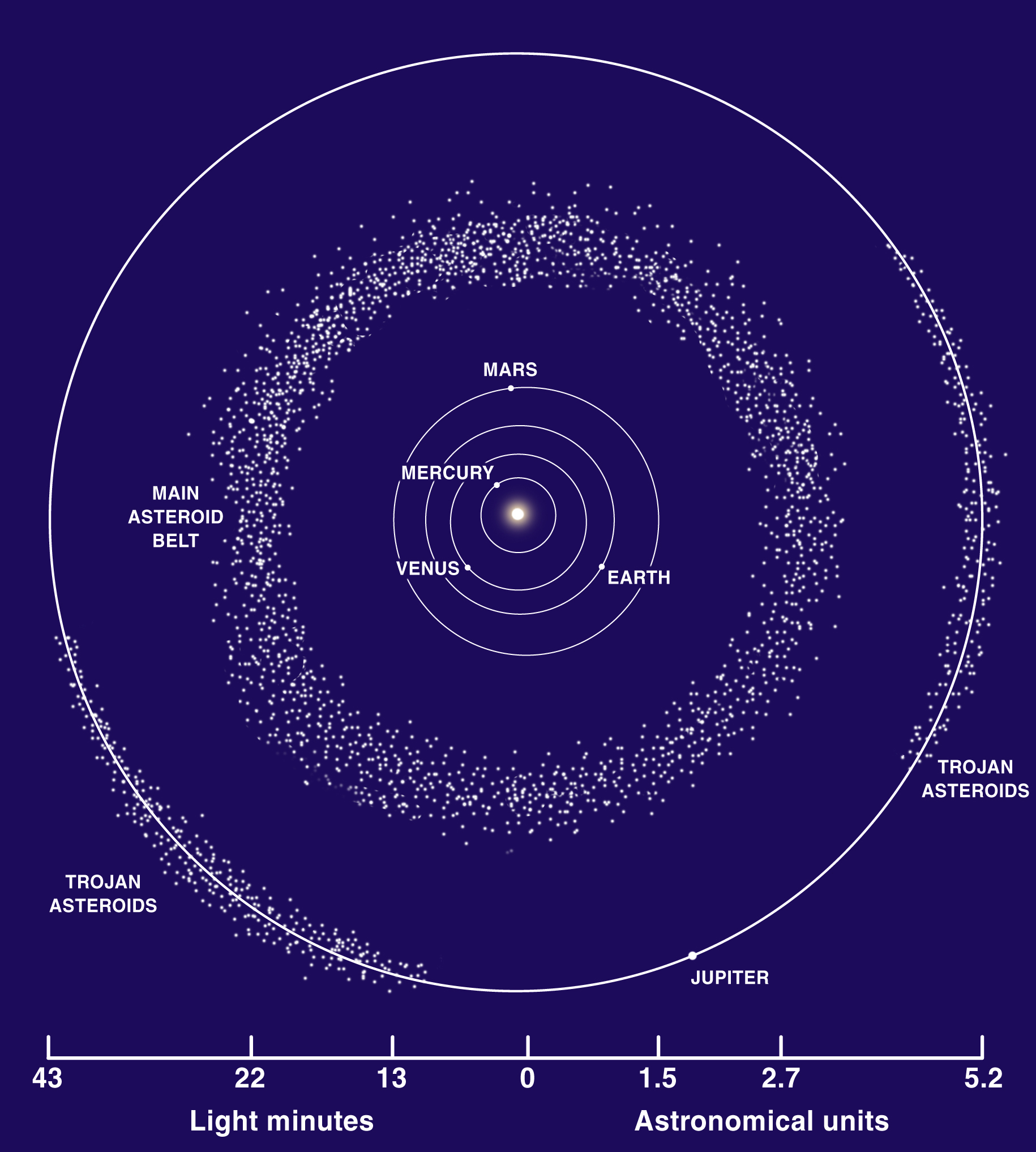
The asteroid belt is a wide ring of rocky objects that orbits the Sun between Mars and Jupiter. The rocks in it are called asteroids. Most are small chunks of stone and metal, though some are hundreds of miles across. Astronomers have found more than one million asteroids in the belt, and they think millions more are too small to spot from Earth.
The belt is huge. It stretches across a zone about 140 million miles wide, which is farther than the distance from Earth to the Sun. Because the belt is so spread out, the asteroids inside it are not packed together. In movies, spaceships dodge asteroids that almost touch each other. The real belt is nothing like that. The average distance between two asteroids is about 600,000 miles, more than twice the distance from Earth to the Moon. NASA spacecraft have flown through the belt many times without ever hitting anything.
Asteroids come in many sizes. The biggest object in the belt is Ceres, which is about 590 miles across. Ceres is so large and round that scientists call it a dwarf planet, the same category as Pluto. The next largest are Vesta, Pallas, and Hygiea. Below those, sizes drop quickly. Most asteroids are just boulders or pebbles.
Where did the belt come from? For a long time, people thought it was a shattered planet. Scientists now believe the opposite. The rocks in the belt are leftover pieces that never managed to form a planet at all. When the solar system was young, clumps of rock were starting to stick together in that region. But Jupiter's huge gravity kept stirring them up. The clumps crashed into each other and broke apart instead of growing. The belt is basically a planet that never got built.
Asteroids are not all the same kind of rock. Some are mostly stone. Some are rich in metals like iron and nickel. A few are dark and full of carbon, and might even hold frozen water. Because of this, some companies have started planning missions to mine asteroids for metal someday.
Robotic spacecraft have already visited the belt. NASA's Dawn mission orbited both Vesta and Ceres between 2011 and 2018. It found bright, mysterious patches of salt on Ceres that nobody expected. Scientists still argue about exactly how those bright spots formed, and what they might tell us about water hidden under the surface.
Last updated 2026-04-22