
Solar System
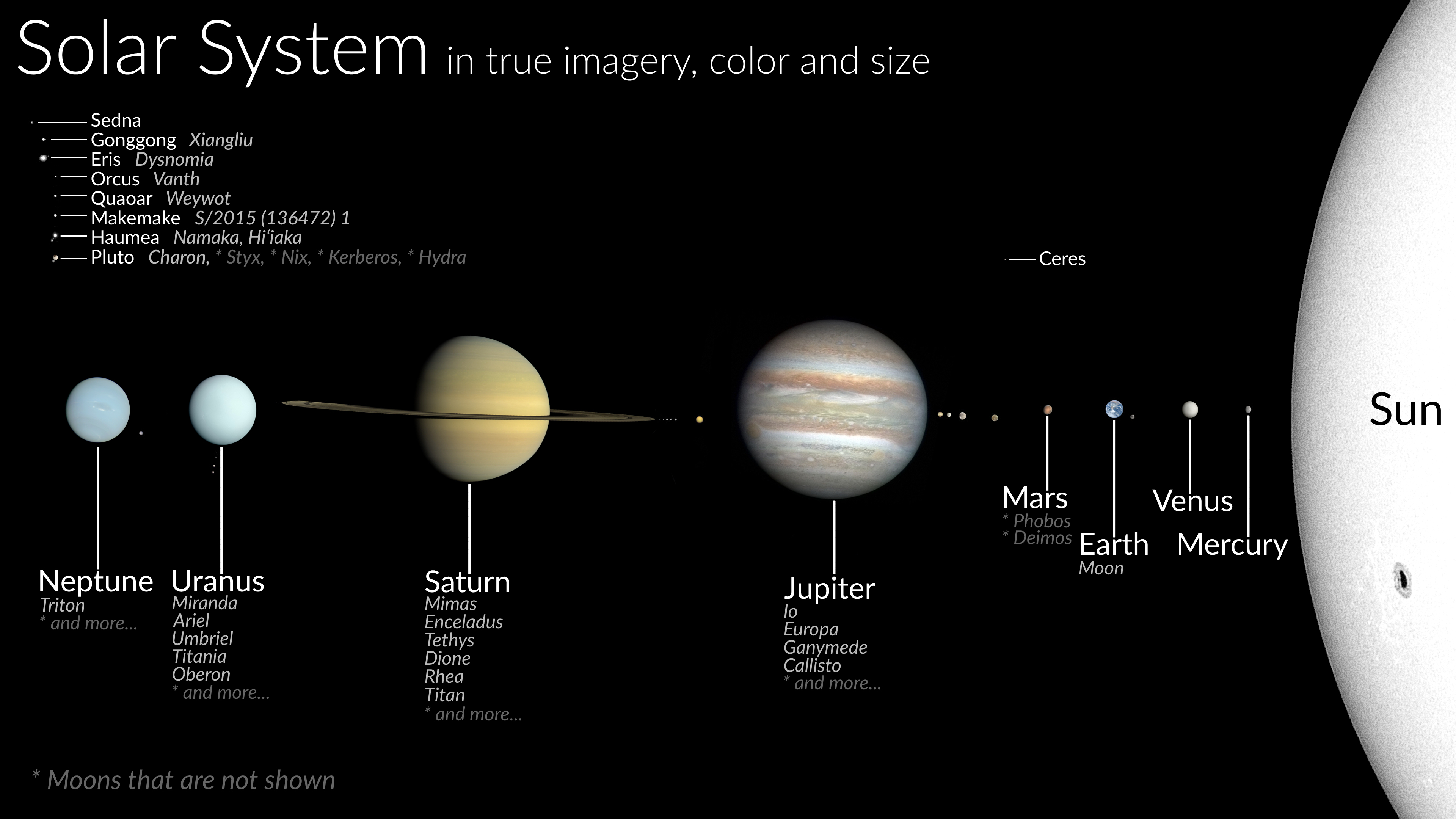
Credit: CactiStaccingCrane · CC BY-SA 4.0
The solar system is our neighborhood in space. It is made up of the Sun, eight planets, many moons, and billions of smaller objects like asteroids and comets. All of these objects orbit the Sun, which sits at the center. The solar system formed about 4.6 billion years ago out of a giant cloud of gas and dust.
The Sun
The Sun is a star, and it is by far the biggest thing in the solar system. It holds more than 99 percent of all the matter here. You could fit more than a million Earths inside the Sun. Its gravity is what keeps every planet, moon, and asteroid in orbit. The Sun also gives off the light and heat that make life on Earth possible.
The planets
There are eight planets in the solar system. In order from the Sun, they are Mercury, Venus, Earth, Mars, Jupiter, Saturn, Uranus, and Neptune. Scientists split them into two groups.
The first four planets are called the rocky planets, or the inner planets. They are small, solid, and made mostly of rock and metal. Mercury is the closest to the Sun and has almost no air. Venus is covered in thick clouds that trap heat, making it the hottest planet. Earth is the only place we know of with life. Mars is cold and dusty, with rust-colored soil that gives it the nickname "the Red Planet."
After Mars comes a wide zone of rubble called the asteroid belt. Millions of rocky chunks orbit there, left over from when the solar system formed.
Beyond the asteroid belt are the four gas giants. Jupiter is the biggest planet, more than twice as heavy as all the other planets combined. It has a giant storm called the Great Red Spot that has been raging for at least 350 years. Saturn is famous for its bright rings, which are made of billions of chunks of ice. Uranus is tipped on its side, so it rolls around the Sun like a ball instead of spinning upright. Neptune is the farthest planet and has winds faster than any hurricane on Earth.
Moons, dwarf planets, and more
Most planets have moons, which are smaller worlds that orbit a planet. Earth has one. Mars has two small ones. Jupiter and Saturn each have more than 90 known moons. Some of these moons are surprising places. Jupiter's moon Europa has a salty ocean hidden under a thick shell of ice. Saturn's moon Titan has rivers and lakes, but they are filled with liquid methane instead of water.
Beyond Neptune is a ring of icy worlds called the Kuiper Belt. Pluto lives there. For 76 years, Pluto was called the ninth planet. In 2006, astronomers voted to call it a dwarf planet instead. Many people are still upset about the change, and some scientists still argue that Pluto should be a planet. Eris, Haumea, and Makemake are other dwarf planets found in the Kuiper Belt.
Farther out still, scientists think there is a huge bubble of icy objects called the Oort Cloud. Most comets come from there. A comet is a ball of ice, rock, and dust. When a comet swings close to the Sun, the heat melts some of its ice and creates a long, glowing tail.
How big is big?
The solar system is almost impossible to picture. Light is the fastest thing in the universe. It travels about 186,000 miles in one second. Sunlight takes about 8 minutes to reach Earth. It takes more than 5 hours to reach Pluto. If you got in a car and drove toward the Sun at highway speed, it would take more than 170 years to get there.
The planets are also very far apart. If you shrank the solar system so Earth was the size of a pea, Jupiter would be a grapefruit half a football field away. Most of the solar system is empty space.
Still exploring
People have sent robot spacecraft to every planet. NASA's Voyager 1, launched in 1977, has flown past the outer planets and is now beyond the edge of the Sun's influence, more than 15 billion miles from home. Rovers roll across Mars, looking for signs that life might have existed there long ago. We still do not know if any other world in the solar system has living things, or ever did. That is one of the biggest questions scientists are trying to answer.
Every year, new telescopes and missions show us something we did not know before. The solar system is old, but our exploration of it is just getting started.
Related
Last updated 2026-04-22