
Jupiter
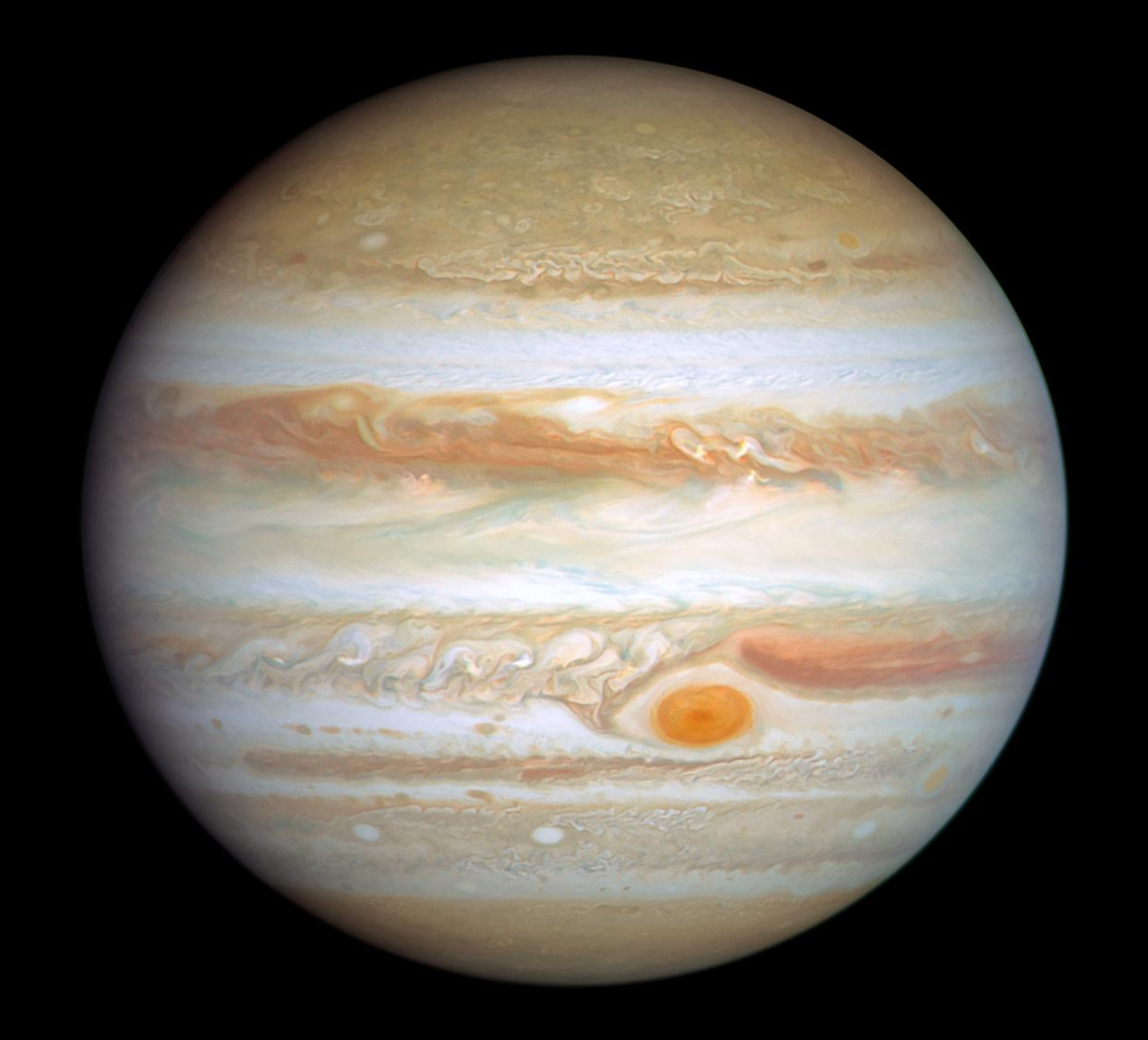
Credit: NASA/STSCI (S.T.A.R.S) · Public domain
Jupiter is the largest planet in our solar system. It is the fifth planet from the Sun, and it orbits about 484 million miles away. Jupiter is a gas giant, which means it does not have a solid surface like Earth. Instead, it is made mostly of hydrogen and helium, the same gases that make up the Sun.
Jupiter is huge. It is about 11 times wider than Earth. If Jupiter were a hollow ball, more than 1,300 Earths could fit inside it. Its mass is more than twice the mass of all the other planets combined. Even so, Jupiter is much smaller than the Sun. The Sun could hold about 1,000 Jupiters.
Even though Jupiter is so big, it spins faster than any other planet. A day on Jupiter is less than 10 hours long. Spinning that fast makes the planet bulge out at its middle. It also stirs up the clouds into bands of white, tan, red, and brown that wrap all the way around the planet.
One of those bands holds the Great Red Spot. The Great Red Spot is a storm bigger than Earth. It has been spinning for at least 350 years, which is how long people have been watching it through telescopes. The storm has been shrinking in recent decades, and scientists are not sure why.
Jupiter has rings, but they are thin and dusty. They are nothing like the bright rings of Saturn. Most people did not even know Jupiter had rings until a NASA spacecraft called Voyager 1 flew past in 1979.
Jupiter has 95 known moons. The four largest were discovered by the Italian astronomer Galileo Galilei in 1610, when he pointed one of the first telescopes at the sky. These four are called the Galilean moons: Io, Europa, Ganymede, and Callisto. Ganymede is the largest moon in the whole solar system. It is even bigger than the planet Mercury.
Europa has attracted special attention from scientists. Under its icy crust, Europa almost certainly has a deep ocean of liquid water. Some scientists think that ocean might be one of the best places to search for life beyond Earth. NASA launched a spacecraft called Europa Clipper in 2024 to find out more.
Looking up, you can often see Jupiter yourself. It is one of the brightest objects in the night sky, outshining every star. The ancient Romans named it after the king of their gods.
Related
Last updated 2026-04-22