
Light-Year
Credit: Richard Powel · CC BY-SA 2.5
A light-year is a unit of distance used in space. It is the distance that light travels in one year. Even though the name has the word "year" in it, a light-year measures how far, not how long.
Light is the fastest thing in the universe. It moves about 186,000 miles per second. In one second, a beam of light could zip around Earth almost seven and a half times. In one year, that same beam covers about 5.88 trillion miles. That is the length of one light-year.
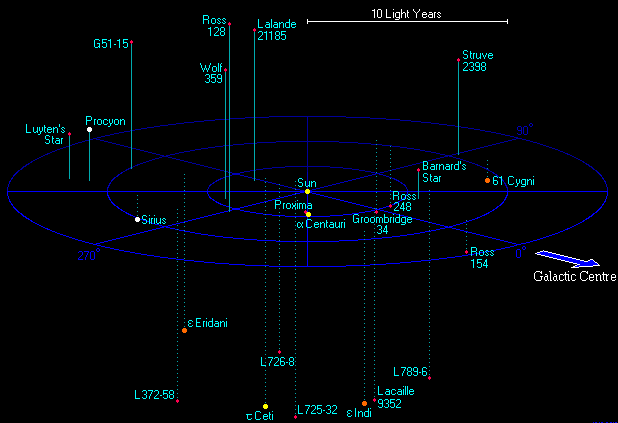
Scientists use light-years because distances in space are almost too big to imagine in regular miles. The closest star to our Sun is called Proxima Centauri. It is about 4.2 light-years away. Written in miles, that number is 25 trillion. The light-year number is much easier to use and easier to picture.
A light-year also acts like a time machine. When you look at a star, you are not seeing it as it is right now. You are seeing light that left that star years ago. Proxima Centauri's light takes 4.2 years to reach us, so you see it as it was 4.2 years ago. The light from stars in our Milky Way galaxy can take thousands of years to arrive. Some of the stars you see at night might not even exist anymore.
Farther out, the numbers get huge. Our whole galaxy, the Milky Way, is about 100,000 light-years across. The nearest large galaxy to ours is the Andromeda Galaxy. It sits about 2.5 million light-years away. When Andromeda's light reaches your eyes tonight, it has been traveling since before modern humans existed.
The most powerful telescopes can see even farther. The James Webb Space Telescope has spotted galaxies more than 13 billion light-years away. Their light has been traveling almost since the Big Bang. Looking deep into space is the same as looking deep into the past.
Light-years have a strange side effect. Because nothing can travel faster than light, we can only ever see parts of the universe whose light has had time to reach us. Beyond that edge, there may be more universe we cannot see yet. Astronomers call the edge the "observable universe." What lies past it is one of the biggest open questions in science.
So every clear night, when you look up, you are really looking backward in time, one light-year at a step.
Last updated 2026-04-22