
Orbit
Credit: User:Zhatt · Public domain
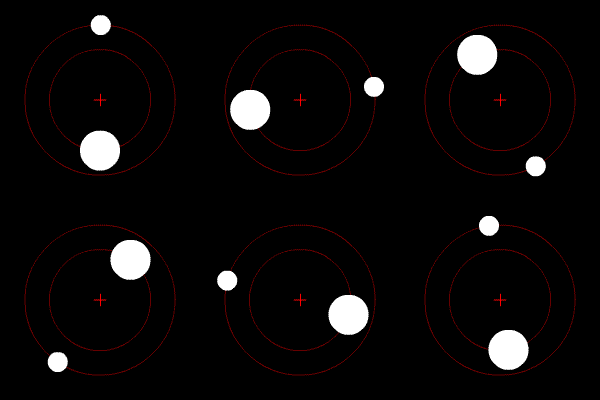
An orbit is the curved path one object takes around another in space. The Moon follows an orbit around Earth. Earth follows an orbit around the Sun. Satellites, space stations, comets, and even whole galaxies all travel in orbits. Orbits are the reason the solar system holds together instead of flying apart.
Orbits exist because of gravity. Gravity is the pull that every object with mass has on every other object. The Sun's huge gravity tugs on Earth and keeps it from drifting away into deep space. Earth's gravity does the same thing to the Moon. Without gravity, objects in space would just travel in straight lines forever.
So why don't orbiting objects fall straight down into the thing they orbit? Because they are also moving sideways, very fast. Imagine throwing a baseball. It curves down and hits the ground. Now imagine throwing it so fast that as it falls, Earth's surface curves away beneath it just as quickly. The ball would keep falling and keep missing the ground. That is what an orbit really is: falling forever without ever landing. Isaac Newton figured this out in the 1600s.
The shape of an orbit is almost never a perfect circle. Most orbits are shaped like a stretched oval called an ellipse. Earth's orbit is close to a circle, but not quite. In January, Earth is about 3 million miles closer to the Sun than it is in July. That is a surprise to many people, because it is winter in the northern half of the world in January. Seasons are caused by Earth's tilt, not by its distance from the Sun.
Orbits come in many sizes. The International Space Station orbits about 250 miles above Earth and goes around every 90 minutes. Weather satellites sit much higher up, around 22,000 miles, and turn at the same speed Earth spins. That keeps them above the same spot on the ground. The Moon orbits Earth from about 239,000 miles away and takes roughly 27 days to go around once.
Some orbits are not so steady. A comet can loop in from far past Pluto, swing close to the Sun, and then race back out. Its next return trip might take hundreds or thousands of years. Gravity is still doing the same simple job. It is pulling, while the comet keeps falling sideways through the dark.
Related
Last updated 2026-04-22