
Moon
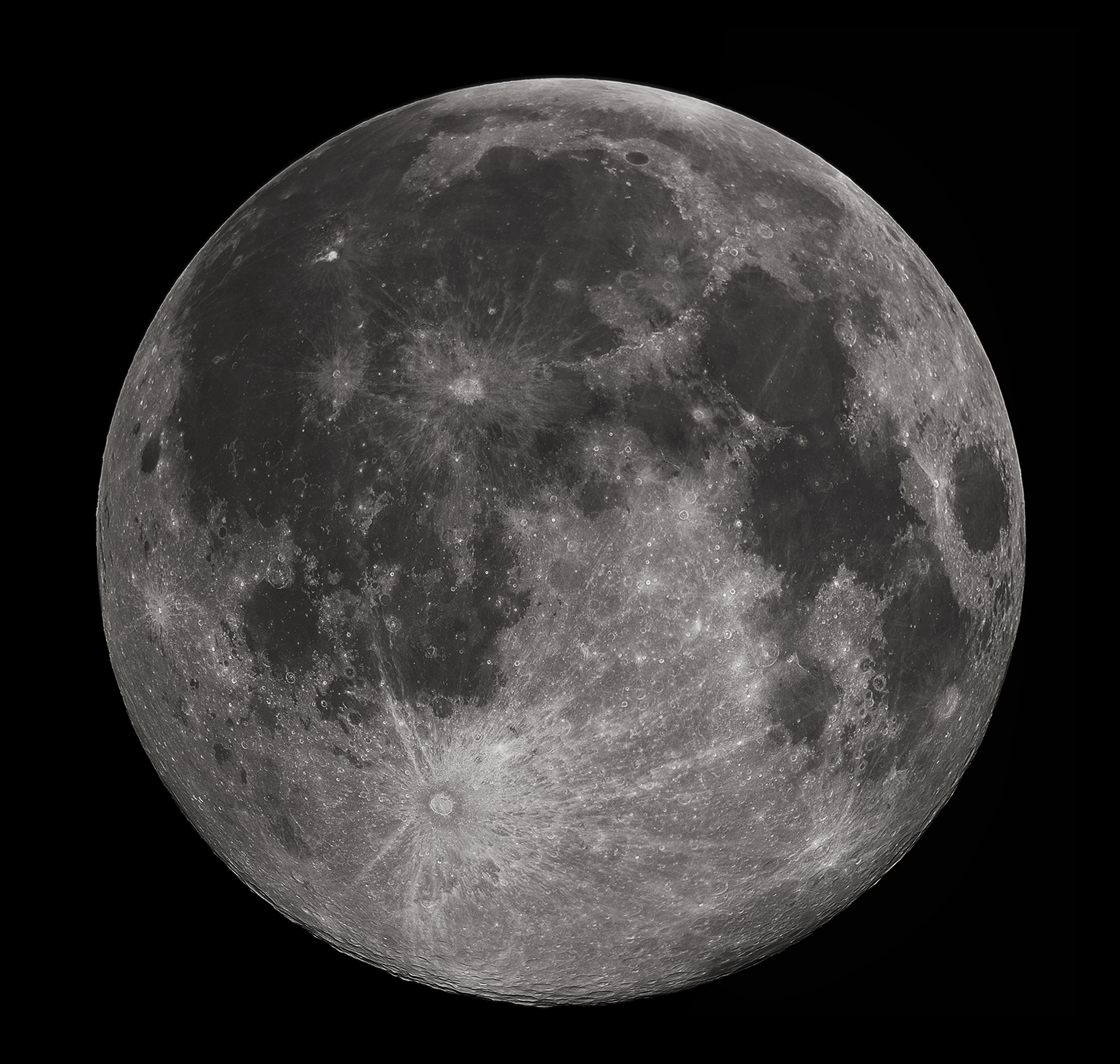
Credit: Gregory H. Revera · CC BY-SA 3.0
The Moon is Earth's only natural satellite. A satellite is an object that orbits a planet. The Moon is a rocky, dusty world about 2,159 miles across. That is roughly one-fourth the width of Earth. It sits about 239,000 miles away from us. If you could drive a car there at highway speed, the trip would take about five months.
The Moon looks bright in the night sky, but it does not make its own light. It shines because sunlight bounces off its surface. As the Moon travels around Earth, we see different amounts of its sunlit side. These are called phases. A full moon happens when the sunlit side faces Earth. A new moon happens when the dark side faces us. One full trip around Earth takes about 27 days.
The Moon's surface is covered in craters, mountains, and flat plains. The craters were made by space rocks crashing into it over billions of years. Earth gets hit by space rocks too, but wind, rain, and moving land slowly erase our craters. The Moon has no air and no weather, so its craters stay almost forever. Some of them are nearly as old as the Moon itself.
Where did the Moon come from? The leading idea is called the giant impact theory. About 4.5 billion years ago, a planet about the size of Mars smashed into the young Earth. The crash threw huge amounts of rock into space. Over time, that rock clumped together and became the Moon. Scientists still debate some of the details, and new computer models keep changing the story.
The Moon's gravity pulls on Earth's oceans. This pull is what causes tides. As the Moon moves across the sky, the oceans bulge slightly toward it. That is why beaches see the water rise and fall twice each day.
Humans have visited the Moon. Between 1969 and 1972, NASA's Apollo missions landed twelve astronauts on its surface. They brought back 842 pounds of moon rocks for scientists to study. No human has been back since 1972, but that may change soon. NASA's Artemis program plans to send astronauts to the Moon again, including the first woman and the first person of color to walk there.
The same side of the Moon always faces Earth. This is because the Moon spins once for every trip it makes around us. The far side was a complete mystery until 1959, when a Soviet spacecraft finally took pictures of it.
Last updated 2026-04-22