
Solar Flare
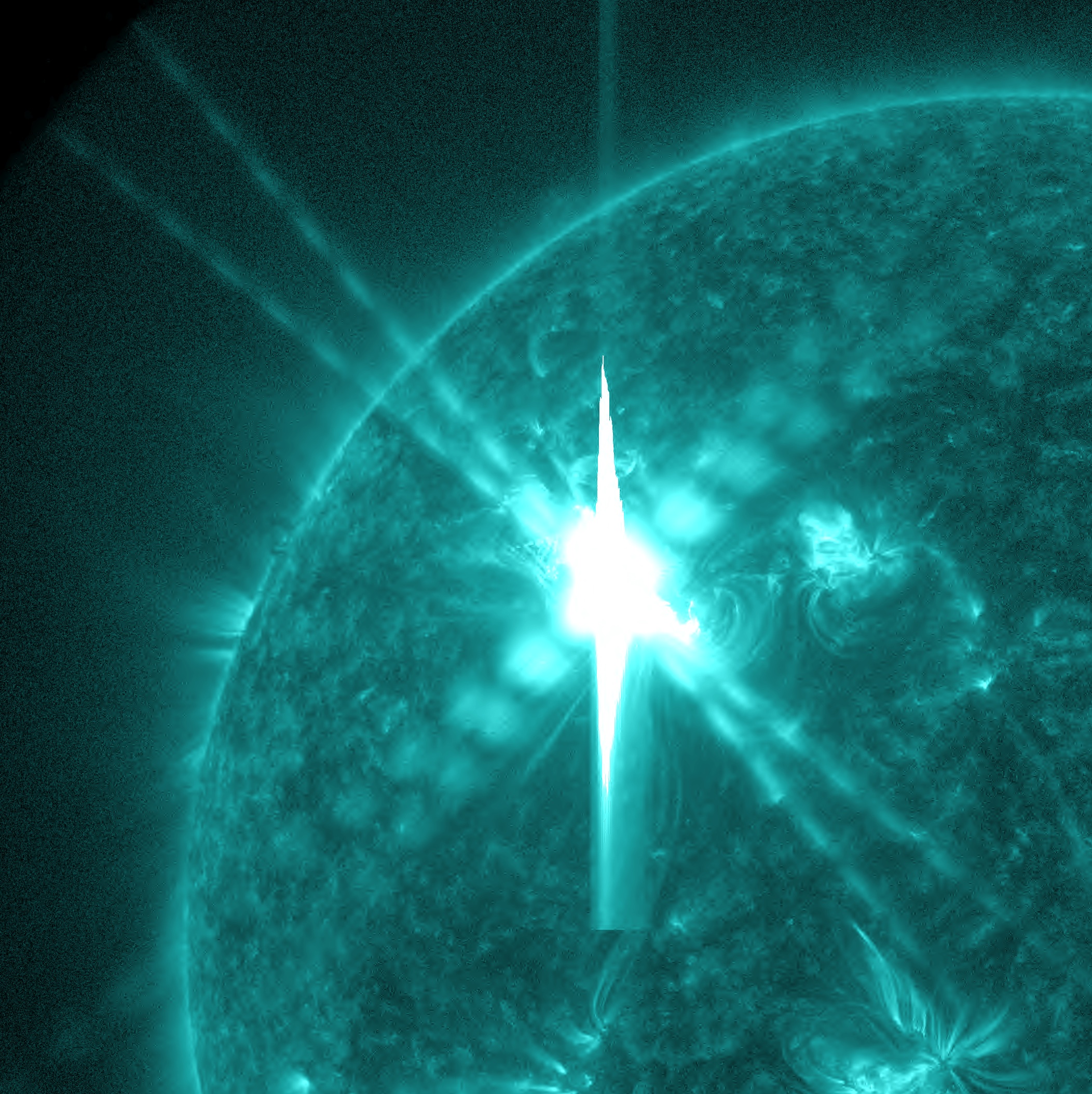
Credit: NASA Goddard Space Flight Center from Greenbelt, MD, USA · Public domain
A solar flare is a sudden burst of energy from the surface of the Sun. Flares happen when twisted magnetic fields on the Sun snap and release a huge amount of light and heat all at once. The light travels to Earth in about eight minutes, the same time regular sunlight takes. Flares are the biggest explosions in our solar system.
The Sun is a giant ball of hot gas called plasma. Inside this plasma are strong magnetic fields that twist and tangle as the Sun spins. Sometimes a tangled field snaps back into place, the way a stretched rubber band does when you let go. The snap sends out a blast of X-rays, ultraviolet light, and visible light. A single big flare can release as much energy as a billion hydrogen bombs.
Many flares come with a second event called a coronal mass ejection. This is a cloud of charged particles thrown out into space. The cloud travels much slower than the light from the flare. It usually takes one to three days to reach Earth. If it hits our planet, it slams into our magnetic field and can cause trouble.
Earth is mostly protected by its magnetic field and atmosphere. But a strong solar storm can still shake things up. It can knock out satellites, scramble radio signals, and confuse GPS. A very strong storm can even damage power grids on the ground. In 1859, a huge storm called the Carrington Event set telegraph wires on fire and made the night sky glow red as far south as the Caribbean.
Solar flares also create the beautiful lights called auroras. When charged particles from the Sun hit gases high in our atmosphere, the gases glow green, pink, and purple. You can see these lights most often near the North and South Poles. During a strong storm, people much farther from the poles can see them too.
The Sun goes through an eleven-year cycle. Some years it is quiet, with few flares. Other years it is stormy, with flares happening almost every day. Scientists watch the Sun all the time using special satellites. They try to warn power companies and astronauts before a big storm arrives. Predicting exactly when a flare will happen is still very hard. We know the Sun will keep throwing these blasts into space, and we keep learning how to protect ourselves when one arrives.
Related
Last updated 2026-04-22