
Space Exploration
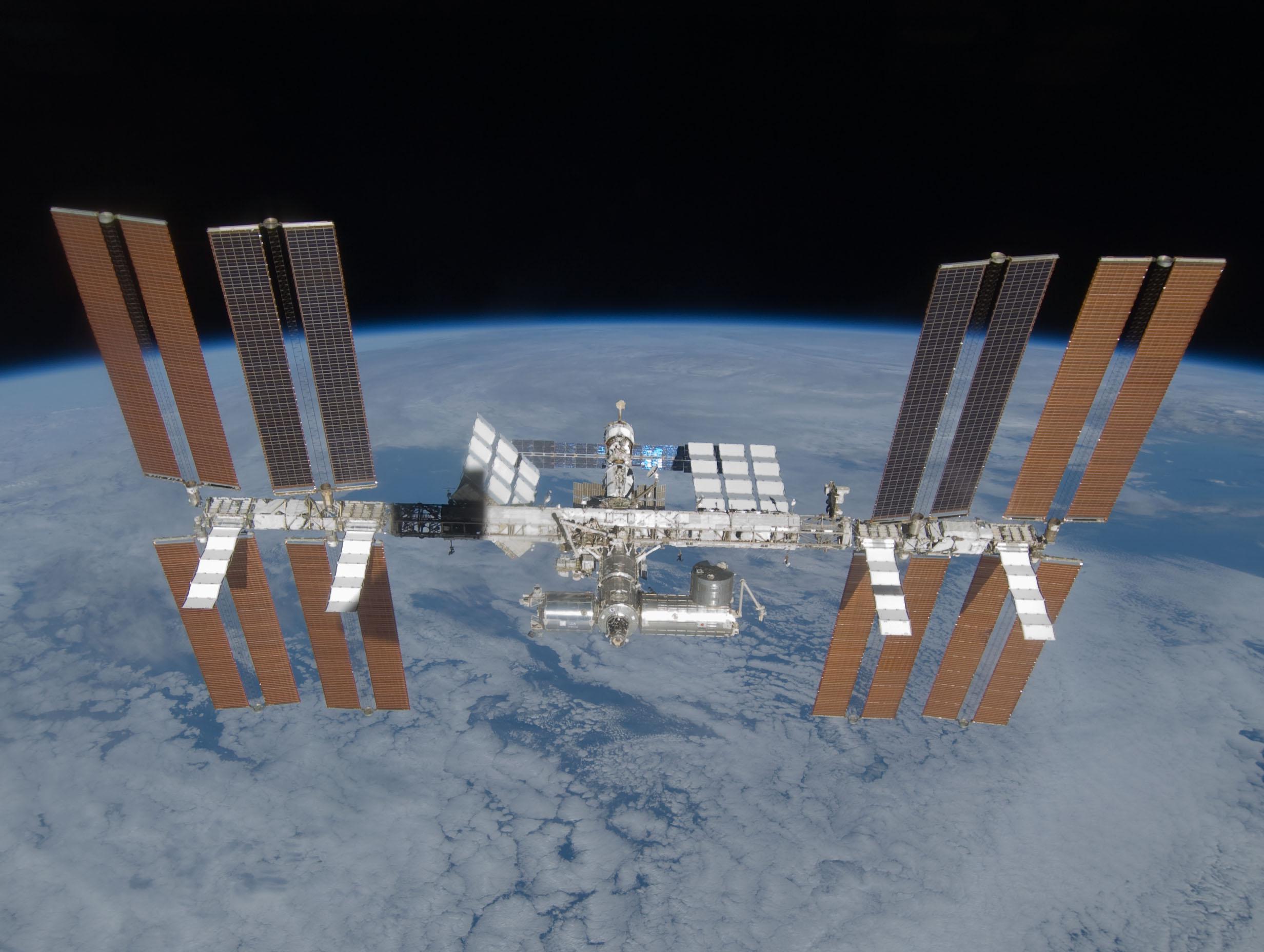
Credit: National Aeronautics and Space Administration (Q23548) · Public domain
Space exploration is the use of rockets, spacecraft, and telescopes to study places beyond Earth. It started in the 1950s, when scientists first built rockets powerful enough to reach outer space. Since then, people have sent machines to every planet in our solar system. Twelve people have walked on the Moon. Robots have landed on Mars, flown past Pluto, and touched a comet.
Getting off the ground
For thousands of years, people looked up at the sky and wondered. But nobody could get there. Earth's gravity pulls everything down, and the air gets thinner the higher you go. To reach space, you have to travel about 62 miles straight up, and you have to go very fast. An object has to move about 17,500 miles per hour to stay in orbit around Earth. That is more than 20 times faster than a jet airplane.
The only machine strong enough to do this is a rocket. A rocket burns fuel very fast and shoots hot gas out the back. The push of the gas going down shoves the rocket up. The first rocket to reach space was a German V-2 in 1944. After World War II, American and Soviet scientists used what they had learned to build bigger rockets.
The Space Race
In 1957, the Soviet Union launched a small metal ball called Sputnik. It was the first human-made object to orbit Earth. Americans were shocked. They had thought their country was ahead in science. The United States and the Soviet Union then raced to beat each other in space. This contest was called the Space Race.
The Soviets kept scoring firsts. In 1961, a Soviet pilot named Yuri Gagarin became the first person in space. He circled Earth one time and came back alive. President John F. Kennedy told Americans the country would land people on the Moon before 1970. In July 1969, the Apollo 11 mission did exactly that. Astronaut Neil Armstrong stepped onto the Moon and said, "That's one small step for man, one giant leap for mankind." Five more Apollo missions landed on the Moon after that.
Robot explorers
People have only traveled as far as the Moon. But robot spacecraft have gone much farther. Starting in the 1960s, NASA sent probes to fly past Venus, Mars, Jupiter, Saturn, Uranus, and Neptune. The two Voyager spacecraft, launched in 1977, have now left the solar system. They carry gold records with sounds and pictures from Earth, in case any alien ever finds them.
Some robots do not just fly past. They land. Robot rovers on Mars, like Curiosity and Perseverance, have been driving around the surface for years. They drill into rocks, take photos, and look for signs that Mars once had life. Scientists do not know yet if Mars ever had living things, and the rovers are hunting for the answer. Other probes have landed on Venus, an asteroid, Saturn's moon Titan, and a comet.
Living in space
Since 2000, people have been living in space without a break. They live on the International Space Station, a large laboratory that orbits 250 miles above Earth. The station flies around the planet once every 90 minutes. Astronauts from many countries work there for months at a time. They test how the human body changes in zero gravity, and they run science experiments that only work without gravity pulling things down.
Life in space is strange. Astronauts sleep strapped into sleeping bags so they do not float around. Water forms into floating balls. Without gravity to work against, muscles and bones slowly get weaker, so astronauts have to exercise for two hours every day.
A new space age
For a long time, only national governments could afford to send things to space. That is changing. Private companies like SpaceX and Blue Origin now build their own rockets. SpaceX has launched astronauts to the space station and sent thousands of small satellites into orbit. Rockets are also getting cheaper, because some of them can now land and be used again.
NASA plans to send astronauts back to the Moon with the Artemis program, including the first woman and the first person of color to walk there. After that, the goal is Mars. Getting humans to Mars is very hard. The trip takes at least six months each way, and travelers would face strong radiation, muscle loss, and long months away from Earth.
Space exploration keeps asking the biggest questions. How did the universe begin? Is there life on other worlds? Could humans live somewhere besides Earth? Every new mission brings back a few more pieces of the answer.
Related
Last updated 2026-04-22