
International Space Station
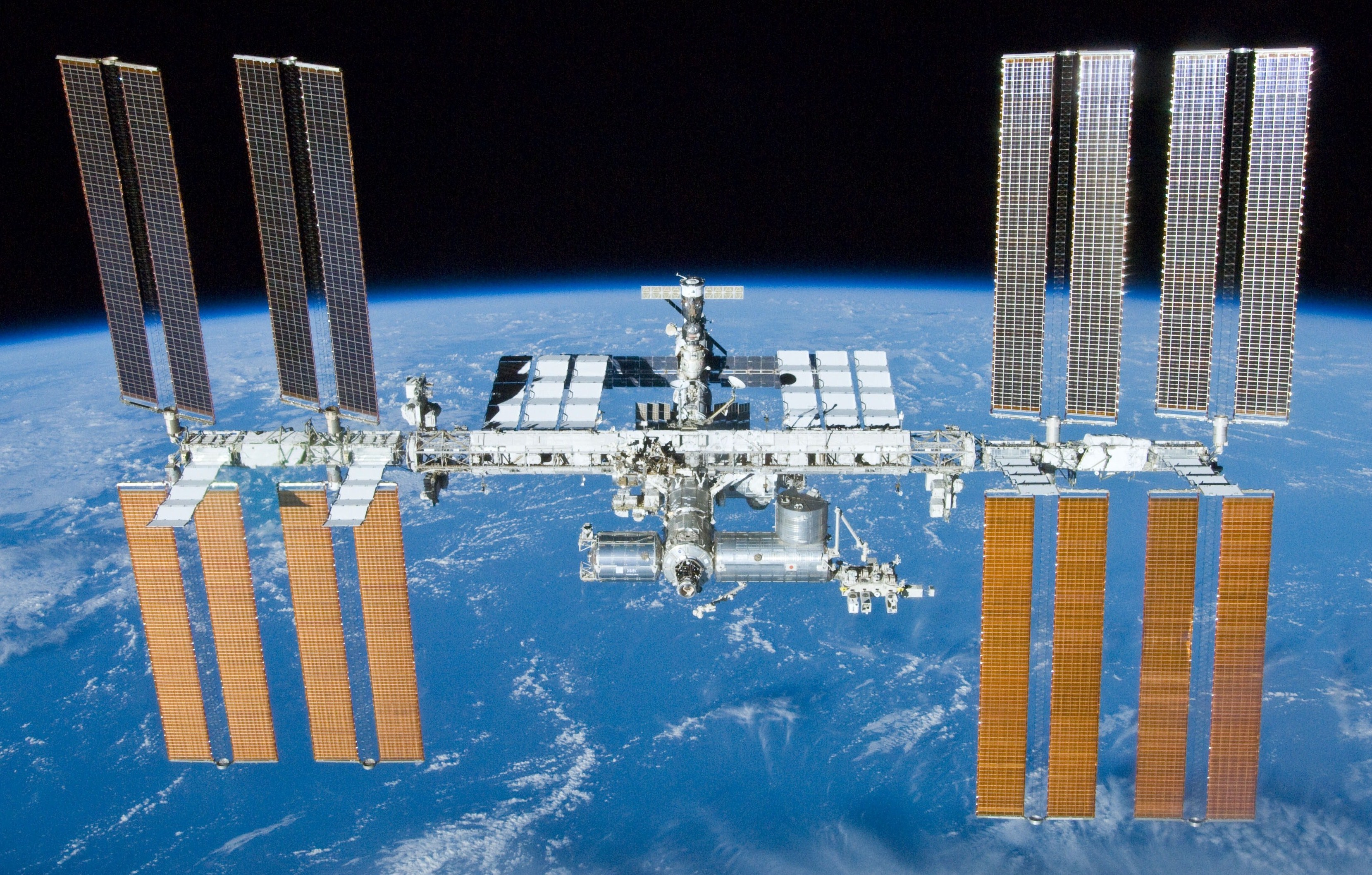
Credit: NASA/Crew of STS-132 · Public domain
The International Space Station is a huge science lab that orbits Earth in space. It is often called the ISS for short. Astronauts live and work inside it while it circles the planet. The ISS is the biggest object humans have ever built in space. It is also the most expensive, costing more than 150 billion dollars to build and run.
The station is about the size of a football field, including the end zones. It weighs almost one million pounds. That is about as much as 300 cars. It has laboratories, sleeping rooms, bathrooms, exercise machines, and large solar panels that catch sunlight to make electricity. Big windows let the astronauts look down at Earth.
The ISS orbits about 250 miles above Earth. It circles the whole planet once every 90 minutes. It moves at 17,500 miles per hour, more than 20 times faster than a jet airplane. Because of this speed, astronauts on board watch the sun rise and set 16 times in a single day.
Fifteen countries worked together to build the ISS. The main partners are the United States, Russia, Japan, Canada, and the countries of the European Space Agency. Construction started in 1998. Over more than a decade, rockets and space shuttles carried up piece after piece. Astronauts in spacesuits bolted the parts together during spacewalks. People have lived on the station without a break since November 2000. That is one of the longest streaks of humans living in space in history.
Usually six or seven astronauts stay on the station at a time. They eat food from sealed bags, sleep in sleeping bags strapped to the wall, and exercise two hours each day so their muscles and bones do not get weak in zero gravity. Water is so precious that they even recycle their own sweat and urine into clean drinking water.
The ISS is mostly a science lab. Astronauts run experiments that cannot be done on Earth. They grow plants without soil, study how flames burn without gravity, and test how the human body changes in space. What scientists learn helps doctors treat sick people on Earth and helps NASA plan future trips to the Moon and Mars.
The ISS will not last forever. Its parts are getting old, and the countries running it plan to retire the station around 2030. When that happens, it will be steered down into the Pacific Ocean. Private companies and other countries are already designing new space stations to take its place.
Last updated 2026-04-22