
Supernova
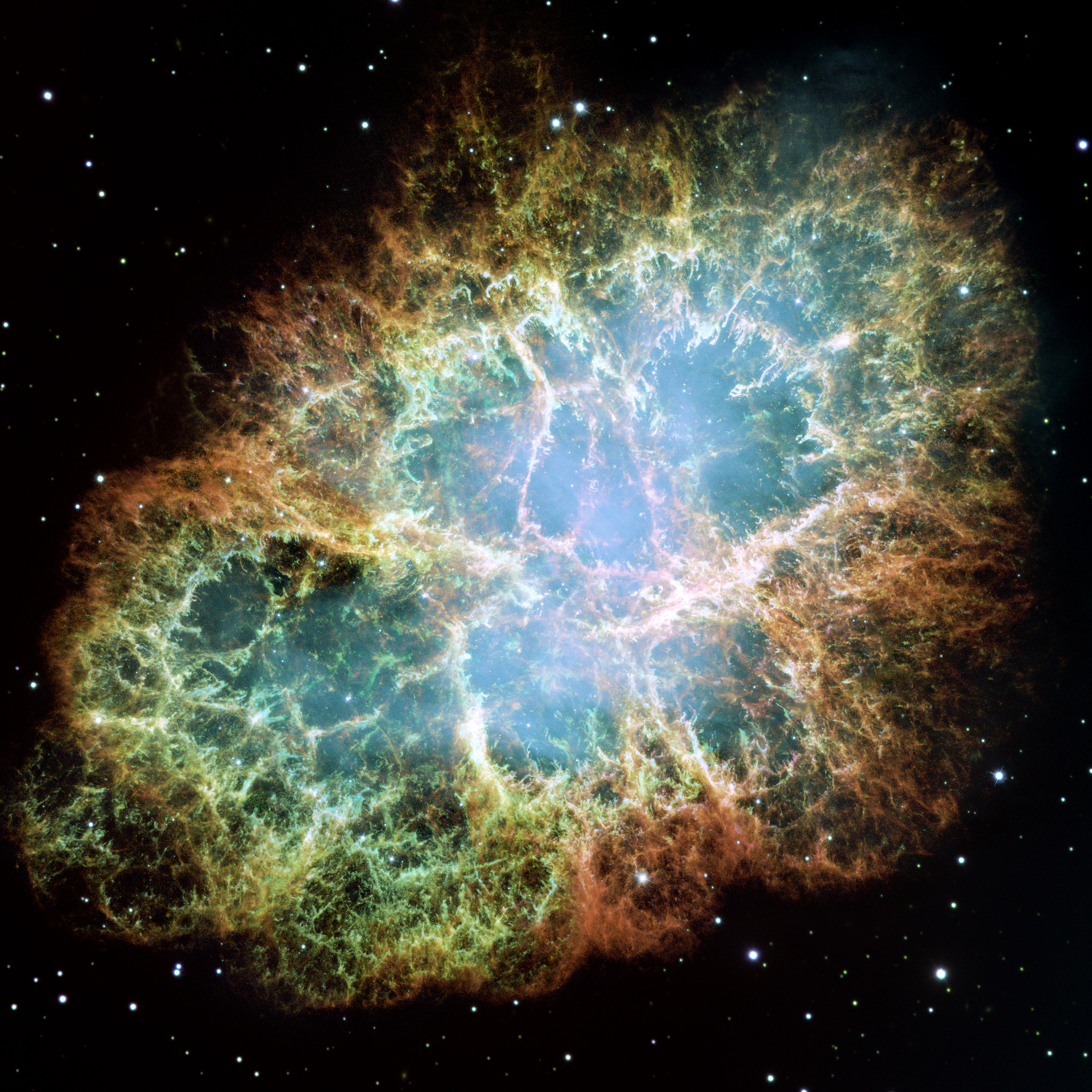
Credit: NASA, ESA, J. Hester and A. Loll (Arizona State University) · Public domain
A supernova is the huge explosion that happens when a star dies. In a few seconds, a single star can shine brighter than an entire galaxy of billions of stars. The word "supernova" means "new star," because early astronomers thought they were seeing new stars suddenly appear in the sky. They were actually seeing old stars blow themselves apart.
There are two main ways a supernova can happen. The first kind involves a very large star, one much bigger than our Sun. A star shines by smashing together atoms deep in its center. This is called fusion. Fusion makes heat and light, and that heat pushes outward against the star's own gravity. For millions of years, the push and the pull stay balanced. But when the star finally runs out of fuel, the push stops. Gravity wins. The star collapses in on itself in less than a second, then rebounds in a massive blast.
The second kind happens to certain pairs of stars. One star pulls matter off the other until it becomes too heavy to hold itself together. Then it explodes. Astronomers use this second kind to measure distances across the universe, because these explosions all give off about the same amount of light.
Supernovas are not just pretty fireworks. They build the universe. Inside a normal star, fusion makes light elements like helium and carbon. But heavier elements, like gold, silver, and iron, can only form in the heat and pressure of a supernova. The explosion then scatters these elements across space. New stars, new planets, and eventually new living things form from that scattered material. The calcium in your bones and the iron in your blood were both cooked inside exploding stars billions of years ago.
What is left behind depends on the size of the star. A medium-sized giant leaves a neutron star, a tiny city-sized ball so dense that one spoonful would weigh a billion tons on Earth. The biggest stars leave behind black holes.
Supernovas are rare. In a galaxy like ours, only one or two happen each century. The last one people on Earth saw with their own eyes was in 1604. Astronomers now watch distant galaxies every night, hoping to catch the next bright flash as a faraway star ends its life.
Last updated 2026-04-22