
Bill of Rights
Credit: United States · Public domain
The Bill of Rights is the name for the first ten amendments to the United States Constitution. An amendment is a change or addition to the Constitution. These ten amendments list specific rights and freedoms that the government cannot take away from people. They became law on December 15, 1791, about two years after the Constitution itself.
The Bill of Rights came out of a fight. When the Constitution was written in 1787, many Americans were nervous about it. They had just won a war against the British king, who had jailed people without trials and silenced people who spoke against him. Some leaders worried the new American government might do the same things. They refused to support the Constitution unless a written list of rights was added. James Madison, a young leader from Virginia, agreed to write that list.
The ten amendments cover different protections. The First Amendment is the most famous. It protects freedom of speech, freedom of religion, freedom of the press, and the right to gather peacefully and complain to the government. The Second Amendment protects the right to keep and bear arms. The Fourth Amendment says the police cannot search your home or take your things without a good reason and, usually, a written order from a judge. The Fifth and Sixth Amendments give people who are accused of crimes the right to a fair trial, a lawyer, and a jury. The Eighth Amendment bans "cruel and unusual" punishments.
The last two amendments are different. The Ninth says people have other rights too, even rights not listed in the Constitution. The Tenth says any power not given to the federal government belongs to the states or to the people.
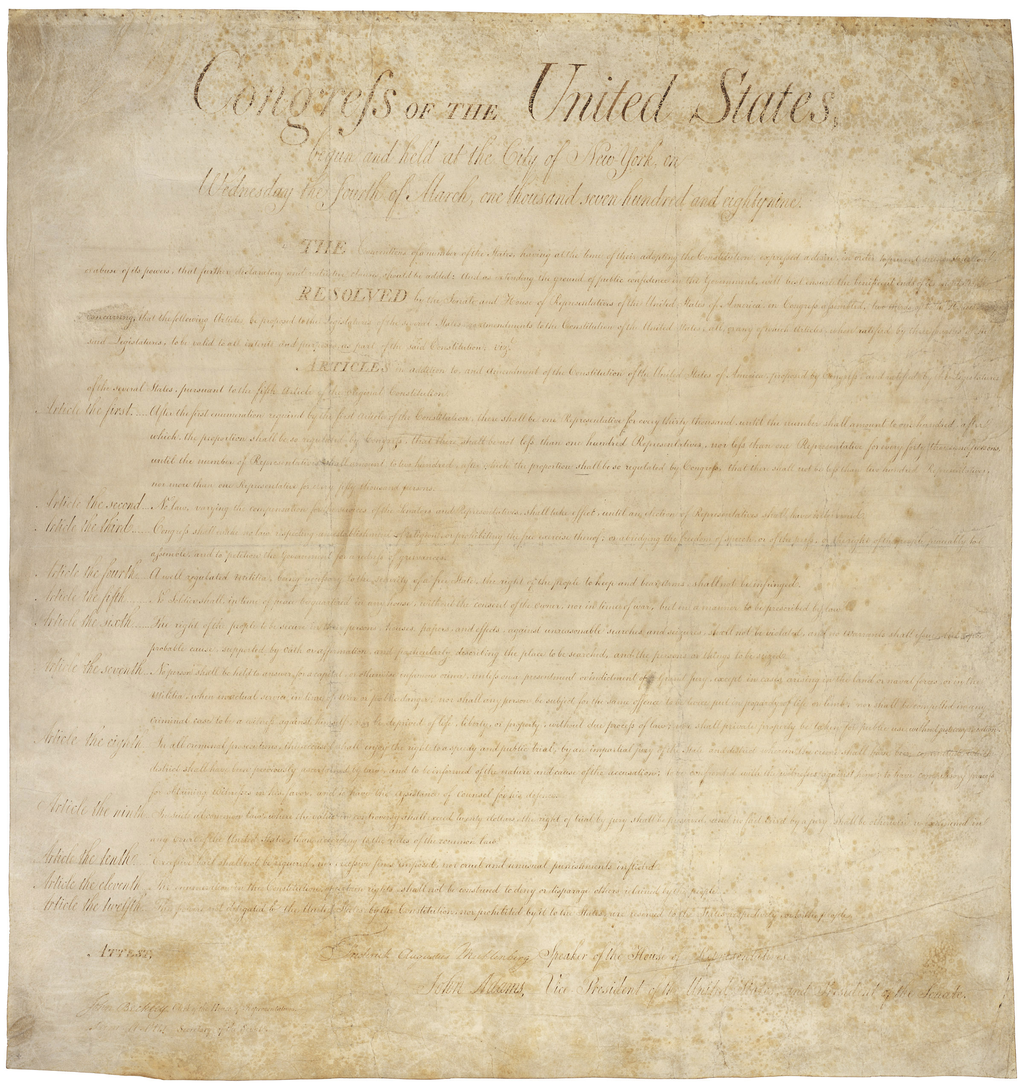
The original Bill of Rights was handwritten on a single sheet of parchment. It is kept today at the National Archives in Washington, D.C., where visitors can see it through thick protective glass.
What the Bill of Rights actually means in real life is still argued about all the time. Courts, lawyers, and ordinary people disagree over questions like what counts as free speech online, when police searches go too far, and what the Second Amendment really protects. The Supreme Court decides many of these arguments, and its rulings have changed over the years. The words written in 1791 are still the same. How those words apply to a new world is a question every generation answers again.
Related
Last updated 2026-04-26