
Civil War (US)
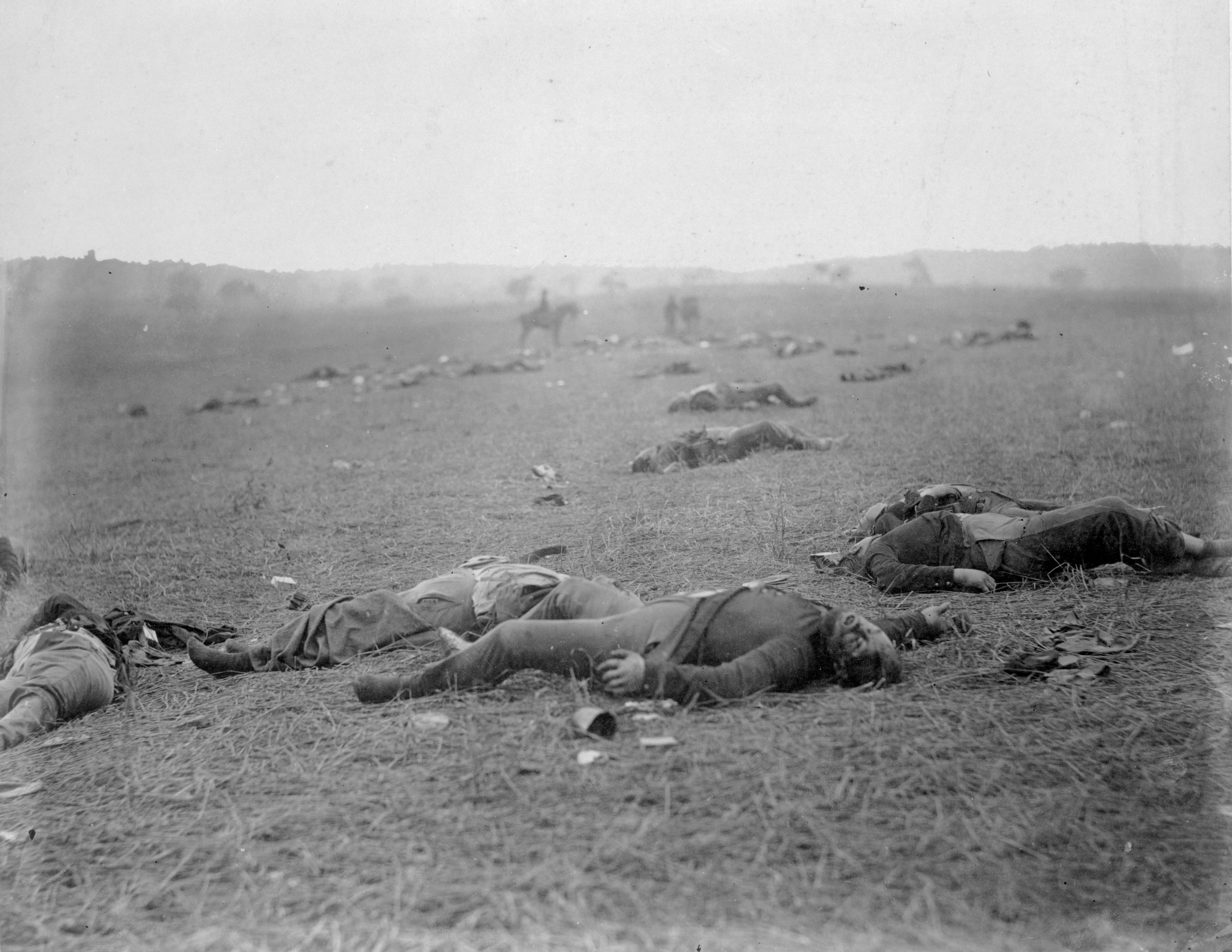
Credit: Timothy H. O'Sullivan · Public domain
The Civil War was a war fought inside the United States between 1861 and 1865. It was a fight between the northern states, called the Union, and eleven southern states that broke away to form their own country, called the Confederacy. The main cause of the war was slavery. About 750,000 soldiers died over four years. That makes it the deadliest war in American history.
What started the war
For years, the United States had argued about slavery. In the South, the economy was built on huge farms called plantations. Enslaved Black people were forced to work on these plantations, growing cotton, tobacco, and sugar. In the North, most states had ended slavery. Many Northerners wanted to stop slavery from spreading into new western states.
In November 1860, Abraham Lincoln was elected president. Lincoln did not promise to end slavery where it already existed. But he wanted to keep it from spreading. Southern leaders did not trust him. Within a few weeks, South Carolina announced it was leaving the Union. Six more states followed. Together they formed the Confederate States of America and chose Jefferson Davis as their president.
The fighting started on April 12, 1861. Confederate soldiers fired cannons at Fort Sumter, a Union fort in the harbor of Charleston, South Carolina. After the fort fell, four more southern states joined the Confederacy. The country was now at war with itself.
The two sides
The Union had big advantages. It had about 22 million people, while the Confederacy had only about 9 million, and almost 4 million of those were enslaved. The North had most of the factories, most of the railroads, and a strong navy. The Confederacy had fewer people and fewer supplies, but it had many skilled officers and was fighting on familiar ground.
Soldiers on both sides were often very young. Many were teenagers. They wore wool uniforms, blue for the Union and gray for the Confederacy. They carried heavy rifles and slept in tents or in the open. Disease killed even more soldiers than battle did. For every soldier who died from a bullet, about two died from sickness.
Major battles
Some battles became famous because so many people died in them. At the Battle of Antietam in Maryland in 1862, about 23,000 men were killed or wounded in a single day. That is still the bloodiest single day in American history. The Battle of Gettysburg in Pennsylvania, in July 1863, lasted three days and is often called the turning point of the war. The Union won, and the Confederate army never fully recovered.
A few months after Gettysburg, Lincoln visited the battlefield to dedicate a cemetery. He gave a short speech, only about two minutes long, called the Gettysburg Address. In it, he said the country needed "a new birth of freedom." His words are still memorized by students today.
The Emancipation Proclamation
On January 1, 1863, Lincoln signed the Emancipation Proclamation. It declared that all enslaved people in the rebelling Confederate states were free. The proclamation did not end slavery everywhere right away. It could not be enforced in places the Union army did not yet control. But it changed the meaning of the war. Now the Union was fighting not just to keep the country together, but to end slavery.
About 200,000 Black soldiers and sailors joined the Union forces. Many had escaped slavery themselves. They fought bravely in dozens of battles, even though they were paid less than white soldiers and faced harsh treatment if captured.
How the war ended
By 1864, the Union had two excellent generals: Ulysses S. Grant in the east and William Tecumseh Sherman in the west. Sherman led his army on a long march through Georgia, burning farms, railroads, and supplies as he went. Grant pushed the main Confederate army, led by General Robert E. Lee, back toward the Confederate capital of Richmond, Virginia.
On April 9, 1865, Lee surrendered to Grant in a small Virginia town called Appomattox Court House. The war was over. Just five days later, Lincoln was shot at Ford's Theatre in Washington, D.C., by a Confederate supporter named John Wilkes Booth. He died the next morning.
What changed
The war ended slavery in the United States. The Thirteenth Amendment, passed at the end of 1865, made slavery illegal everywhere in the country. About 4 million people who had been enslaved were now free. The country also stayed together as one nation.
But the war left deep wounds. Much of the South was destroyed. The work of building real freedom for Black Americans was just beginning, and it would take more than a hundred years of struggle that continues today. Historians still debate the war's causes, its battles, and its meaning.
Related
Last updated 2026-04-26