
Underground Railroad
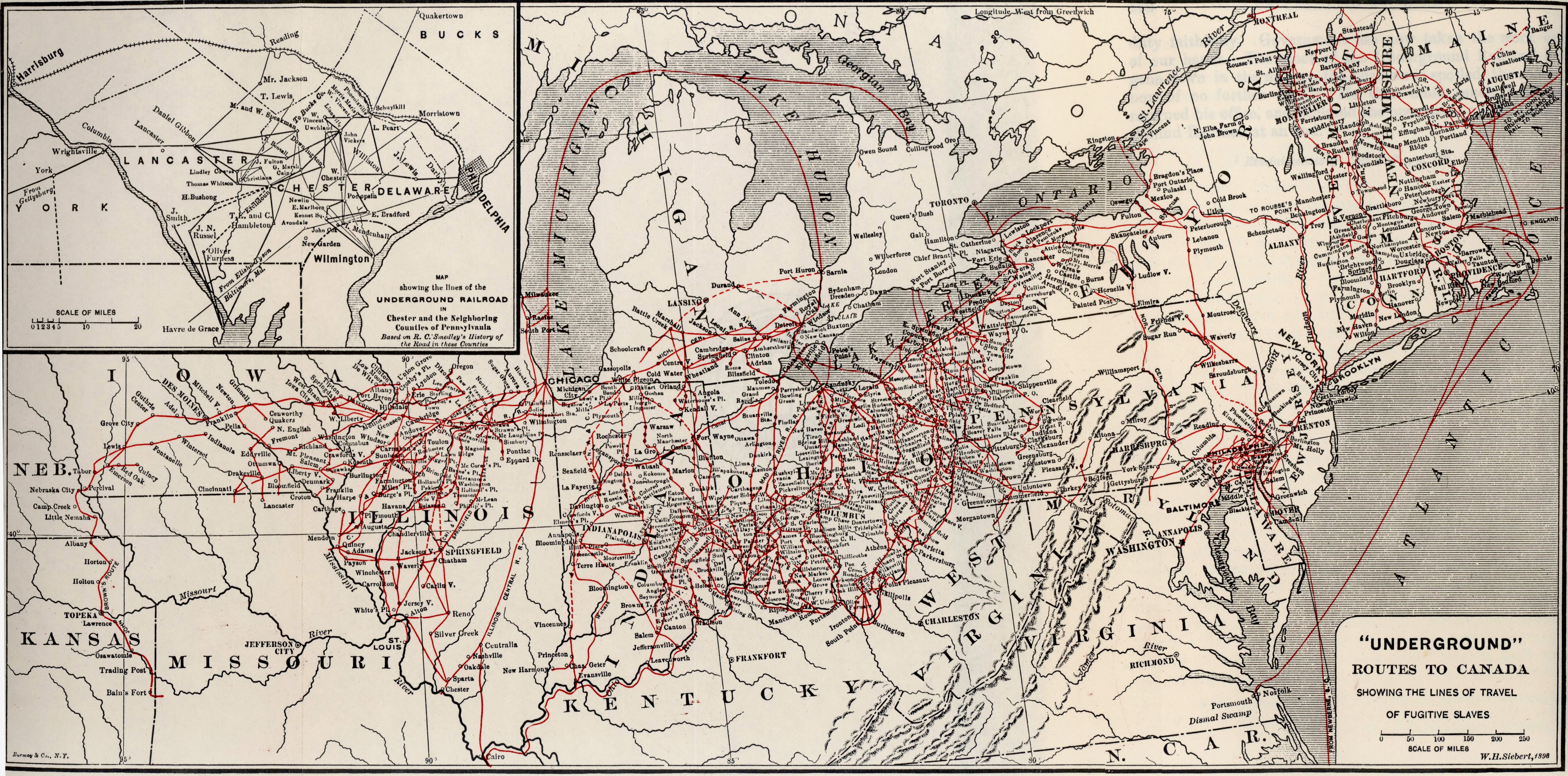
Credit: https://lccn.loc.gov/68003375 Siebert, Wilbur Henry, 1866-1961. The underground railroad from slavery to freedom. With an introd. by Albert Bushnell Hart. Gloucester, Mass., P. Smith, 1968 [c1898] xxvi, 478 p. illus., facsim., fold. map, ports. 21 cm. E450 .S57 1968 · Public domain
The Underground Railroad was a secret network that helped enslaved people in the United States escape to freedom. It was not a real railroad, and it was not underground. It was a chain of safe houses, hidden paths, and brave people who passed escapees north toward free states and Canada. The network was busiest from about 1830 until the end of the Civil War in 1865.
The name borrowed words from real trains. People who guided escapees were called "conductors." Safe houses were called "stations" or "depots." The people running the safe houses were "stationmasters." The escapees themselves were called "passengers" or "cargo." Using train words let helpers send messages that sounded normal, even when the messages were actually about hiding people.
Most travel happened at night. Escapees walked through woods, swamps, and fields, often with only the North Star to guide them. By day they hid in barns, attics, root cellars, or church basements. A station might be a Quaker farmhouse in Pennsylvania, a free Black family's home in Ohio, or a small church in New York. Many stations were close to rivers, since rivers helped hide a person's scent from tracking dogs.
The journey was long and dangerous. From the Deep South to a free state could be hundreds of miles on foot. Even reaching a free state was not always safe. The Fugitive Slave Act of 1850 said that escaped people had to be returned to slavery, even from free states. After 1850, many escapees kept going all the way to Canada, where U.S. laws did not reach.
Free Black Americans did most of the dangerous work, although Quakers, Methodists, and other white allies helped too. Harriet Tubman was the most famous conductor. After escaping slavery in 1849, she went back into the South about 13 times and led around 70 people to freedom. She said she never lost a single passenger. Other key figures included William Still, a Black abolitionist in Philadelphia who kept careful records, and Levi Coffin, a Quaker whose home in Indiana was called the "Grand Central Station" of the network.
Historians do not agree on exact numbers. Some estimate the Underground Railroad helped around 100,000 people reach freedom between 1810 and 1860. Others think the true number was lower. Records were rarely kept on purpose, because written proof could send helpers to prison.
The Underground Railroad ended when slavery itself ended. The Thirteenth Amendment, passed in 1865, made slavery illegal across the entire United States. The hiding places were no longer needed, but the courage of the people who built the network is still remembered today.
Related
Last updated 2026-04-26