
Great Depression
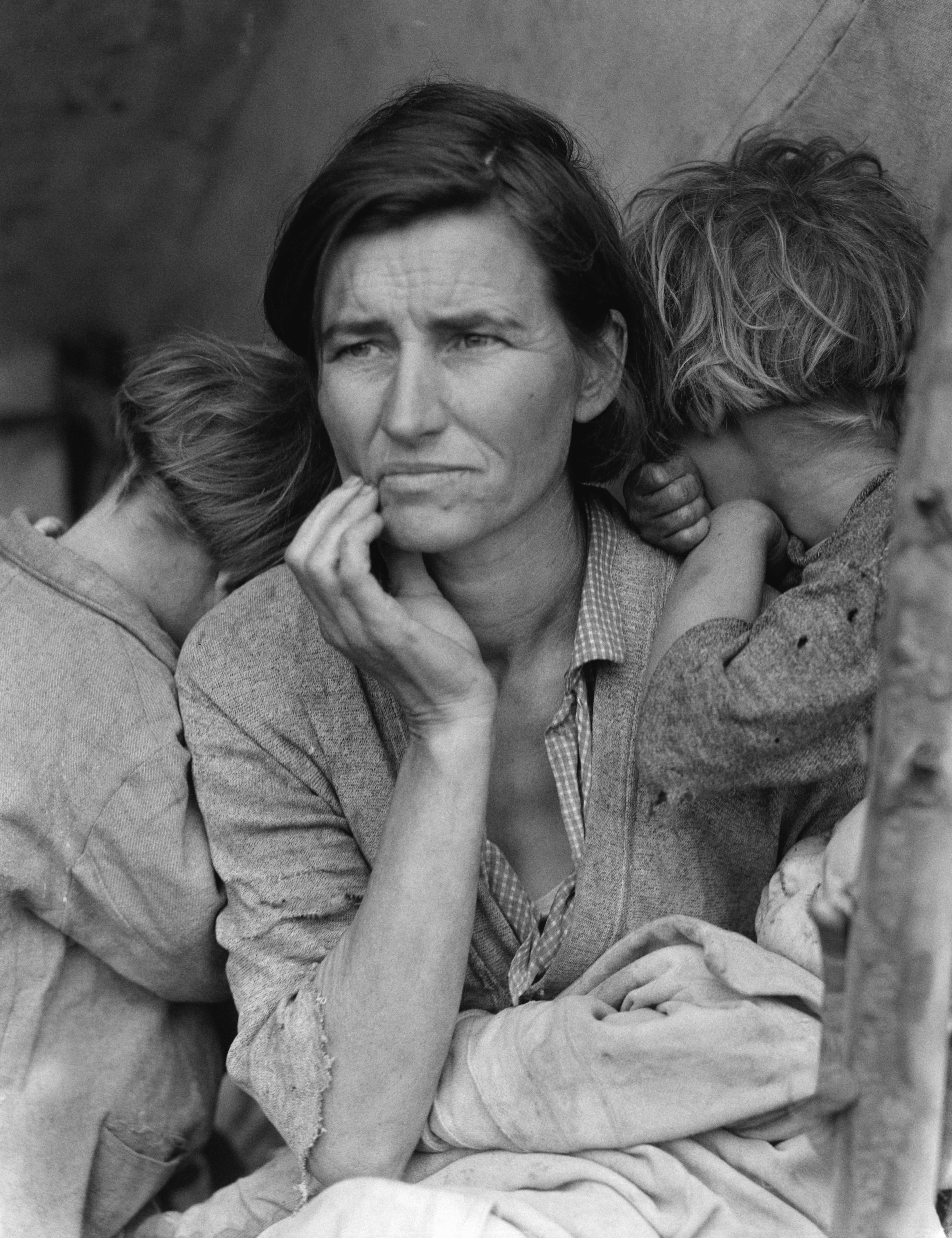
Credit: Dorothea Lange · Public domain
The Great Depression was the worst economic crisis in American history. It began in 1929 and lasted through most of the 1930s. During those years, millions of Americans lost their jobs, their savings, their homes, and their farms. The Depression spread from the United States to most of the world. It only fully ended when the country went to war in the 1940s.
How it started
In the 1920s, the American economy seemed to be doing great. Factories were busy. New inventions like radios, cars, and washing machines filled stores. Many people bought stocks, which are small shares of companies. If the company did well, the stock went up in value. People could sell it for more than they paid.
By 1929, stock prices had climbed very high. Many people had even borrowed money to buy more stocks. Then on October 29, 1929, the stock market crashed. Prices fell so fast that billions of dollars vanished in a single day. That day is now called Black Tuesday.
The crash was the start, not the whole story. Banks had loaned out money that people could not pay back. When worried customers rushed to take their savings out, the banks ran out of cash. About 9,000 banks failed during the Depression. People who had trusted them lost everything inside.
Life during the Depression
By 1933, about 25 percent of American workers had no job. That means one in every four adults who wanted to work could not find any. Whole families lost their homes. Some built shacks out of cardboard, scrap metal, and old boards on the edges of cities. These camps were called "Hoovervilles," named after President Herbert Hoover, whom many people blamed for the crisis.
Long lines formed outside places that gave away free bread or soup. Children went to school hungry, sometimes wearing shoes stuffed with newspaper. Parents took any work they could find, even for pennies a day.
Things got even worse in the middle of the country. For years, farmers on the Great Plains had plowed up the natural grasses to plant wheat. When a long drought hit in the 1930s, the dry soil began to blow away. Huge dust storms rolled across Oklahoma, Kansas, Texas, and nearby states. Some storms were dark enough to turn day into night. This disaster was called the Dust Bowl. Thousands of farm families packed their belongings into old cars and drove west to California, hoping to find work picking fruit.
A new president and the New Deal
In 1932, Americans elected a new president, Franklin D. Roosevelt. He told the country, "The only thing we have to fear is fear itself." He promised quick action.
Roosevelt's plan was called the New Deal. It was a set of new laws and new government programs. The goal was to put people back to work and stop the economy from getting worse. Programs like the Civilian Conservation Corps hired young men to plant trees, build trails, and fight forest fires. The Works Progress Administration paid workers to build schools, post offices, bridges, and roads. Many of those buildings still stand today. Another program, Social Security, started in 1935. It still pays money to older Americans and to people who cannot work.
How the Depression ended
Historians still debate exactly what ended the Great Depression. Most agree the New Deal helped, but it did not fix everything. Many people were still out of work in the late 1930s. The crisis really ended when the United States entered World War II in 1941. Suddenly factories had to make tanks, planes, ships, and uniforms by the millions. Millions of new workers, including many women for the first time, were hired to build them. Almost overnight, jobs were everywhere again.
Why it still matters
The Great Depression changed America for good. Banks today are much more carefully watched. The government now helps people who lose their jobs or grow too old to work. Schools, parks, and bridges built by New Deal workers are still in use. Even new ideas about money and government came out of those hard years.
Most people who lived through the Depression never forgot it. They saved string, washed and reused tin foil, and kept every coin they could. They had learned, the hard way, how quickly a strong country can be shaken, and how long it can take to recover.
Related
Last updated 2026-04-26