
Oregon Trail
Credit: Wikimedia Commons · CC BY-SA 3.0
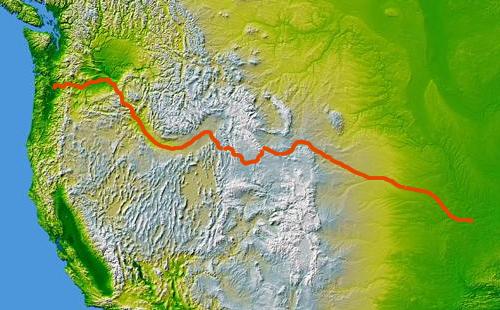
The Oregon Trail was a long wagon route that settlers used to travel from the Missouri River to the Oregon Country in the western United States. The trail stretched about 2,000 miles, roughly the distance from New York to Las Vegas. It was used most heavily between 1841 and 1869. During those years, around 400,000 settlers, farmers, miners, and ranchers traveled west on it.
The trip usually took four to six months. Families packed their belongings into covered wagons pulled by oxen or mules. Most travelers walked beside the wagons rather than riding in them, because the wagons were full of supplies and had no springs to soften the bumps. A typical group, called a wagon train, included dozens of wagons traveling together for safety.
The trail crossed plains, rivers, and mountains. Travelers passed famous landmarks like Chimney Rock in Nebraska, Independence Rock in Wyoming, and the steep crossing of the Rocky Mountains at South Pass. They had to start in spring so they could cross the mountains before winter snow blocked the passes. Leaving too late could be deadly.
Life on the trail was hard. Disease killed far more people than anything else. Cholera, a sickness spread through dirty water, swept through wagon trains and could kill a healthy person in a single day. Historians think about one in ten travelers died along the way. They were buried in shallow graves beside the trail.
Native American nations, including the Lakota, Cheyenne, Pawnee, and Shoshone, had lived on these lands for hundreds of years. At first, many tribes traded peacefully with the travelers and sometimes guided them across rivers. As more and more wagons came through, the settlers' livestock ate the grass, scared away buffalo, and brought new diseases. Conflicts grew. The trail was one of the early steps in the long, painful loss of Native land across the West.
Why did so many people make the trip? Some wanted free farmland that the U.S. government promised in Oregon. Others were chasing gold in California after 1848. Some wanted to escape debt or start fresh. Newspapers and guidebooks made the West sound like paradise, though they often left out the dangers.
The Oregon Trail faded quickly after 1869, when the Transcontinental Railroad was finished. A trip that once took six months by wagon now took about a week by train. The wagons stopped, but the trail did not disappear. In parts of Wyoming, Nebraska, and Oregon, you can still walk along ruts pressed into the ground by wagon wheels more than 150 years ago.
Related
Last updated 2026-04-26