
Persian Empire
Credit: Cattette · CC BY 4.0
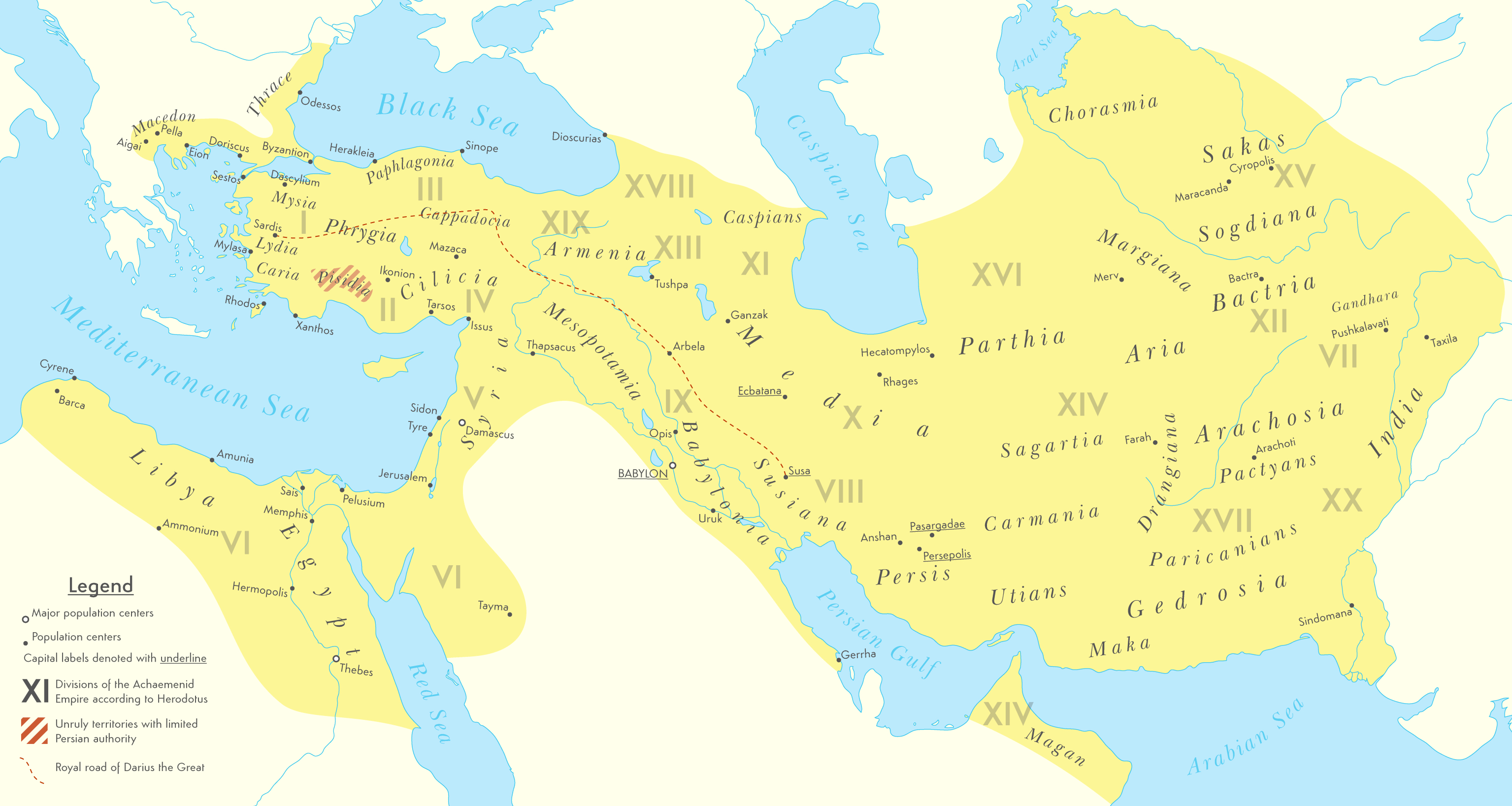
The Persian Empire was a huge ancient empire that began in what is now Iran. It started around 550 BCE when a king named Cyrus the Great united the Persian people and began conquering his neighbors. At its peak, the empire stretched from Egypt in the west to India in the east. It ruled over about 50 million people, which was nearly half of everyone alive at the time.
Cyrus the Great is the founder most people remember. He took the throne by defeating the Medes, then went on to conquer Babylon, Lydia, and much of the Middle East. Cyrus was unusual for his time. Instead of forcing conquered people to follow Persian customs, he let them keep their own languages, gods, and traditions. When he captured Babylon in 539 BCE, he freed the Jewish people who were being held there and let them return home to rebuild their temple. The Hebrew Bible calls him a hero.
The empire grew even larger under later kings, especially Darius the Great. Darius divided the empire into 20 regions called satrapies. Each one was run by a governor who collected taxes and answered to the king. To keep the empire connected, Darius built the Royal Road, a paved highway with stations every 15 miles where messengers could swap to fresh horses.
Persia clashed with the Greek city-states in a long fight called the Persian Wars. Darius and his son Xerxes both tried to invade Greece. Both failed. The Greeks won famous battles at Marathon, Salamis, and Plataea. These wars are why we hear so much about Persia from Greek writers, who often described their enemies as the bad guys. Modern historians try to balance this by also reading Persian sources.
Most Persians followed a religion called Zoroastrianism. It was one of the first religions to teach that there is one main god, Ahura Mazda, and that the world is a battle between good and evil. Some scholars think Zoroastrian ideas later shaped parts of Judaism, Christianity, and Islam, though that connection is still debated.
The empire ended in 330 BCE, when Alexander the Great of Macedonia invaded and defeated the last Persian king, Darius III. Alexander burned the great capital city of Persepolis to the ground. Some historians think it was revenge for earlier Persian attacks on Greece. Others think it was just an accident that started during a drunken party. The ruins of Persepolis still stand in Iran today, and visitors can walk among the carved stone staircases the Persian kings once climbed.
Related
Last updated 2026-04-26