
Republic (Government)
Credit: Cesare Maccari · Public domain
A republic is a kind of government where the people choose leaders to represent them, and there is no king or queen in charge. The word comes from the Latin phrase res publica, meaning "the public thing." In a republic, power belongs to the citizens. They use that power by voting for the people who make the laws.
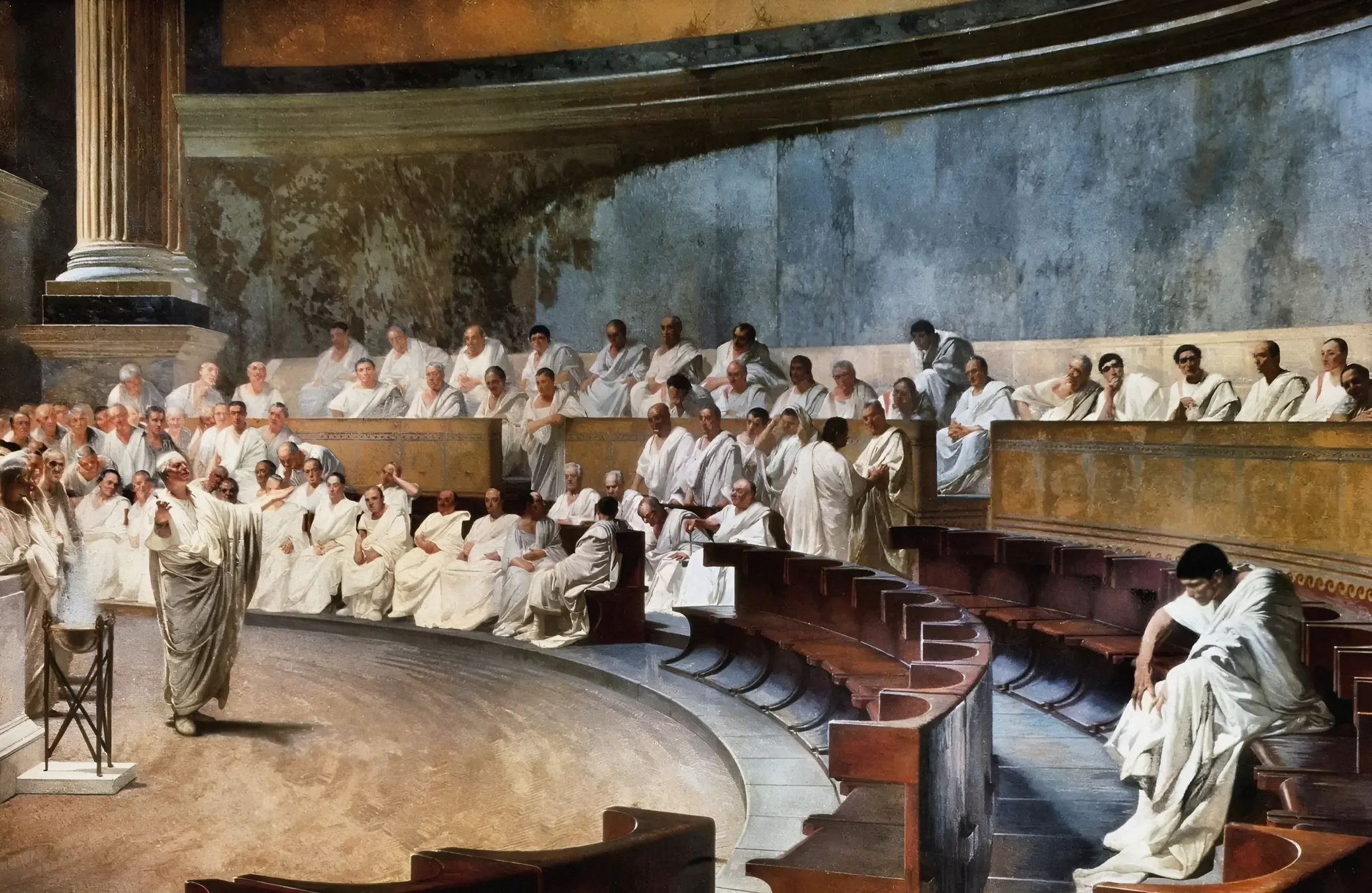
The first famous republic was the Roman Republic. It began around 509 BCE, when the Romans overthrew their last king. They did not want one person to have total power ever again. So they set up a system with elected officials called consuls, an assembly of citizens, and a powerful group of leaders called the Senate. The Roman Republic lasted almost 500 years before it turned into an empire ruled by emperors.
Republics and democracies are similar, but they are not exactly the same thing. In a pure democracy, every citizen votes directly on every law. That works for a small village, but it is hard to do with millions of people. In a republic, citizens instead vote for representatives who make the laws for them. Most countries today that call themselves democracies are really republics, or a mix of the two.
The United States is a republic. When the country was founded in 1776, the leaders had just fought a war against a king. They did not want another one. James Madison and other writers of the Constitution studied the Roman Republic carefully. They borrowed ideas like a Senate, separated powers, and elected leaders. France became a republic after its revolution in 1792. Many other countries followed in the 1800s and 1900s.
Not every country with "Republic" in its name is actually run by its people. North Korea calls itself the Democratic People's Republic of Korea, but one family has ruled it for more than 70 years. Historians and political scientists argue about where the line is. How free do elections need to be? How much power can one leader hold before a republic stops being a real one? These questions do not have simple answers.
Today, most countries in the world are republics of some kind. Some have presidents as their main leaders. Others have prime ministers. A few, like the United Kingdom and Japan, still have kings or queens, but the royal family no longer makes the laws. The big idea behind every republic is the same one the Romans had long ago: power should belong to the people, not to a crown.
Related
Last updated 2026-04-26