
Bee
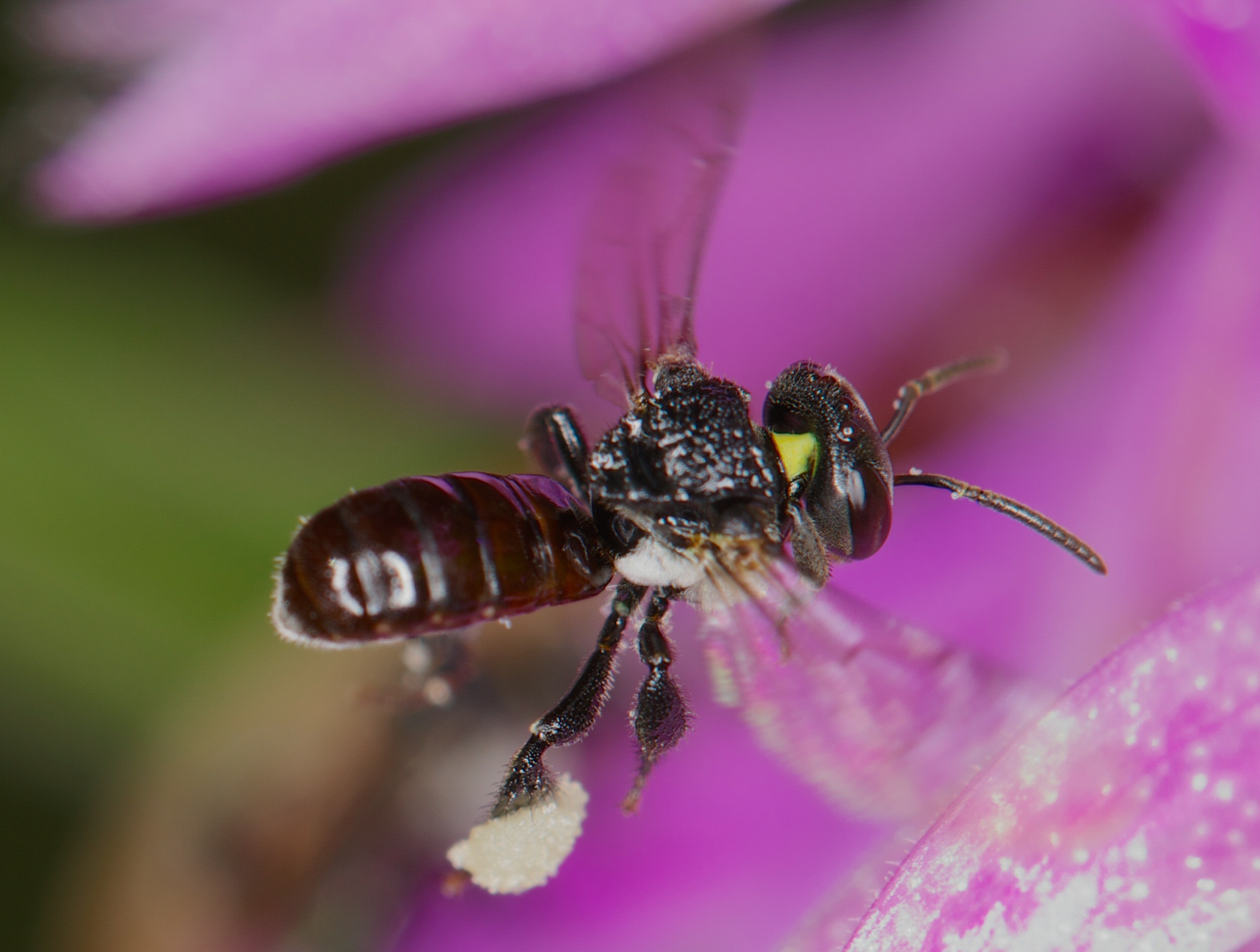
Credit: Graham Wise from Brisbane, Australia · CC BY 2.0
A bee is a flying insect that feeds on flowers. Bees are found on every continent except Antarctica. There are more than 20,000 known species of bees. They range from tiny ones smaller than a grain of rice to big bumblebees the size of a grape. All bees have six legs, two pairs of wings, and a body covered in fine hairs.
Bees eat two things from flowers: nectar and pollen. Nectar is a sweet liquid that gives the bee energy. Pollen is a yellow powder that gives the bee protein. As a bee flies from flower to flower, pollen sticks to the hairs on its body. When the bee lands on the next flower, some of that pollen rubs off. This is how most flowering plants make seeds. Scientists call this job pollination, and bees are some of the most important pollinators on Earth.
About one out of every three bites of food people eat depends on pollinators, mostly bees. Apples, almonds, blueberries, strawberries, pumpkins, and watermelons all need bees to make fruit. Without bees, grocery stores would look very different.
Most bees are not honey bees, and most bees do not live in hives. More than three-quarters of bee species live alone. A single female digs a small tunnel in the ground or in a piece of wood. She lays her eggs there and leaves food for her young. These are called solitary bees. Mason bees and leafcutter bees are common examples.
Honey bees and bumblebees are different. They live in large groups called colonies. A honey bee colony can have up to 60,000 bees. Each colony has one queen, who lays all the eggs. The other females are workers. They clean the hive, feed the young, guard the entrance, and gather food. Honey bees make honey by swallowing nectar, storing it in wax cells, and fanning it with their wings until it thickens. A single worker bee makes only about one-twelfth of a teaspoon of honey in her whole life.
Honey bees also do something strange to share news. When a worker finds a good patch of flowers, she flies home and dances. The direction and speed of her dance tell the other bees exactly where to go. This is called the waggle dance. A scientist named Karl von Frisch figured it out in the 1940s and won a Nobel Prize for it.
Bees are in trouble in many parts of the world. Pesticides, disease, and the loss of wild flowers have caused their numbers to drop. Planting native flowers in a yard or garden gives local bees more food.
Last updated 2026-04-22