
Deer
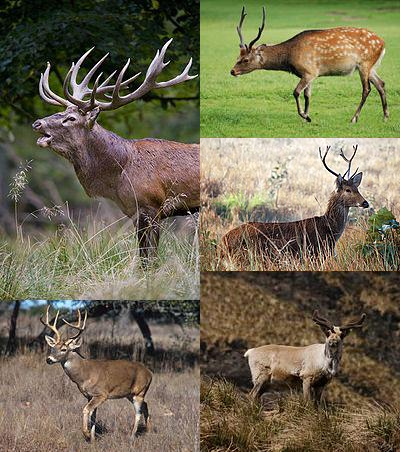
Credit: This image is a derivative work of the following images: File:White-tailed deer.jpg (USDA photo by Scott Bauer) File:RangiferTarandus.jpg (uploaded by User:Sydpolen) File:Red deer stag 2009 denmark.jpg (uploaded by User:Atomicbre) File:The barasingha.jpg (uploaded by aloshbennett) File:Dama dama 002.jpg (uploaded by User:Lily_M)) · CC BY-SA 3.0
The deer is a hoofed mammal found on every continent except Antarctica and Australia. There are about 50 species of deer, including the white-tailed deer, mule deer, reindeer, red deer, and tiny muntjac. All deer are plant eaters, and most live in forests, grasslands, or mountain areas. They are famous for one big feature: the males grow antlers.
Antlers are made of bone. They grow out of two spots on the top of a male deer's head. Each spring, the antlers start growing under a soft, fuzzy skin called velvet. The velvet feeds blood to the growing bone. By late summer, the antlers are full size, and the velvet dries up and falls off. Males use their antlers to fight other males during the mating season. After winter, the antlers drop off, and a new set grows the next year. A big set of moose antlers can weigh 40 pounds, about as much as a full box of books.
Deer have long legs built for running. A white-tailed deer can sprint 30 miles per hour and jump fences almost 8 feet high. Their eyes are on the sides of their heads, which lets them watch for danger in nearly every direction. Their large ears swivel to catch quiet sounds. When a deer senses a predator, it lifts its white tail like a flag to warn the rest of the herd before bounding away.
A baby deer is called a fawn. Most fawns are born with white spots that help them blend into patches of sunlight on the forest floor. For the first few weeks, a fawn stays hidden in tall grass while its mother feeds nearby. She returns a few times a day to nurse it. The spots fade within a few months.
Deer play a huge role in forest life. Wolves, mountain lions, bears, and coyotes all hunt them. In places where those predators have been removed by humans, deer numbers can grow too large. Hungry herds then eat young trees faster than new ones can grow, changing whole forests. When wolves were brought back to Yellowstone National Park in 1995, elk stopped overgrazing the riverbanks, and willow and aspen trees returned.
People have lived alongside deer for a very long time. Cave paintings in France, made more than 17,000 years ago, show deer running across stone walls. Today deer appear in stories, on flags, and in the backyards of millions of suburban homes.
Last updated 2026-04-22