
Pterosaurs
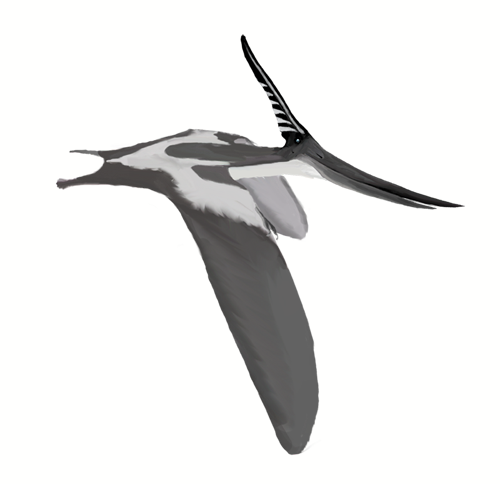
Credit: Matt Martyniuk · CC BY 3.0
Pterosaurs were flying reptiles that lived at the same time as the dinosaurs. They were the first animals with backbones to fly using flapping wings. Pterosaurs lived from about 228 million years ago to 66 million years ago. They died out at the same time as the dinosaurs, in the same disaster that ended the age of reptiles.
Many people call pterosaurs "flying dinosaurs," but that is not quite right. Pterosaurs were close cousins of dinosaurs, not dinosaurs themselves. Both groups came from the same reptile family long ago. The two groups split and went in different directions.
A pterosaur's wing was nothing like a bird's wing. It was made of skin stretched between the body and one very long finger. Imagine your ring finger growing as long as your whole arm, with a flap of skin running from its tip down to your ankle. That is roughly how a pterosaur flew. The other three fingers on each hand stayed small and worked like tiny claws for climbing or grabbing.
Pterosaurs came in a huge range of sizes. The smallest kinds were about the size of a sparrow. The largest, Quetzalcoatlus, stood as tall as a giraffe when it folded its wings and walked on all fours. Its wingspan stretched about 36 feet across. Scientists once thought Quetzalcoatlus was too heavy to fly. Newer studies suggest it could launch itself by pushing off the ground with its strong arms, like a pole vaulter.
Most pterosaurs had long beaks, and many had strange crests on their heads. Pteranodon had a bony crest that pointed backward from its skull. Tupandactylus had a huge sail-shaped crest bigger than the rest of its head. Scientists think these crests were used to show off to other pterosaurs, the way a peacock uses its tail feathers.
What did pterosaurs eat? Different kinds ate different things. Many caught fish, skimming the water like modern seabirds. Others ate insects, small reptiles, or even the eggs of dinosaurs. A few had tiny, needle-like teeth that worked like a filter to trap shrimp.
Fossils show that pterosaurs had fuzzy, hair-like fibers covering their bodies, called pycnofibers. This means they were probably warm-blooded, like birds and mammals. For a long time people pictured pterosaurs as scaly and cold. The real animals were more like leathery, furry gliders with beaks. When the asteroid struck Earth 66 million years ago, every pterosaur species vanished. Only the birds, descended from small dinosaurs, kept the skies.
Related
Last updated 2026-04-22