
Starfish
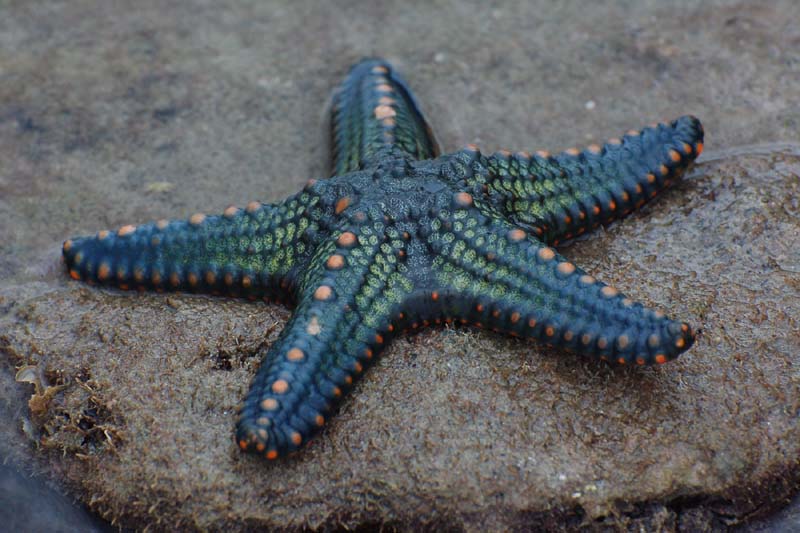
Credit: Paul Shaffner, Iringa, Tanzania · CC BY 2.0
A starfish is a sea animal with a flat body and arms that stick out like the points of a star. Scientists call them sea stars, because they are not actually fish. Fish have backbones, gills, and fins. Starfish have none of those things. They belong to a group of animals called echinoderms, which also includes sea urchins and sand dollars.
There are about 2,000 species of starfish. They live in every ocean on Earth, from warm tropical reefs to the freezing water under Arctic ice. Some live in shallow tide pools near the shore. Others live more than 20,000 feet down, in parts of the deep sea darker than any night.
Most starfish have five arms, but some have many more. The sunflower sea star can grow up to 24 arms and stretch more than three feet across, wider than a car tire. If a starfish loses an arm to a predator, it can grow the arm back. In a few species, the lost arm can even grow a whole new starfish from itself.
Underneath each arm are hundreds of tiny tube feet. These work a bit like suction cups. Each foot fills with seawater and presses against the ground. Together, the tube feet pull the starfish slowly across rocks and sand. They also grip prey. A starfish's favorite meal is often a clam or a mussel. The starfish wraps its arms around the shell and pulls steadily for hours until the shell opens just a crack. Then it does something strange. It pushes its stomach out through its mouth, slips the stomach into the shell, and digests the clam inside its own home.
Starfish do not have a brain. They do not have blood either. Instead of blood, seawater flows through their bodies and carries what they need. A small red or orange spot at the tip of each arm is an eye. It cannot see clear pictures, but it can tell light from dark and help the starfish find shelter.
Starfish are important to their habitats. When a certain kind of starfish disappears, whole ecosystems can change. Since around 2013, a disease called sea star wasting syndrome has killed billions of starfish along the Pacific coast of North America. Scientists are still studying what causes it. Without enough starfish, sea urchins multiply too fast and eat up the kelp forests where many other sea animals live. The next time you spot a starfish in a tide pool, you are looking at one of the quietest but most powerful animals in the sea.
Related
Last updated 2026-04-22