
Gemstone
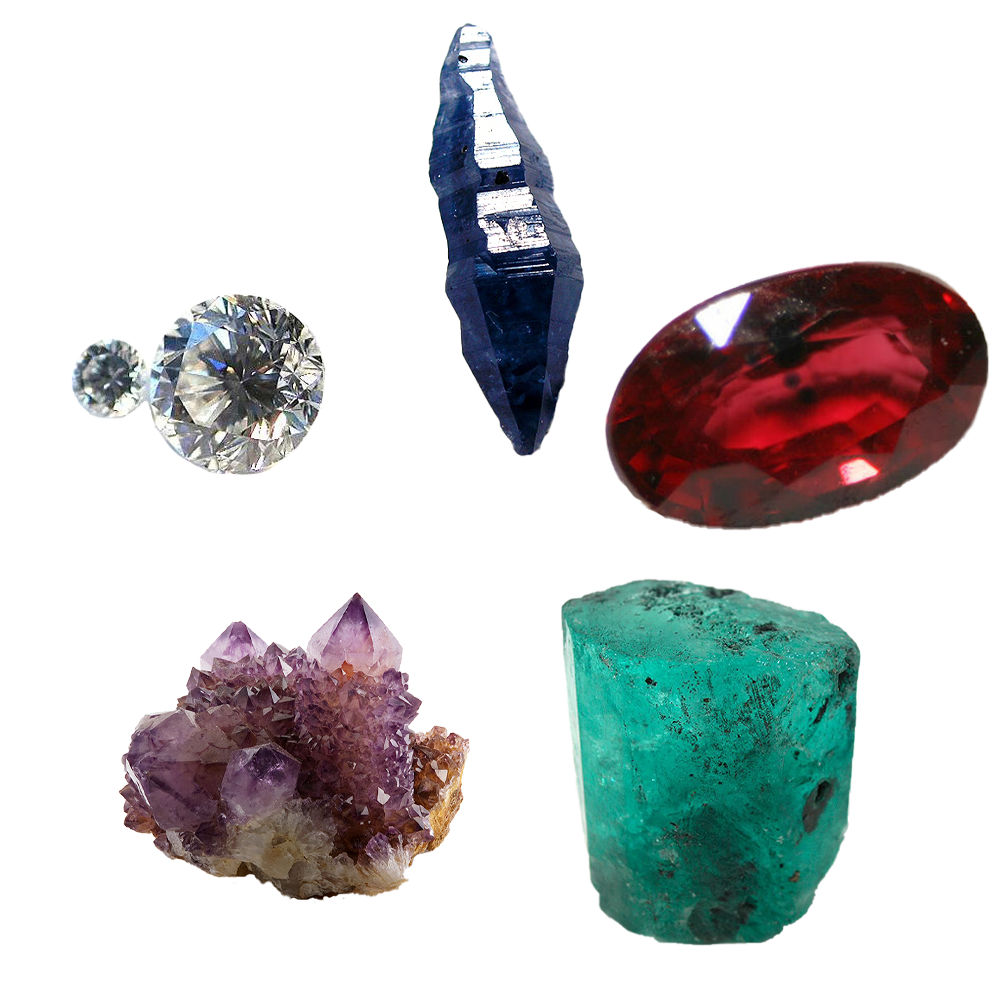
Credit: Robert M. Lavinsky / Robert M. Lavinsky · CC BY-SA 3.0
A gemstone is a rare mineral that people cut and polish to use in jewelry or art. Most gemstones start out as crystals deep inside the Earth. Heat, pressure, and chemicals work on the rock for millions of years. Slowly, atoms line up into bright, hard crystals. Miners dig the crystals out, and gem cutters shape them into the sparkling stones you see in rings and necklaces.
Three things make a stone a gem: it has to be beautiful, it has to be hard enough to last, and it has to be rare. A pretty rock from your backyard might be lovely, but if it scratches easily or is common, it is not a gem.
Hardness is measured on the Mohs scale, which runs from 1 to 10. A fingernail is about 2.5. A steel knife is about 6. Diamond, the hardest natural material on Earth, is a 10. Diamonds are made of pure carbon, the same stuff in pencil lead. The difference is how the atoms are arranged. In a pencil, carbon atoms slide apart easily. In a diamond, they lock together in a tight pattern that almost nothing can scratch.
Color comes from tiny amounts of other elements mixed into the crystal. Pure corundum is colorless. Add a little chromium, and it turns red, a ruby. Add iron and titanium instead, and the same mineral turns blue, a sapphire. So rubies and sapphires are really the same rock with different "ingredients."
The four most famous gems are diamond, ruby, sapphire, and emerald. People call these the precious stones. Other popular gems, like amethyst, topaz, garnet, and turquoise, are called semi-precious. Pearls and amber are sometimes counted as gems too, even though they are not minerals. Pearls grow inside oysters. Amber is tree sap that hardened into stone over millions of years, sometimes trapping ancient insects inside.
The most valuable gemstones are not always the ones you have heard of. Tanzanite, found in only one small area of Tanzania, is rarer than diamond. Painite was once called the rarest mineral on Earth. For decades, only a few crystals were known to exist anywhere.
Some famous gems have wild histories. The Hope Diamond, a deep blue stone now in the Smithsonian, has passed through kings, thieves, and bankrupt owners. People say it is cursed. Scientists, of course, do not believe in curses. But the stories that grow around gems are part of why humans have prized them for thousands of years.
Related
Last updated 2026-04-25