
Crystal
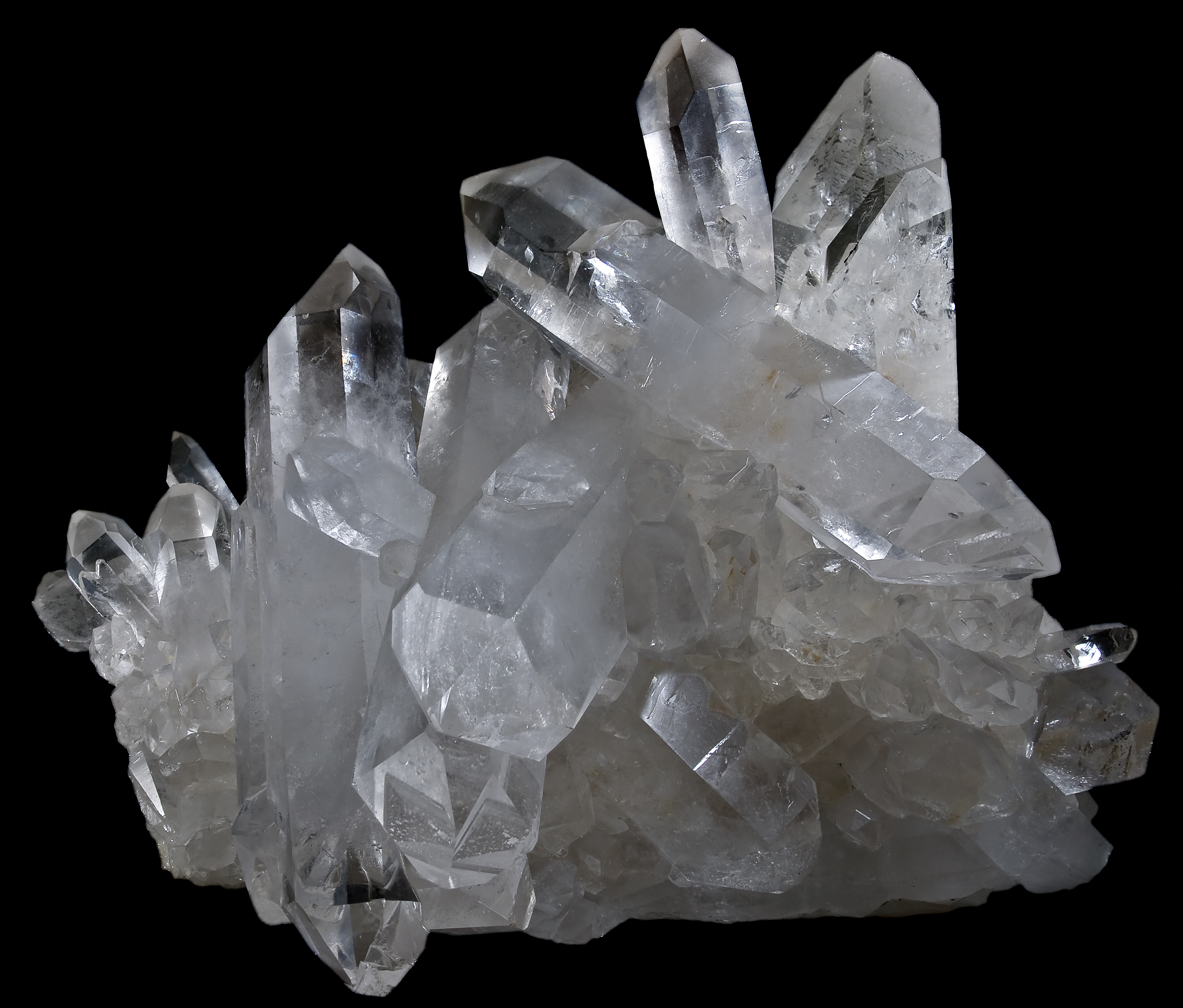
Credit: Didier Descouens · CC BY-SA 4.0
A crystal is a solid in which the atoms or molecules are lined up in a repeating pattern. That pattern goes in every direction, like a 3D grid. The neat arrangement inside is why crystals often have flat sides and sharp corners on the outside. Salt, sugar, snowflakes, and diamonds are all crystals.
Crystals form when a liquid cools down or when a liquid dries up and leaves a solid behind. As the atoms slow down, they settle into the spot where they fit best with their neighbors. Once one tiny crystal starts, more atoms lock on in the same pattern. Given enough time and space, the crystal grows larger and larger.
The shape of a crystal depends on the atoms inside it. Salt atoms stack into cubes, so table salt grains are little cubes. Water molecules lock together with six-sided symmetry, which is why every snowflake has six arms. Quartz grows into pointed columns with six sides. If you look closely at these shapes with a magnifying glass, you can see the same pattern over and over.
Most rocks are made of crystals, even when they do not look shiny. Granite, the rock in many kitchen counters, is packed with tiny crystals of quartz, feldspar, and mica. When a crystal grows slowly underground, it can get huge. When it grows fast, it stays small. A cave in Mexico called the Cave of Crystals holds gypsum crystals that took about 500,000 years to grow, and some are longer than a school bus.
Crystals are not just pretty rocks. They are useful. Quartz crystals vibrate at a very steady rate when electricity runs through them, which is how most watches and clocks keep time. Silicon crystals are the base for computer chips. Every phone, laptop, and video game console depends on them. Salt crystals season your food. Diamond crystals, the hardest natural material on Earth, are used to cut and polish other hard stones.
People sometimes confuse crystals with glass. Glass looks clear and solid, but its atoms are jumbled up inside, not arranged in a neat grid. Scientists call glass an amorphous solid, which means "without shape." So a glass window is not really a crystal, even if it sparkles.
You can grow your own crystals at home. Dissolve sugar or salt in hot water until no more will dissolve, then hang a string in the jar and wait. Over days or weeks, crystals will build themselves on the string, one atom at a time.
Related
Last updated 2026-04-23