
Lightning
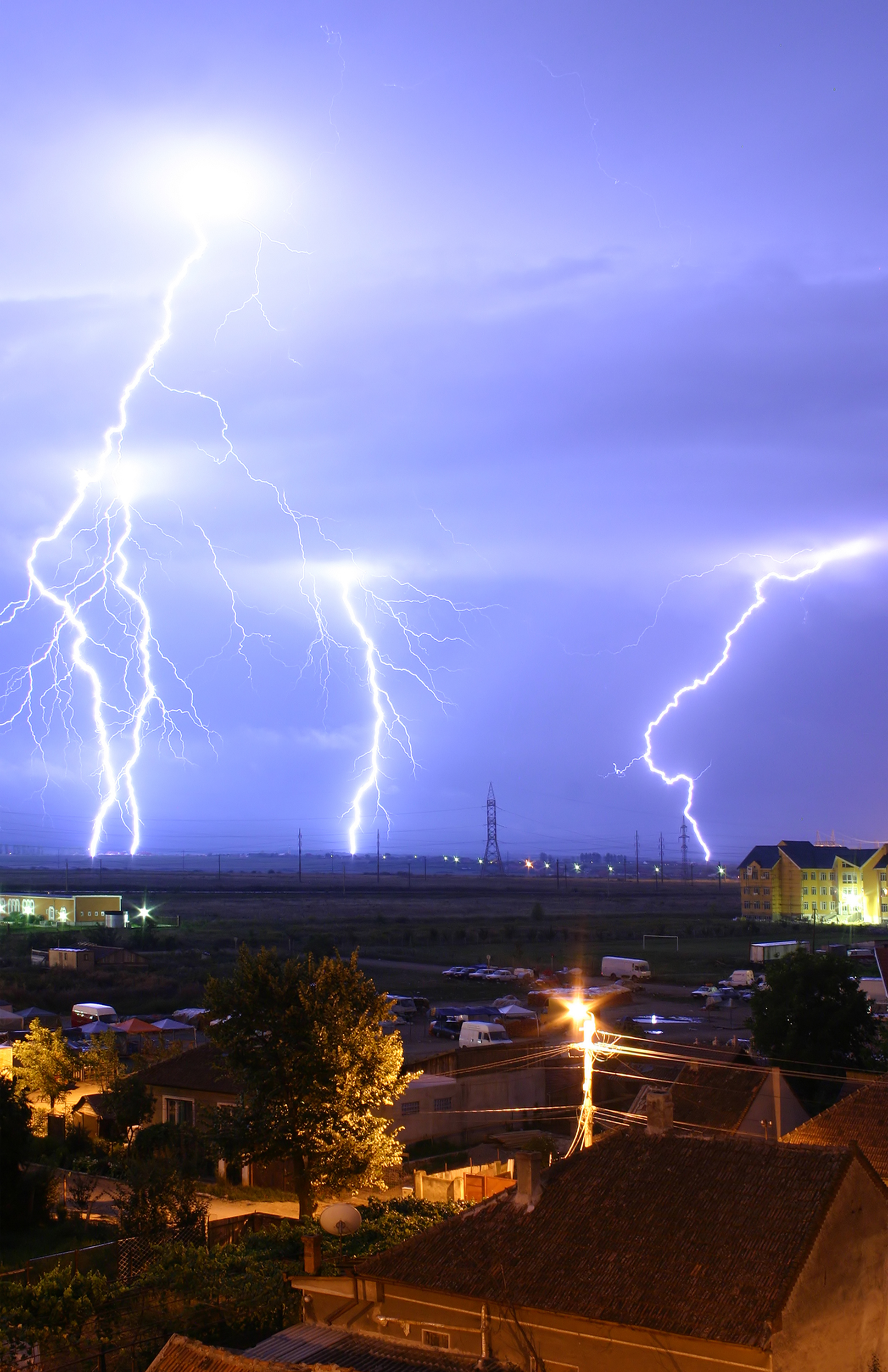
Credit: Mircea Madau · Public domain
Lightning is a giant spark of electricity that flashes through the sky during storms. It happens when electric charges build up inside clouds and then jump from one place to another. Lightning can leap from cloud to cloud, from a cloud to the ground, or even inside the same cloud. Most lightning happens during thunderstorms, but it can also flash from volcanoes, dust storms, and snowstorms.
Lightning starts with tiny pieces of ice and water inside a tall storm cloud. Strong winds push these pieces around, and they bump into each other. The bumping rubs off electric charges. Lighter ice pieces float to the top of the cloud and become positively charged. Heavier ones sink to the bottom and become negatively charged. The two halves of the cloud act like the two ends of a battery.
When the difference in charge gets big enough, the air can no longer hold it back. A bolt of lightning rips through the air to balance things out. This is the same kind of electricity you feel when you shuffle across a carpet and zap a doorknob, just billions of times more powerful.
A lightning bolt is incredibly hot. It can reach about 50,000 degrees Fahrenheit, which is roughly five times hotter than the surface of the Sun. The bolt heats the air around it so fast that the air explodes outward. That explosion is what makes the booming sound called thunder. Light travels much faster than sound, so you see the flash before you hear the boom. Every five seconds between flash and thunder means the lightning is about one mile away.
Earth gets struck by lightning about 100 times every second. That adds up to more than 8 million strikes a day. The most lightning-prone place on Earth is Lake Maracaibo in Venezuela, where storms flash almost every night.
Lightning is dangerous, but it is also useful for the planet. When a bolt rips through the air, it splits apart nitrogen molecules. Plants need that nitrogen to grow, and rain washes it down into the soil. Lightning has been fertilizing forests and fields for billions of years.
In 1752, Benjamin Franklin did a famous experiment to prove that lightning is electricity. He flew a kite into a stormy sky with a metal key tied to the string. Sparks jumped from the key to his hand. The experiment was wildly dangerous, and other scientists who copied it later were killed. But Franklin lived, and his discovery led to the lightning rod, which still protects buildings today.
Related
Last updated 2026-04-25