
Static Electricity
Credit: Drbaker171 at English Wikipedia · Public domain
Static electricity is a buildup of electric charge on the surface of an object. The word "static" means "not moving." Unlike the electricity that flows through wires in your house, static electricity sits still on something until it has a chance to jump. You have felt it if you ever got a zap from a doorknob or watched a balloon stick to a wall.
To understand static, it helps to know a little about atoms. Everything around you is made of atoms. Inside each atom are even smaller parts called electrons, and electrons carry a negative charge. Most of the time, an object has the same number of positive and negative charges, so it feels neutral. But electrons can move from one object to another.
That is what happens when you rub your socks on a carpet. Tiny electrons jump from the carpet onto your body. Now you have extra electrons, which means you have extra negative charge. When you reach for a metal doorknob, those extra electrons leap across the gap to the metal. You see a spark and feel a zap. The sound you hear is the air heating up for a split second.
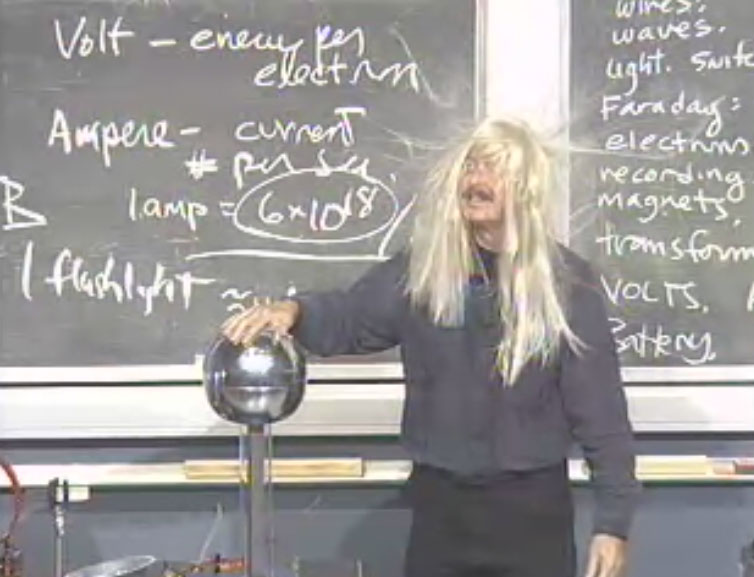
Charges follow a simple rule. Opposite charges pull toward each other, and the same charges push apart. That is why a balloon rubbed on your hair sticks to a wall. The balloon picks up extra electrons, and the wall's positive charges pull it close. It is also why your hair stands up inside a winter hat. Each hair has the same charge as the others, so every strand is pushing its neighbors away.
Lightning is static electricity on a giant scale. Inside a storm cloud, ice and water crystals rub against each other as they are tossed around by the wind. Electrons pile up at the bottom of the cloud. When enough charge builds up, it jumps to the ground in a huge spark we call lightning. A single bolt can heat the air to around 50,000 degrees Fahrenheit.
Static tends to show up more in winter. Cold air holds less moisture, and dry air lets charges build up on your skin and clothes. In summer, the damp air carries the extra electrons away before they can zap you. The physics is the same, but the weather changes how much you notice it.
Last updated 2026-04-23