
Harriet Tubman
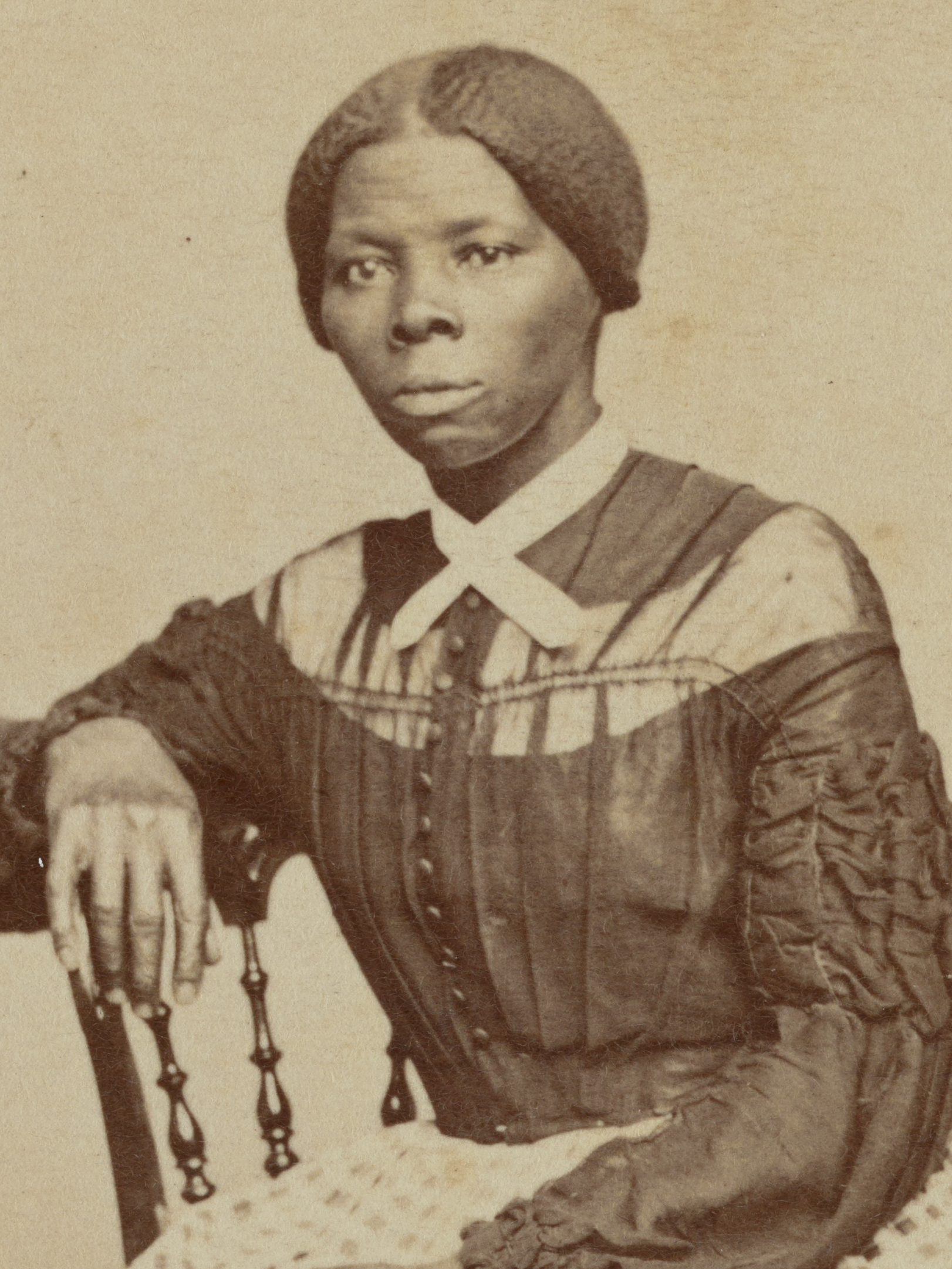
Credit: Powelson, Benjamin F. 1823 - 1885 · Public domain
Harriet Tubman was an American hero who escaped slavery and then helped many others escape too. She lived from about 1822 to 1913. During her life, she led dozens of enslaved people to freedom through the Underground Railroad. She also served as a spy and scout for the Union Army during the Civil War. She is one of the most famous people in American history.
She was born Araminta Ross on a plantation in Maryland. Everyone called her Minty. Her family did not know her exact birth year; historians think she was born around 1822. Ever since she was very small, she was forced to work for the family that owned her. When she was six, she was sent to another house to care for a baby. She was whipped if the baby cried. When she was about thirteen, an overseer threw a heavy iron weight at another enslaved person. It hit Minty in the head instead. The injury almost killed her. For the rest of her life, she had headaches, dizziness, and spells where she would suddenly fall asleep.
Around 1844, she married a free Black man named John Tubman. She changed her first name to Harriet, after her mother. In 1849, she heard that she and her sisters might be sold to plantations farther south. She decided to escape. Traveling at night and using the North Star to find her way, she walked almost 90 miles to Pennsylvania, a free state. "When I found I had crossed that line," she said later, "I looked at my hands to see if I was the same person."
She could have stayed safe in the North. Instead, she joined the Underground Railroad. This was not a real railroad. It was a secret group of people — free Black Americans, Quakers, and others — who helped enslaved people escape to the free states and Canada. Tubman became one of its most important "conductors." Over about ten years, she went back into the South about thirteen times. She led around seventy people to freedom and helped many others escape on their own. She never lost a single person she was guiding. Slave owners offered big rewards for her capture, but they never caught her.
When the Civil War began in 1861, Tubman joined the Union Army. At first she worked as a cook and a nurse. Then the Army put her to work as a spy and a scout. She was very good at moving secretly through enemy territory. In June 1863, she helped lead a raid called the Combahee Ferry Raid. Union boats traveled up a river in South Carolina while Tubman guided them past Confederate traps. The raid freed more than 700 enslaved people in a single day. Tubman was the first woman in American history to lead a major armed attack in war.
After the war, Tubman settled in Auburn, New York, on land she had bought from Senator William Seward. She never became rich. She gave away almost everything she earned. She cared for her aging parents and opened her home to elderly Black people who had nowhere else to go. Later in life, she worked for another cause: the right of women to vote. She traveled and gave speeches with leaders like Susan B. Anthony. She said women had earned the right to vote through everything they had done and suffered.
Tubman died in 1913 at about 91 years old. She was buried with military honors. She had been fighting almost her whole life — first for her own freedom, then for the freedom of others, and finally for the rights of Black Americans and women. She once said, "I had crossed the line. I was free; but there was no one to welcome me to the land of freedom. I was a stranger in a strange land."
Her face now appears on stamps, statues, and schools. In 2016, the U.S. Treasury announced plans to put her face on the twenty-dollar bill. There is a national park in Maryland where visitors can walk the same fields and woods she once crossed in the dark. Tubman directly helped about seventy people reach freedom. Her example has inspired many more people in the years since.
Related
Last updated 2026-04-20