
Indian Ocean
Credit: United States Central Intelligence Agency · Public domain
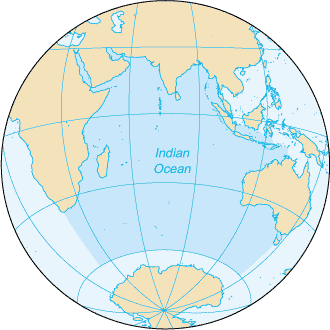
The Indian Ocean is the third-largest ocean on Earth. It sits between Africa to the west, Asia to the north, and Australia to the east. To the south, it blends into the icy waters around Antarctica. The ocean covers about 27 million square miles. That is almost seven times the size of the United States.
The Indian Ocean is named after the country of India, which sits right at its northern edge. More than two billion people live in the lands around the Indian Ocean. That is almost one out of every four people on Earth.
Warm water and monsoons
The Indian Ocean is the warmest ocean in the world. Most of it lies near the equator, where the sun shines strongest. This warm water powers a weather pattern called the monsoon. Twice a year, winds over the ocean change direction. In summer, they blow wet air from the sea onto the land, bringing heavy rains to India and Southeast Asia. In winter, they blow dry air from the land back out to sea. Farmers across Asia depend on these rains to grow rice, tea, and other crops.
Life in the ocean
The warm water is home to huge numbers of sea creatures. Coral reefs line many coasts, especially around the Maldives, a country made up of about 1,200 low islands. Whale sharks, the biggest fish in the world, cruise through these waters. So do dolphins, sea turtles, and tuna. The Indian Ocean also has dangerous storms called cyclones, which are the same kind of storm as a hurricane.
People and trade
For thousands of years, the Indian Ocean has been a highway for trade. Sailors used the steady monsoon winds to move between Africa, Arabia, India, and China. They carried spices, silk, gold, and ideas. Today, the ocean is still one of the busiest shipping routes in the world. Much of the world's oil travels by tanker through the narrow Strait of Hormuz in the Persian Gulf.
A dangerous memory
In December 2004, a giant earthquake under the Indian Ocean triggered a tsunami. Huge waves slammed into coasts across 14 countries, from Indonesia to Africa. More than 225,000 people died. It was one of the deadliest natural disasters in modern history. After the disaster, countries worked together to build a new warning system. Floating sensors now watch for sudden changes in the ocean, so people on shore get a chance to reach higher ground.
Related
Last updated 2026-04-22