
Aurora
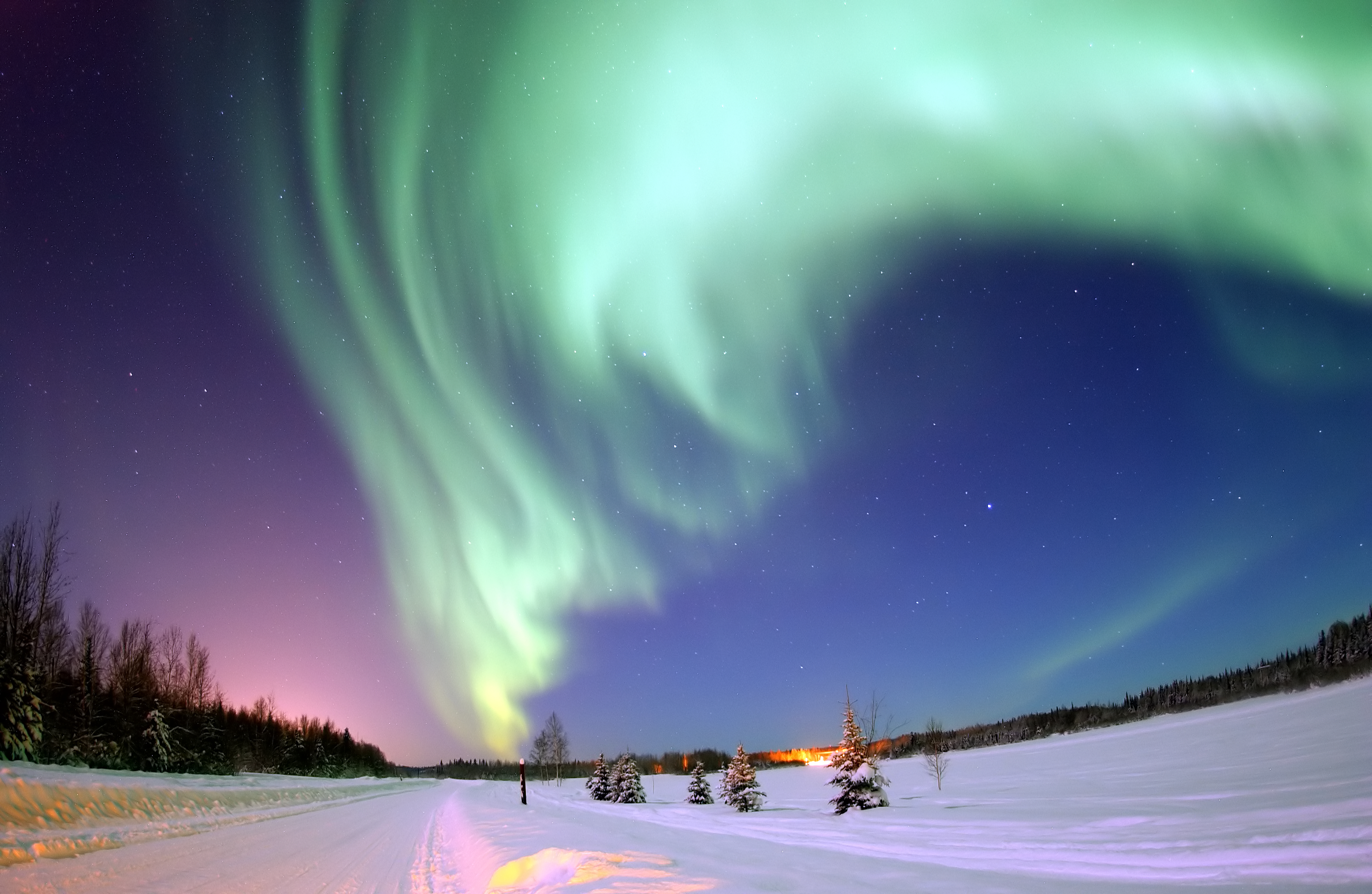
Credit: United States Air Force photo by Senior Airman Joshua Strang · Public domain
An aurora is a glowing light show that appears in the night sky near Earth's poles. The lights often look like ribbons, curtains, or waves that shift and dance. They can glow green, pink, red, purple, or blue. Auroras near the North Pole are called the northern lights, or aurora borealis. Auroras near the South Pole are called the southern lights, or aurora australis.
Auroras are made by the Sun. The Sun is always sending tiny bits called charged particles out into space. This stream of particles is called the solar wind. When the solar wind reaches Earth, most of it is pushed away by Earth's magnetic field. That field acts like an invisible shield around the planet. But near the North and South Poles, the shield has weak spots. Some particles slip through and crash into gases high in the atmosphere.
The colors come from different gases. When the particles hit oxygen, the sky glows green or red. When they hit nitrogen, the sky glows blue or purple. The green curtains people see most often come from oxygen about 60 miles above the ground. The rare deep-red auroras come from oxygen even higher up, around 200 miles high. That is about as high as the International Space Station orbits.
The best places to see auroras on Earth are near the Arctic Circle. Alaska, Canada, Iceland, Norway, Sweden, and Finland all get strong shows. In the Southern Hemisphere, the best views are from Antarctica, southern New Zealand, and the tip of South America. Auroras are hardest to see near the equator, though huge solar storms can sometimes push them much farther from the poles.
The Sun goes through a roughly 11-year cycle. During the most active years, it shoots out bigger bursts of particles called solar flares and solar storms. These storms make the auroras brighter, bigger, and more colorful. A very strong storm in 1859, called the Carrington Event, made auroras glow so brightly that people in Cuba and Hawaii could see them.
People have watched auroras for thousands of years and tried to explain them. Some Inuit stories said the lights were the spirits of ancestors dancing in the sky. Some Norse stories said the lights came from the armor of warrior goddesses. Scientists did not work out the real cause until the early 1900s, when a Norwegian researcher named Kristian Birkeland showed that charged particles from the Sun were behind the glow.
Related
Last updated 2026-04-22