
Constellation
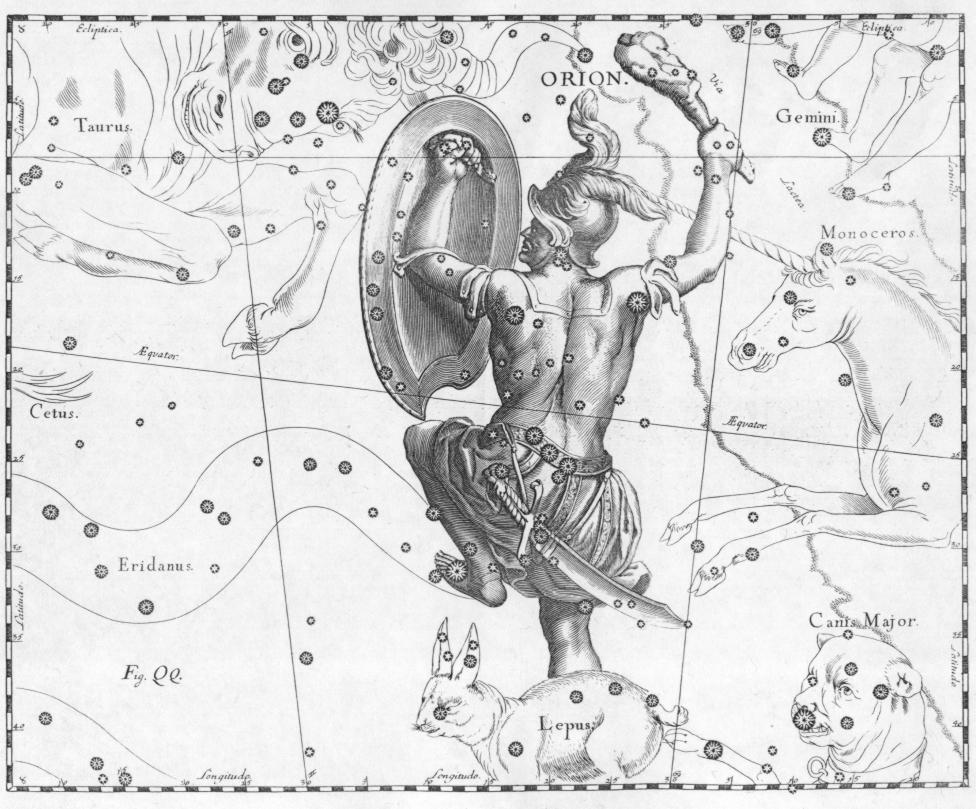
Credit: Johannes Hevelius (28 January 1611 – 28 January 1687) Scanned by Torsten Bronger, 4 April 2003. · Public domain
A constellation is a group of stars in the night sky that forms a pattern or picture. People have been connecting stars with imaginary lines for thousands of years. Today, astronomers officially recognize 88 constellations that together cover the whole sky.
The stars in a constellation are not really close to each other in space. They only look like a group from Earth. One star in a pattern might be 50 light-years away. Another star in the same pattern might be 500 light-years away. If you could fly out into space and look from a different angle, the pattern would fall apart. A constellation is a picture that only works from our exact spot in the universe.
Different cultures saw different pictures in the same stars. The ancient Greeks saw a hunter named Orion, with three bright stars as his belt. Ancient Egyptians saw a god named Osiris in the same stars. Many Native American nations saw the Big Dipper as a bear being chased by hunters. In China, people grouped the sky into four great animals: the Azure Dragon, the White Tiger, the Vermilion Bird, and the Black Tortoise. The stars were the same. The stories were not.
In 1922, the International Astronomical Union made the list of 88 constellations official. They also drew exact borders around each one, like states on a map. Every spot in the sky belongs to one constellation. This helps astronomers tell each other where to point their telescopes.
Constellations also help us keep track of the seasons. Orion is easy to see in winter in the Northern Hemisphere. Scorpius shows up in summer. Ancient farmers used these changes to know when to plant crops. Sailors used constellations to steer ships across the ocean. The North Star, at the end of the Little Dipper's handle, sits almost exactly above the North Pole. If you find it, you know which way is north.
Over very long spans of time, constellations slowly change shape. Every star in the sky is moving, just too slowly for us to notice. In about 50,000 years, the Big Dipper will not look like a dipper anymore. The handle will bend the wrong way. The people who look up then will need to invent new pictures and tell new stories about them.
Last updated 2026-04-22