
Telescope
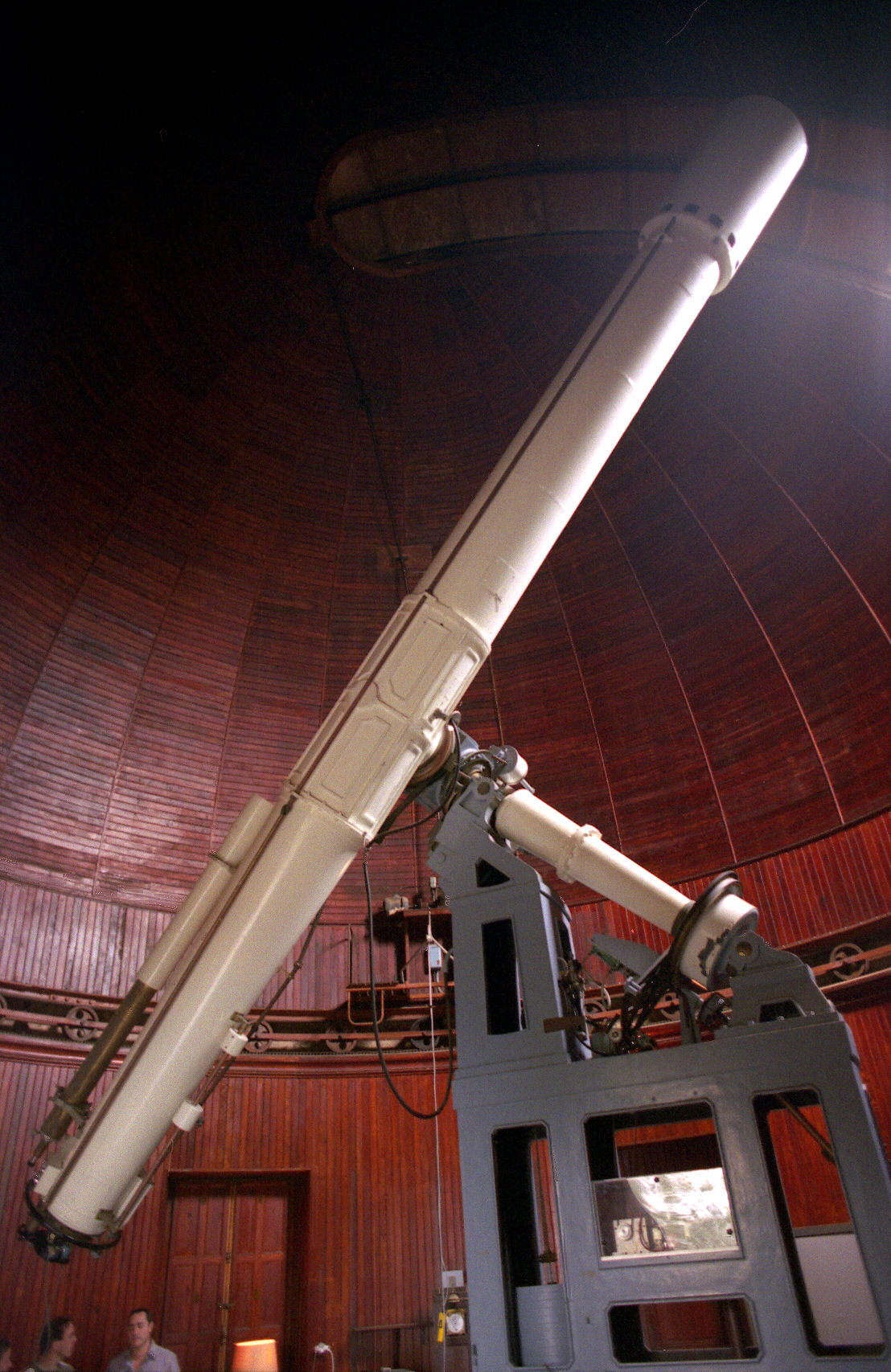
Credit: Users Ericd on en.wikipedia · CC BY-SA 3.0
A telescope is a tool that makes faraway things look closer and brighter. People use telescopes to study the Moon, planets, stars, and galaxies. Most telescopes work by gathering light with a large lens or mirror and bending it toward the viewer's eye or a camera. The bigger the lens or mirror, the more light a telescope can collect, and the more it can see.
The first useful telescope was built in the Netherlands in 1608 by a glasses maker named Hans Lippershey. A year later, an Italian scientist named Galileo Galilei heard about the invention and built his own. Galileo pointed his telescope at the night sky and changed science forever. He saw mountains on the Moon, four moons orbiting Jupiter, and the phases of Venus. These discoveries helped prove that Earth was not the center of the universe.
There are two main kinds of telescopes. A refracting telescope uses a glass lens at the front to bend light. A reflecting telescope uses a curved mirror at the back to bounce light forward. Isaac Newton built the first reflecting telescope in 1668. Most large telescopes today are reflectors because big mirrors are easier to make and support than big lenses.
Earth's atmosphere is a problem for astronomers. Air moves and ripples, which makes stars twinkle and makes images blurry. To get sharper views, scientists build telescopes on tall, dry mountains where the air is still. The biggest ones sit on peaks in Hawaii and Chile. Even better, some telescopes are launched into space. The Hubble Space Telescope, launched in 1990, has sent back stunning images of distant galaxies for more than 30 years. The James Webb Space Telescope, launched in 2021, can see even farther.
Not all telescopes collect visible light. Some collect radio waves, which let astronomers study things that glow in a way human eyes cannot see. Radio telescopes look like giant satellite dishes. Others collect X-rays, infrared light, or ultraviolet light. Each kind reveals something different about the universe. Together, they give scientists a much fuller picture than any single telescope could.
Telescopes keep getting bigger and more powerful. New ground-based giants, like the Extremely Large Telescope being built in Chile, will have mirrors more than 130 feet across. That is wider than a blue whale is long. With each new telescope, astronomers push farther back in time and deeper into space. The next great discovery about the universe is probably already waiting, hiding in light that no telescope has yet been built to catch.
Related
Last updated 2026-04-22