
James Webb Space Telescope
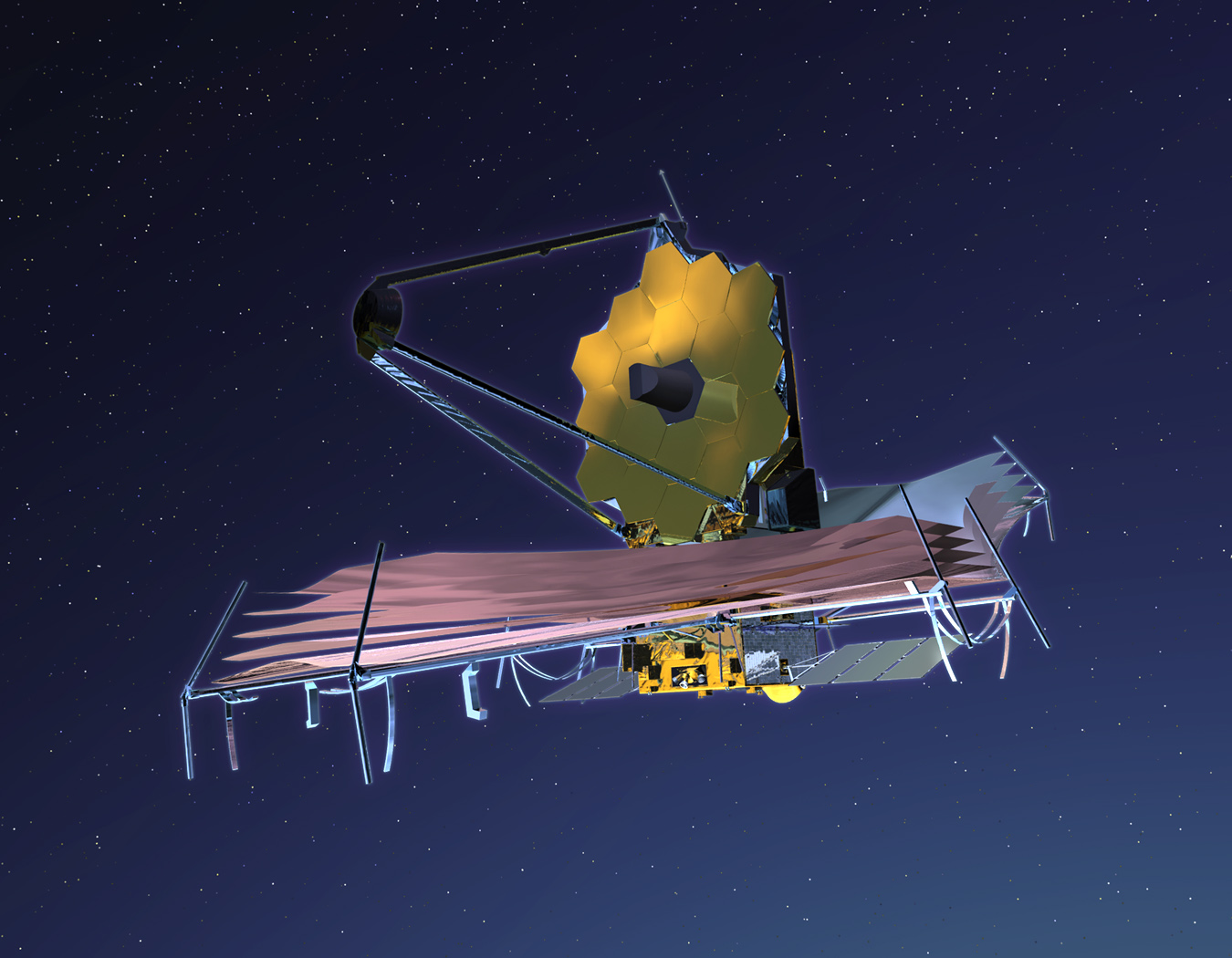
Credit: Wikimedia Commons · Public domain
The James Webb Space Telescope is a giant space telescope that NASA launched in December 2021. It is the most powerful telescope ever sent into space. NASA built it with help from the European Space Agency and the Canadian Space Agency. The telescope is named after James Webb, who ran NASA in the 1960s during the early Apollo missions.
Webb does not orbit Earth the way the Hubble Space Telescope does. Instead, it sits about a million miles from Earth, roughly four times farther away than the Moon. From there, it can stay cold and still, pointed into deep space without Earth getting in the way.
The heart of the telescope is its main mirror. It is made of 18 smaller mirrors shaped like hexagons, fitted together to form one big mirror that is 21 feet across. That mirror is more than six times larger than Hubble's. Each small mirror is coated with a thin layer of real gold, because gold reflects infrared light very well.
Infrared is the key to what Webb does. Infrared is a kind of light our eyes cannot see. We feel it as heat. Many things in space, including young stars hidden inside clouds of dust and the most distant galaxies, send out more infrared light than regular visible light. To see it, Webb has to be extremely cold. Its sunshield blocks the Sun, Earth, and Moon, keeping the mirror at about 370 degrees below zero Fahrenheit.
Webb launched on a rocket from South America. Getting it to work was risky. The telescope was too big to fit in the rocket fully open, so it had to fold up like origami. After launch, it spent about a month unfolding itself in space. Hundreds of parts had to move in the right order. If even a few had failed, the mission could have been ruined. Everything worked.
Since then, Webb has sent back some of the most amazing pictures humans have ever seen. It has photographed galaxies whose light has been traveling toward us for more than 13 billion years, from when the universe was very young. It has studied the air around planets that orbit other stars, looking for gases like water and carbon dioxide. It has shown the hearts of star nurseries that Hubble could never see through.
Scientists hope Webb can help answer some of the biggest open questions in astronomy. How did the first galaxies form? Could any of those distant planets support life? The telescope is built to last at least ten years, and it is just getting started.
Last updated 2026-04-22