
Hubble Space Telescope
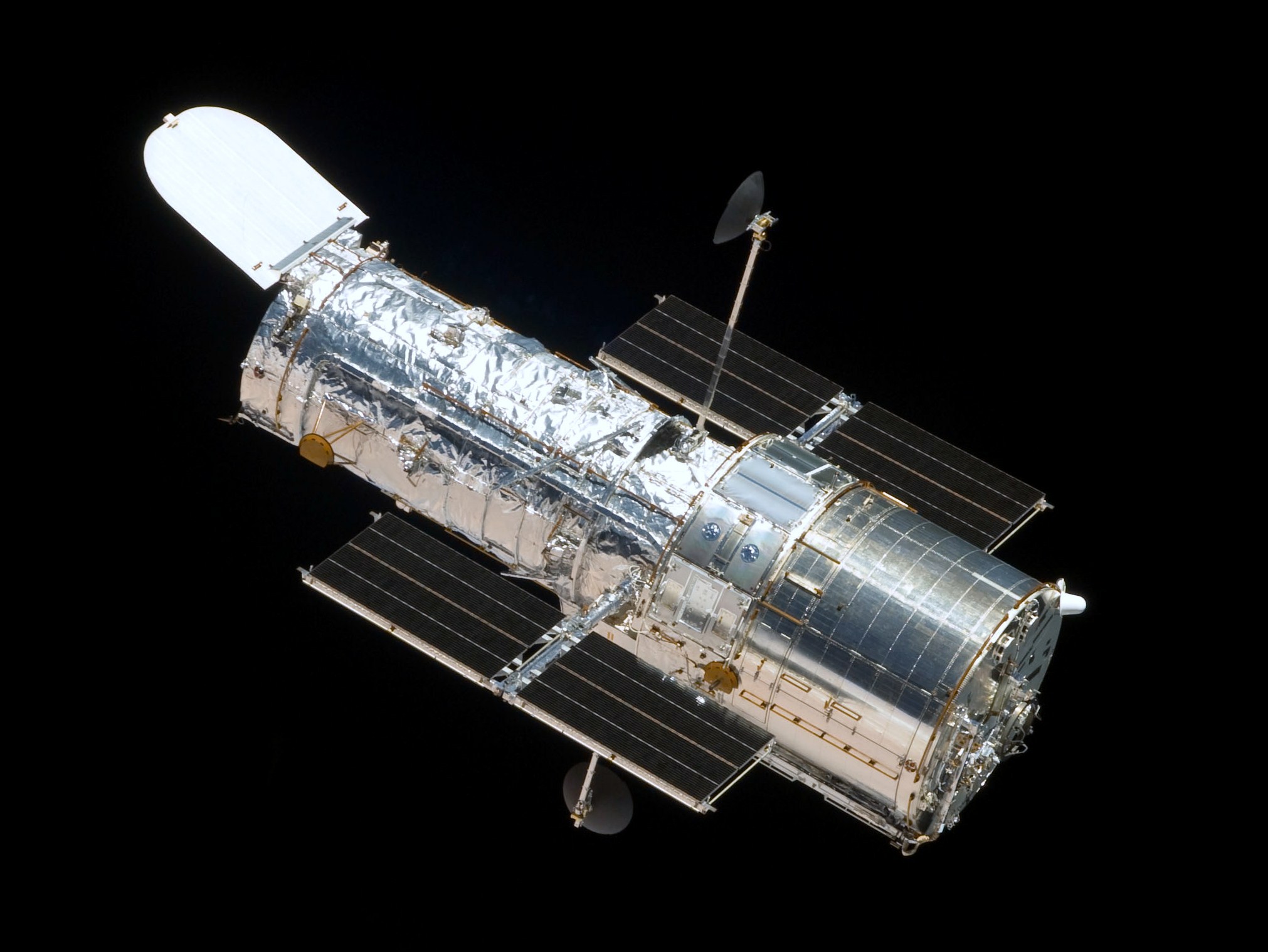
Credit: Ruffnax (Crew of STS-125) · Public domain
The Hubble Space Telescope is a large telescope that orbits Earth and takes pictures of space. NASA launched it in 1990 with help from the European Space Agency. Hubble is about the size of a school bus and weighs around 24,000 pounds. It is named after Edwin Hubble, an American astronomer who showed that the universe is much bigger than people thought.
Hubble circles Earth about 340 miles above the ground. That is higher than the International Space Station. From up there, it can see stars and galaxies without any air in the way. Down on the ground, Earth's atmosphere makes stars twinkle and blurs the view through telescopes. Above the atmosphere, Hubble's pictures are sharp and clear.
Hubble's main mirror is almost eight feet across. The mirror catches light from faraway objects and sends it to cameras and other instruments. Some of that light has been traveling for billions of years before it reaches the telescope. When Hubble takes a picture of a distant galaxy, it is really looking back in time.
The start of the mission was a disaster. Soon after launch, scientists saw that the main mirror had been ground into slightly the wrong shape. The error was tiny, thinner than a human hair, but it made every photo blurry. In 1993, astronauts flew up on the Space Shuttle and added special lenses to fix the problem. The repair worked. Over the years, five more shuttle missions visited Hubble to swap out old parts and add new cameras.
Hubble has changed what we know about space. It helped measure how fast the universe is expanding. It found that almost every big galaxy has a black hole at its center. It watched pieces of a comet smash into Jupiter. It spotted baby stars forming inside huge clouds of gas and dust. One of its most famous pictures, called the Hubble Deep Field, stared at a tiny dark patch of sky for ten days. That patch turned out to be full of thousands of galaxies nobody knew were there.
In 2021, NASA launched the James Webb Space Telescope, a much larger telescope that sees in infrared light. Some people thought Webb would replace Hubble. It has not. The two telescopes see different kinds of light and work well as a team. Hubble is still taking pictures today, more than 35 years after it launched. Scientists hope it will keep working into the 2030s, though nobody knows exactly when its orbit will finally decay and the telescope will fall back toward Earth.
Related
Last updated 2026-04-22