
Earth
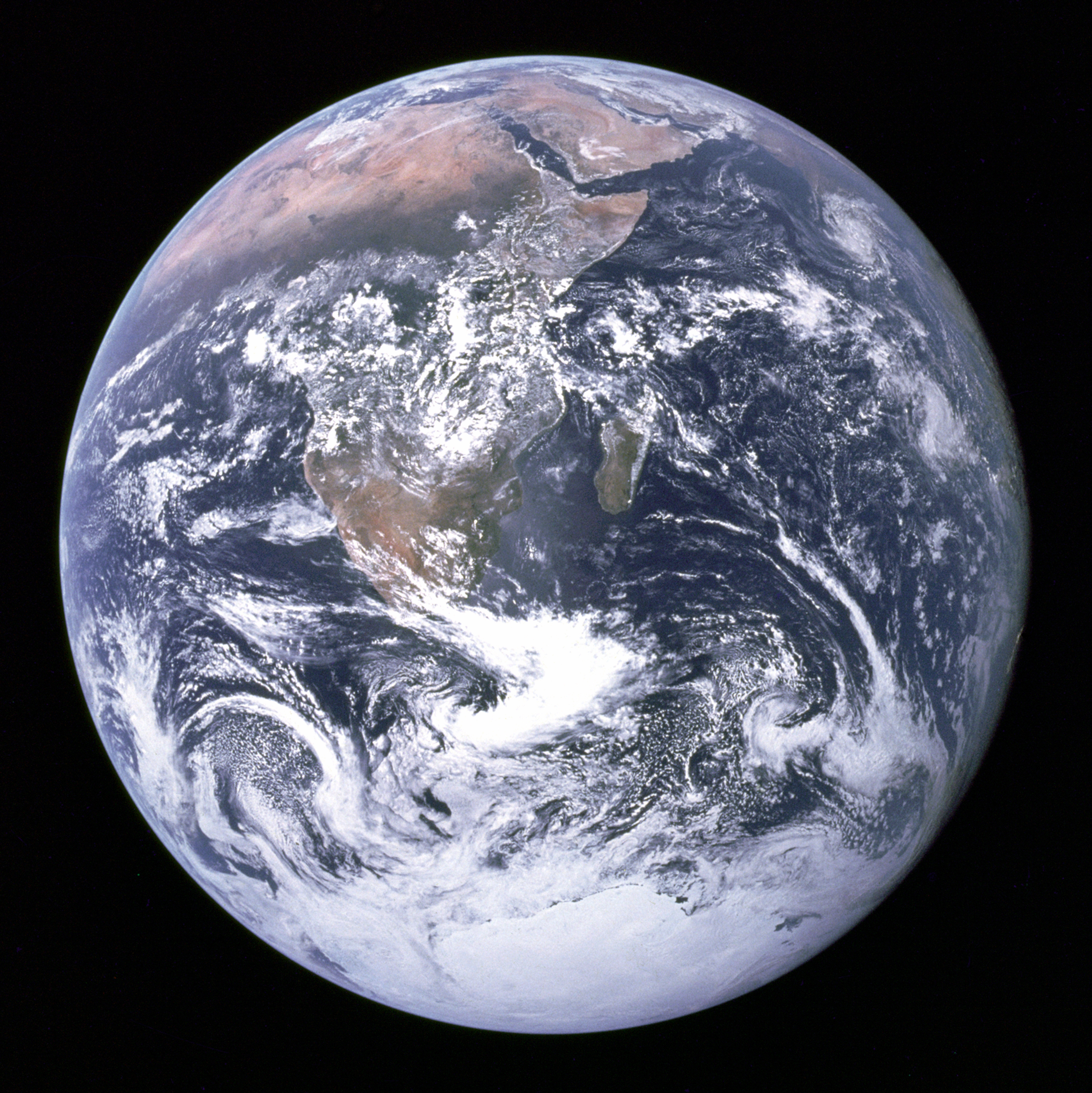
Credit: NASA/Apollo 17 crew; taken by either Harrison Schmitt or Ron Evans · Public domain
Earth is the third planet from the Sun and the only place in the universe where we know for sure that life exists. It is a rocky world about 7,918 miles across. It orbits the Sun once every 365.25 days, which is what we call a year. Earth is roughly 4.5 billion years old. That is so long ago that the dinosaurs, which died out 66 million years ago, only show up near the very end of Earth's story.
A planet of water
From space, Earth looks blue. About 71 percent of its surface is covered by ocean. The rest is land, ice, and clouds. Astronauts in the 1960s called Earth "the Blue Marble" when they first saw it from far away.
Earth is the only planet we know of with liquid water on its surface. Mars has frozen water and tiny amounts of vapor. Venus is far too hot for water to stay liquid. Earth sits in a special zone around the Sun, sometimes called the "Goldilocks zone," where temperatures are not too hot and not too cold. Water on Earth keeps moving in a cycle. It evaporates from the oceans, forms clouds, falls as rain or snow, flows through rivers, and returns to the sea.
Inside Earth
Earth is not solid all the way through. It has layers, like an onion. The outer layer, called the crust, is the thin shell of rock we live on. Under the crust is the mantle, a thick layer of hot rock that flows very slowly, like warm taffy. Below the mantle is the outer core, made of liquid metal. At the very center is the inner core, a ball of solid iron and nickel. The inner core is about as hot as the surface of the Sun.
The moving liquid metal in the outer core acts like a giant magnet. It creates Earth's magnetic field, which reaches far out into space. This magnetic field protects us from harmful particles streaming off the Sun. Without it, the air around us could slowly be stripped away, the way it was on Mars long ago.
A surface that moves
Earth's crust is broken into huge pieces called tectonic plates. These plates float on the soft rock below and slowly move, about as fast as your fingernails grow. Where plates push together, mountains rise. The Himalayas are still growing today because India is pressing into Asia. Where plates pull apart, magma rises and makes new ground. Where plates slide past each other, earthquakes shake the surface.
Continents have not always looked the way they do now. About 250 million years ago, all of Earth's land was joined into one supercontinent called Pangaea. Over millions of years, it broke apart, and the pieces drifted to where they are today. Africa and South America still fit together like puzzle pieces if you look at a map.
Air and life
Earth is wrapped in a thin layer of air called the atmosphere. The atmosphere is mostly nitrogen and oxygen, with small amounts of other gases. It traps just enough heat from the Sun to keep the planet warm, and it shields the surface from most meteors and harmful radiation. Compared to the size of Earth, the atmosphere is incredibly thin. If Earth were the size of an apple, the breathable layer of air would be thinner than the apple's skin.
Life on Earth started at least 3.5 billion years ago. The first living things were tiny single cells in the ocean. Over a very long time, life grew more complex. Some of those cells learned to use sunlight to make food, a process called photosynthesis. They gave off oxygen as waste. That oxygen slowly built up in the air and made it possible for animals, including humans, to breathe. Today scientists have named about 1.5 million species, and they think millions more have not been discovered yet.
Earth's place in space
Earth has one moon, which orbits us about every 27 days. The Moon's pull is what makes ocean tides rise and fall. Earth itself is held in orbit by the Sun's gravity. As we travel around the Sun, our planet is also tilted slightly to one side. That tilt is why we have seasons. When the northern half of Earth leans toward the Sun, it is summer there and winter in the south.
So far, every other world we have studied is empty of life. Scientists keep searching, with telescopes and rovers, for signs that we are not alone. For now, Earth is the only living planet we know.
Related
Last updated 2026-04-25