
Voyager Mission
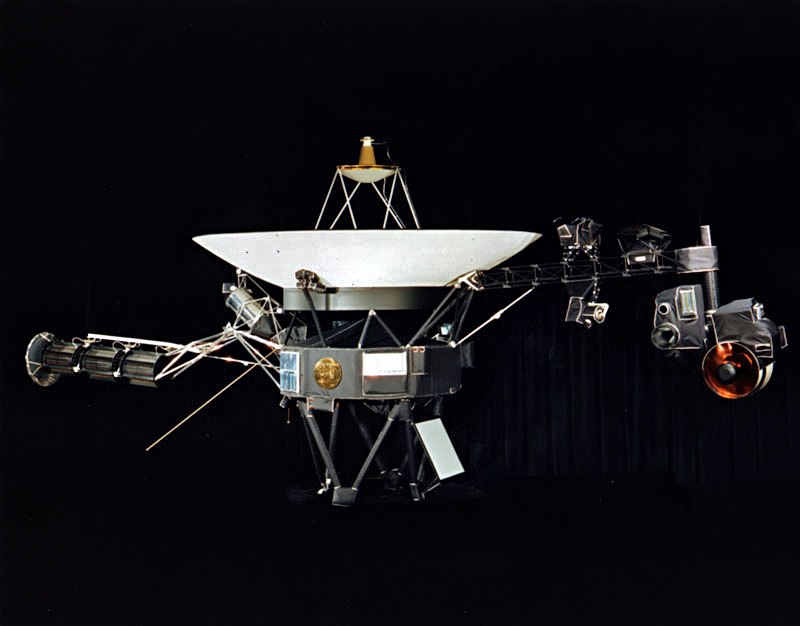
Credit: NASA/JPL-Caltech · Public domain
The Voyager Mission is a pair of NASA space probes sent to explore the outer planets of our solar system. Voyager 2 launched first, on August 20, 1977. Voyager 1 launched 16 days later but took a faster path. Both spacecraft are still flying today, almost 50 years later. They are the farthest human-made objects from Earth.
NASA timed the launches to match a rare lineup of the planets. Jupiter, Saturn, Uranus, and Neptune all lined up on the same side of the Sun. This lineup happens only once every 175 years. It let each probe swing from one planet to the next, using the gravity of each planet like a slingshot to boost its speed.
Voyager 1 reached Jupiter in 1979 and Saturn in 1980. It sent back the first close-up photos of their moons, rings, and storms. Then it flew up and out of the solar system. Voyager 2 took a longer path. It visited Jupiter, Saturn, Uranus in 1986, and Neptune in 1989. It is still the only spacecraft that has ever visited Uranus or Neptune.
The pictures changed what scientists knew about the outer planets. Voyager found active volcanoes on Jupiter's moon Io. It found a thick, smoggy atmosphere on Saturn's moon Titan. It discovered new rings around Jupiter and new moons around every planet it visited. Neptune turned out to have winds of 1,500 miles per hour, the fastest in the solar system.
Each probe carries a Golden Record. This is a gold-plated copper disk with music, greetings, and pictures from Earth. The scientist Carl Sagan helped choose what to include. The record is a message for any alien beings who might find the spacecraft in the distant future. No one expects this to actually happen, but the records will last for billions of years.
Today both probes have left the main part of the solar system and entered interstellar space, the space between the stars. Voyager 1 crossed this boundary in 2012. Voyager 2 crossed it in 2018. They are more than 15 billion miles from Earth. A radio signal from them takes over 20 hours to reach us, even though it travels at the speed of light.
The probes are running low on power. NASA is slowly shutting off their instruments to save energy. By around 2030, the Voyagers will go silent. After that, they will keep drifting through space forever, carrying their Golden Records past other stars. In about 40,000 years, Voyager 1 will pass near a star called Gliese 445.
Last updated 2026-04-22