
Saturn
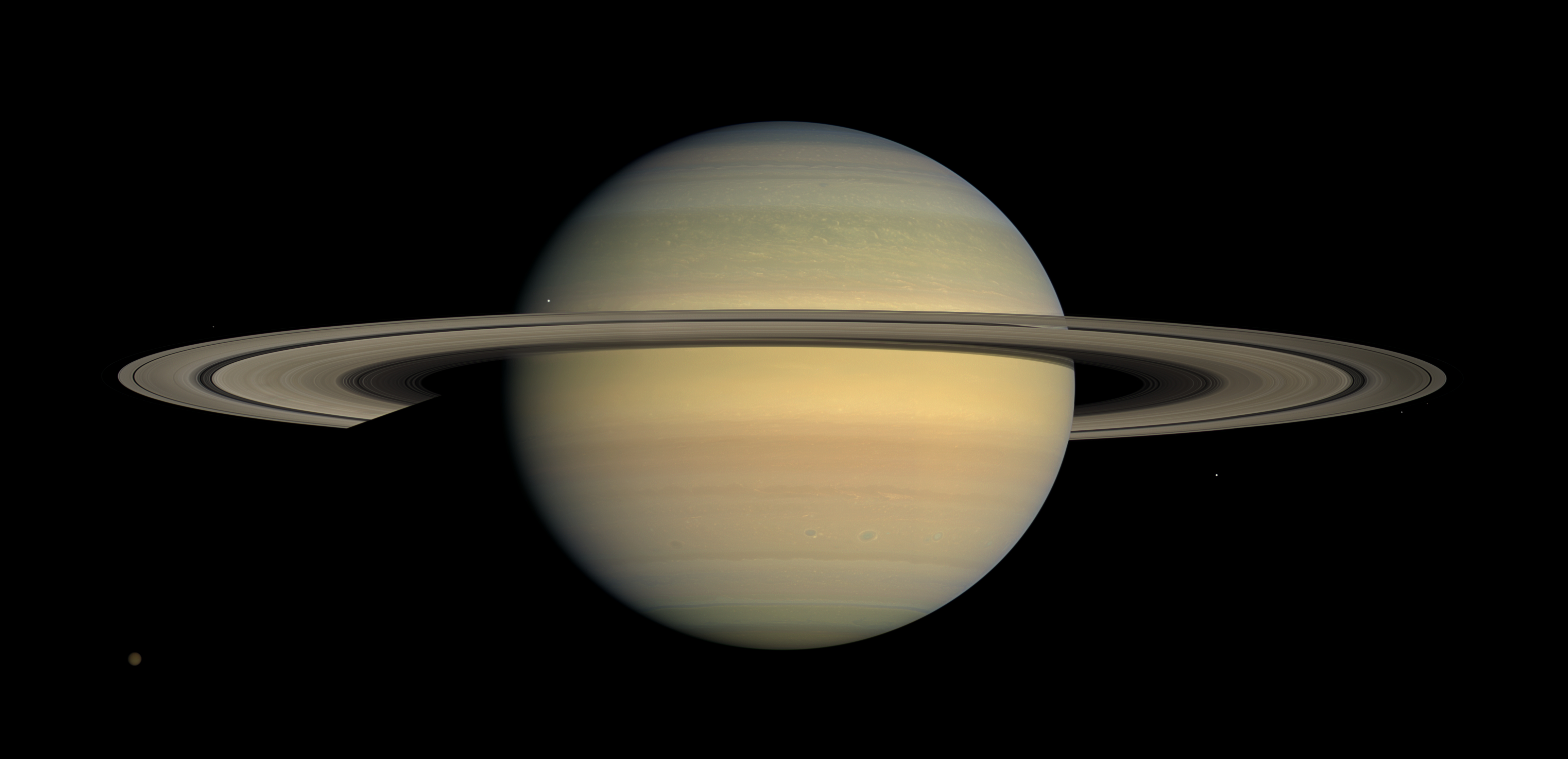
Credit: NASA / JPL / Space Science Institute · Public domain
Saturn is the sixth planet from the Sun and the second largest planet in our solar system. It is a giant ball of gas surrounded by a huge, bright set of rings. Saturn is about 886 million miles from the Sun, almost ten times farther away than Earth. A year on Saturn, one full trip around the Sun, takes about 29 Earth years.
Saturn is big. About 764 Earths could fit inside it. But Saturn is not solid. It is made mostly of hydrogen and helium, the same gases that make up the Sun. If you tried to stand on Saturn, you would just sink into thick clouds and hot gas. Deep inside, the pressure squeezes the gas into a strange liquid metal. At the very center, scientists think there is a small rocky core.
The rings are what make Saturn famous. They stretch more than 170,000 miles across, wider than 21 Earths lined up in a row. But they are surprisingly thin. In most places the rings are only about 30 feet thick, thinner than a two story house. The rings are not solid. They are made of billions of chunks of ice and rock, most no bigger than a house, some as small as grains of sugar.
How did the rings get there? Scientists are still not sure. Some think the rings are leftover bits from when Saturn formed, about 4.5 billion years ago. Others think the rings are much younger, maybe only 100 million years old, and formed when a moon or comet got too close and was torn apart by gravity. Recent studies of the rings lean toward the younger age, but the question is still open.
Saturn spins very fast. A day there lasts only about 10.7 hours. That fast spin pushes winds to incredible speeds. Near the equator, winds can blow at 1,100 miles per hour, more than five times faster than the strongest hurricane on Earth. At the north pole, there is a strange six sided cloud pattern called the Hexagon. Nothing like it has been seen on any other planet.
Saturn has at least 146 known moons, more than any other planet. The biggest, Titan, is larger than the planet Mercury. Titan has a thick orange atmosphere, rivers, and lakes. The rivers and lakes are not made of water. They are made of liquid methane, a chemical that is a gas on Earth.
Last updated 2026-04-22