
Television
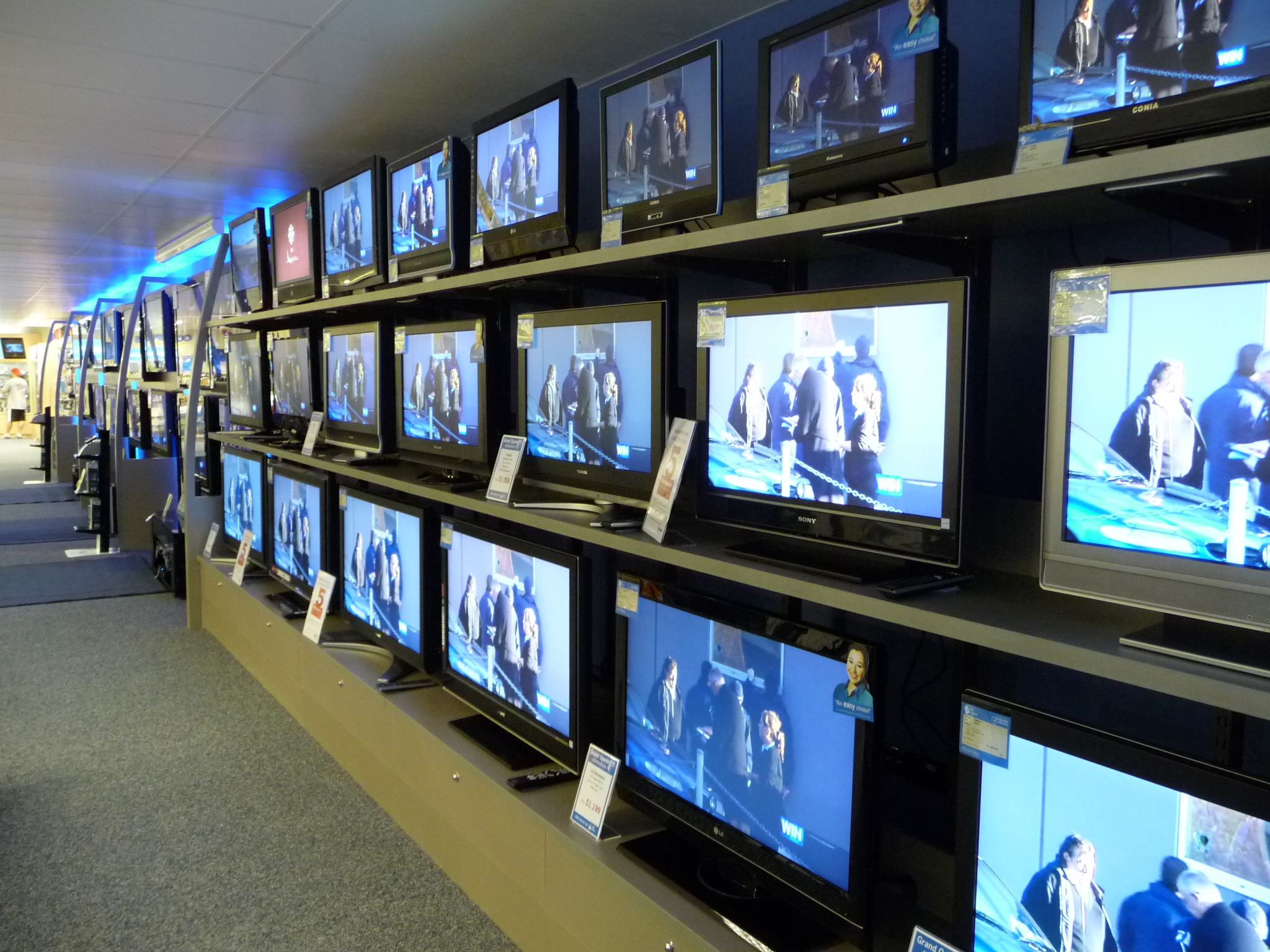
Credit: Wags05 at English Wikipedia · Public domain
Television is a machine that sends moving pictures and sound through the air or through cables. The word comes from two older words. "Tele" means far away, and "vision" means seeing. So television means "seeing from far away." Most homes around the world now have at least one TV.
Television was invented step by step in the early 1900s. Many inventors worked on it at the same time. A Scottish engineer named John Logie Baird showed off a working TV in 1926. A young American named Philo Farnsworth built a different and better version in 1927. Farnsworth was only 21 years old. He had first sketched the idea on a chalkboard when he was 14, after watching a tractor plow a field in straight lines back and forth. Both men are now called inventors of TV, and historians still argue about who deserves more credit.
Early TVs showed only black-and-white pictures. The screens were small and the images were fuzzy. Color TV did not become common in American homes until the 1960s. The picture quality kept getting better over the years. Today's TVs show millions of tiny colored dots, called pixels, on flat screens that can be more than 8 feet wide.
How does a TV work? A camera in a studio captures light from a scene and turns it into an electric signal. That signal travels through cables, through the air as radio waves, or over the internet. Your TV catches the signal and turns it back into light and sound. Old TVs used heavy glass tubes to make the picture. Modern flat-screen TVs use thin layers of glowing crystals or tiny lights called LEDs.
Television changed the world fast. People who had never met before could watch the same news, the same sports games, and the same shows. About 600 million people watched live as astronauts walked on the Moon in 1969. Important moments, such as presidential speeches and the Olympics, suddenly belonged to everyone at once.
The way people watch TV keeps changing. For a long time, families gathered at fixed times to watch shows on a few big channels. Now, services like Netflix and YouTube let people stream whatever they want, whenever they want, on phones and tablets as well as TVs. Some scientists wonder if the word "television" will even make sense in 50 years, when screens may be very different from anything we use today.
Related
Last updated 2026-04-25