
Magna Carta
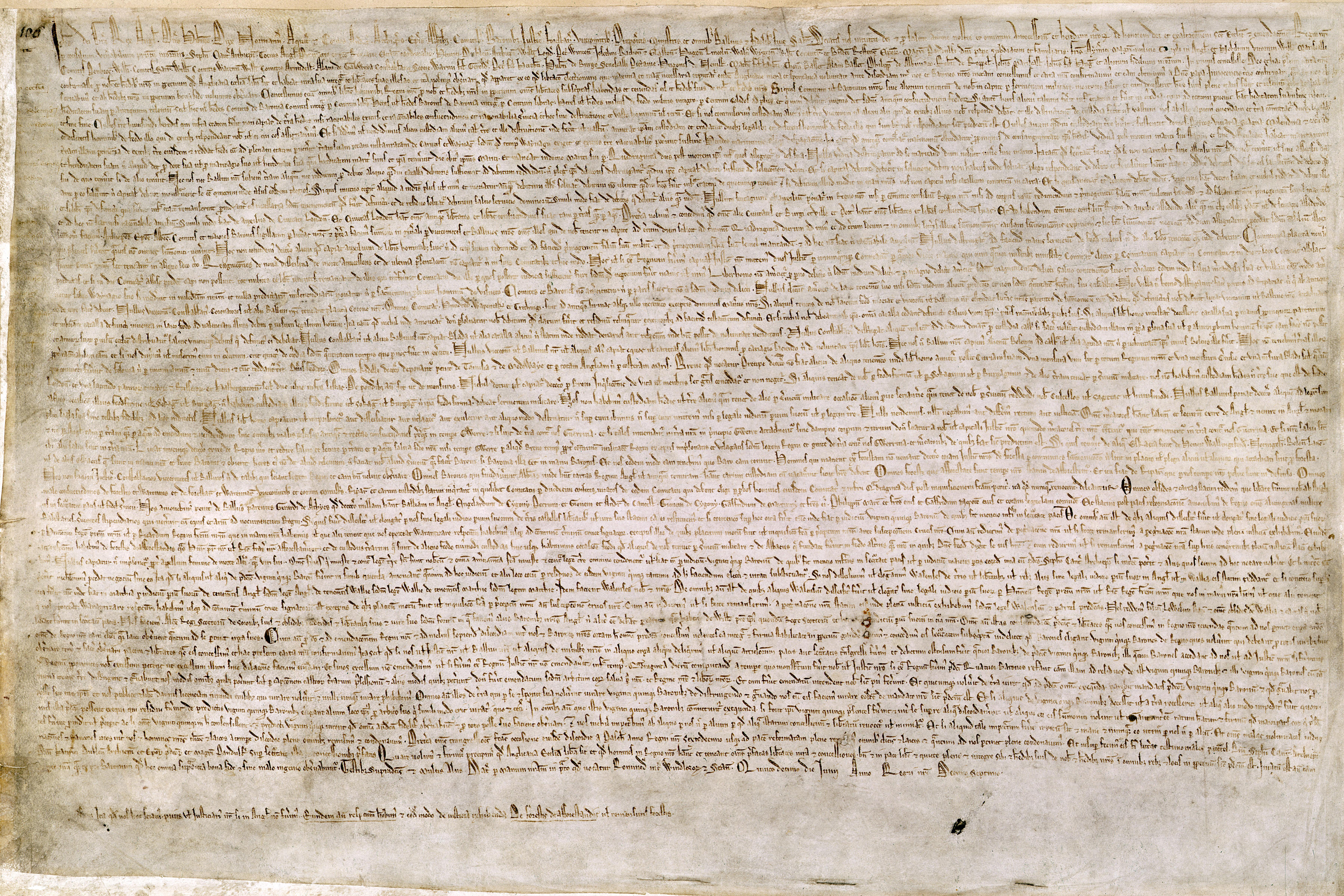
Credit: Original authors were the barons and King John of England. Uploaded by Earthsound. · Public domain
The Magna Carta is a famous document signed in England in 1215. Its name is Latin for "Great Charter." The document was an agreement between King John of England and a group of angry nobles called barons. It promised that the king had to follow the law, just like everyone else. Most historians see it as one of the first big steps toward modern ideas of rights and limited government.
King John was not a popular ruler. He had lost wars in France, raised taxes again and again, and treated his nobles harshly. By 1215, the barons had had enough. They gathered an army and marched on London. The king saw he could not win a war against them. So he agreed to meet them in a meadow called Runnymede, beside the River Thames. There, on June 15, 1215, he placed his royal seal on the Magna Carta.
The charter had 63 rules. Some were small, like rules about fishing in rivers. Others were huge. One rule said the king could not collect new taxes without asking a council of nobles first. Another said no free man could be put in prison or punished without a fair trial by his equals. That idea, often called "due process," is still part of law today in many countries.
The Magna Carta did not protect everyone. It mostly helped wealthy nobles and church leaders. Most ordinary people, including women and enslaved or unfree workers, got very little from it. King John also tried to cancel the agreement only weeks after signing it. He asked the Pope to throw it out, and the Pope agreed. War broke out again right away. But after John died in 1216, his young son Henry III brought the charter back, and later kings issued new versions of it.
Over the centuries, the Magna Carta grew into a powerful symbol. People began to use it to argue that no ruler is above the law. English colonists carried these ideas to America. When the founders of the United States wrote the Constitution and the Bill of Rights in the late 1700s, they borrowed directly from the charter. The right to a fair trial, the rule against unfair punishment, and the idea that government must follow its own laws all trace back to that meadow at Runnymede.
Today, the Magna Carta is more than 800 years old. Its parchment is fragile, but its main idea is still alive: even kings must obey the law.
Related
Last updated 2026-04-26