
Orangutan
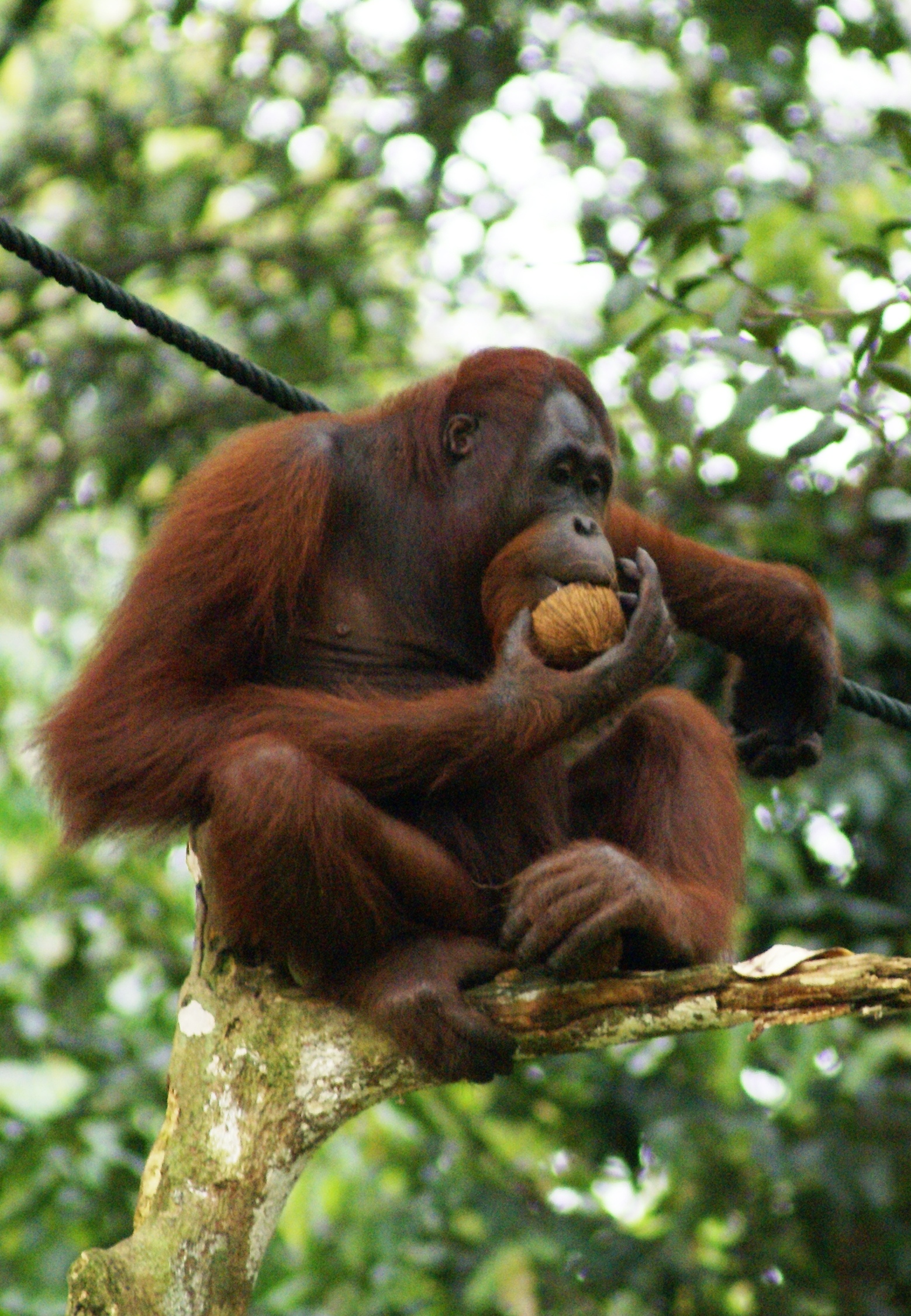
Credit: Eleifert · CC BY-SA 3.0
The orangutan is a large ape that lives in the rainforests of Southeast Asia. It is the only great ape found in Asia. All the other great apes (gorillas, chimpanzees, and bonobos) live in Africa. There are three species of orangutan. Two live on the island of Borneo and one on the island of Sumatra. Their name comes from two Malay words, orang and hutan, which together mean "person of the forest."
Orangutans have long, shaggy reddish-orange fur. Adult males can weigh up to 200 pounds, about as much as a grown man. Females are much smaller, usually around 100 pounds. Their arms are amazingly long. When a male stretches his arms out, the span can reach seven feet, wider than he is tall. Those long arms help them swing and climb through the treetops.
Orangutans spend almost their whole lives in trees. They eat, sleep, and travel high above the forest floor. Their diet is mostly fruit, especially wild figs and a spiky, strong-smelling fruit called durian. They also eat leaves, bark, insects, and honey. Every night, they build a new nest out of branches and leaves to sleep in.
Unlike chimpanzees and gorillas, orangutans mostly live alone. A mother and her baby form the closest bond in the animal world besides humans. A young orangutan stays with its mother for about seven or eight years, longer than almost any other wild animal. During that time, the mother teaches her baby which fruits to eat, how to find water, and how to build a nest. Orangutans have to learn hundreds of skills to survive, and it takes years.
Orangutans are very smart. In the wild, they use sticks as tools to pull insects out of holes and to pry seeds out of tough fruits. In zoos and sanctuaries, they have learned to untie knots, use keys, and even solve puzzles. Scientists debate just how their minds compare to ours, but nobody argues that orangutans are among the most clever animals on Earth.
All three species are critically endangered. The biggest problem is the loss of their forests. Huge areas of rainforest in Borneo and Sumatra have been cut down to make room for palm oil farms, which grow a crop used in many foods and soaps. Fewer than 120,000 orangutans are left in the wild today. Conservation groups are working to protect what forest remains and to rescue orphaned babies whose mothers were killed. Whether the person of the forest survives this century depends on choices people make now.
Related
Last updated 2026-04-22