
Continental Drift
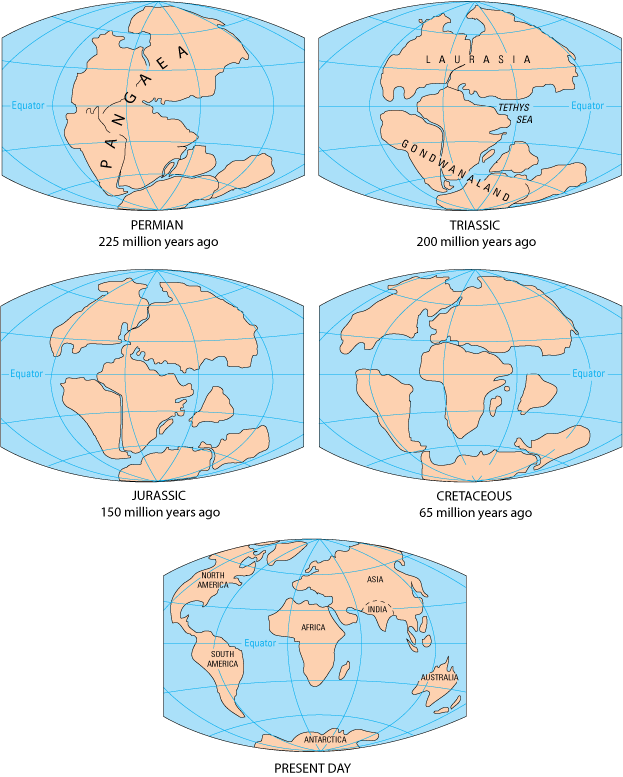
Credit: Kious, Jacquelyne; Tilling, Robert I.; Kiger, Martha, Russel, Jane · Public domain
Continental drift is the idea that Earth's continents slowly move across the planet's surface over millions of years. The continents are not stuck in place. They glide a few inches each year, carried on huge slabs of rock called tectonic plates. Over very long stretches of time, these small movements add up to thousands of miles.
A German scientist named Alfred Wegener first explained this idea in 1912. He noticed something strange when he looked at a world map. The east coast of South America and the west coast of Africa looked like puzzle pieces that could fit together. Wegener thought all the continents had once been joined into a single giant landmass. He called it Pangaea, which means "all lands" in Greek. About 200 million years ago, before dinosaurs ruled Earth, Pangaea began to break apart.
Wegener gathered other clues. Matching fossils of the same ancient plants and reptiles showed up on continents now separated by oceans. Layers of rock in Africa lined up perfectly with layers in South America. Coal beds in cold Antarctica suggested it once sat in a warm, swampy place near the equator.
Most scientists laughed at him. Wegener could not explain HOW the continents moved. He guessed they plowed through the ocean floor like ships, but other scientists showed that this was impossible. He died in 1930 still defending his idea, and few people believed him.
Then, in the 1950s and 1960s, new evidence changed everything. Scientists mapped the bottom of the ocean and found long mountain chains running down the middle of the seas. Hot melted rock was rising up through these ridges, hardening, and pushing the seafloor apart. The continents were not plowing through anything. They were riding on the moving plates beneath them.
This bigger idea is called plate tectonics, and it is one of the most important discoveries in earth science. Earth's outer shell is broken into about 15 large plates plus several smaller ones. Where plates pull apart, new ocean floor is born. Where they crash together, mountains rise and earthquakes shake the ground. Where one plate slides under another, volcanoes form.
The continents are still moving today. North America and Europe drift apart by about 1 inch per year, slow but steady. Scientists think that in 250 million years, the continents may join again into a new supercontinent. Earth's map is never finished.
Related
Last updated 2026-04-25