
Equinox
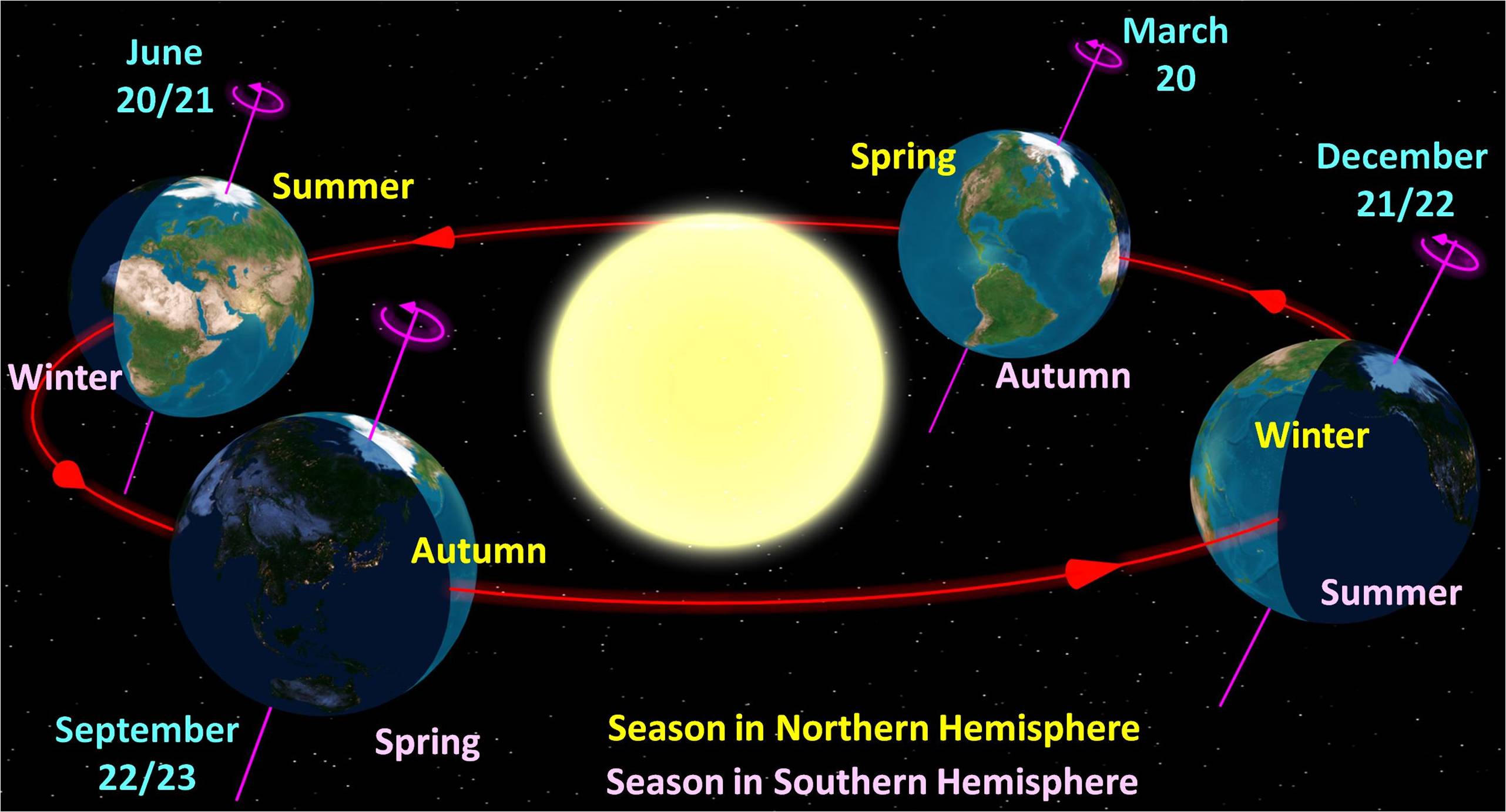
Credit: Tauʻolunga · CC0
An equinox is a day when the hours of sunlight and the hours of darkness are nearly equal everywhere on Earth. The word comes from two Latin words. "Aequi" means equal, and "nox" means night. Equinoxes happen twice a year, once in March and once in September. They mark the start of spring and fall.
Equinoxes happen because of the way Earth is tilted. Earth's axis is the imaginary line that runs through the North and South Poles. The axis is tilted about 23.5 degrees, like a spinning top leaning to one side. As Earth travels around the Sun each year, this tilt is what gives us seasons. For most of the year, one half of Earth leans toward the Sun and the other half leans away.
But twice a year, neither pole leans toward the Sun. The tilt is sideways compared to the Sun's rays. On these two days, sunlight falls evenly on the northern and southern halves of the planet. That is the equinox.
In the Northern Hemisphere, the spring equinox happens around March 20. The fall equinox happens around September 22. In the Southern Hemisphere, the dates are flipped. March is fall in Australia and Argentina, while September is spring.
Day and night are not exactly 12 hours each on the equinox, even though the name suggests they should be. Daylight is a few minutes longer. This happens for two reasons. The Sun is a disk, not a single point, so its top edge rises before its center does. And Earth's atmosphere bends sunlight, letting us see the Sun a little before it actually clears the horizon. The day with truly equal light and dark is called the equilux, and it falls a few days before or after the equinox.
People have noticed equinoxes for thousands of years. Ancient builders lined up their temples and pyramids with the Sun's path. At Chichén Itzá in Mexico, the Maya built a pyramid where, on the spring and fall equinoxes, sunlight and shadow form the shape of a snake slithering down the steps. In ancient Egypt, the Great Sphinx faces directly toward the rising Sun on the equinox.
Many cultures still celebrate the equinox today. Persian New Year, called Nowruz, begins on the spring equinox. Japan marks both equinoxes as national holidays for visiting family graves. The equinox is one of the oldest dates humans have measured, and we have been watching it since long before we understood why it happens.
Last updated 2026-04-25