
Cotton
Credit: Wikimedia Commons · Public domain
Cotton is a plant grown for the soft white fibers that grow around its seeds. People spin those fibers into thread and weave the thread into cloth. Most of the T-shirts, jeans, and socks in the world are made from cotton. The plant grows best in warm places with long summers, like the southern United States, India, China, Pakistan, and parts of Africa.
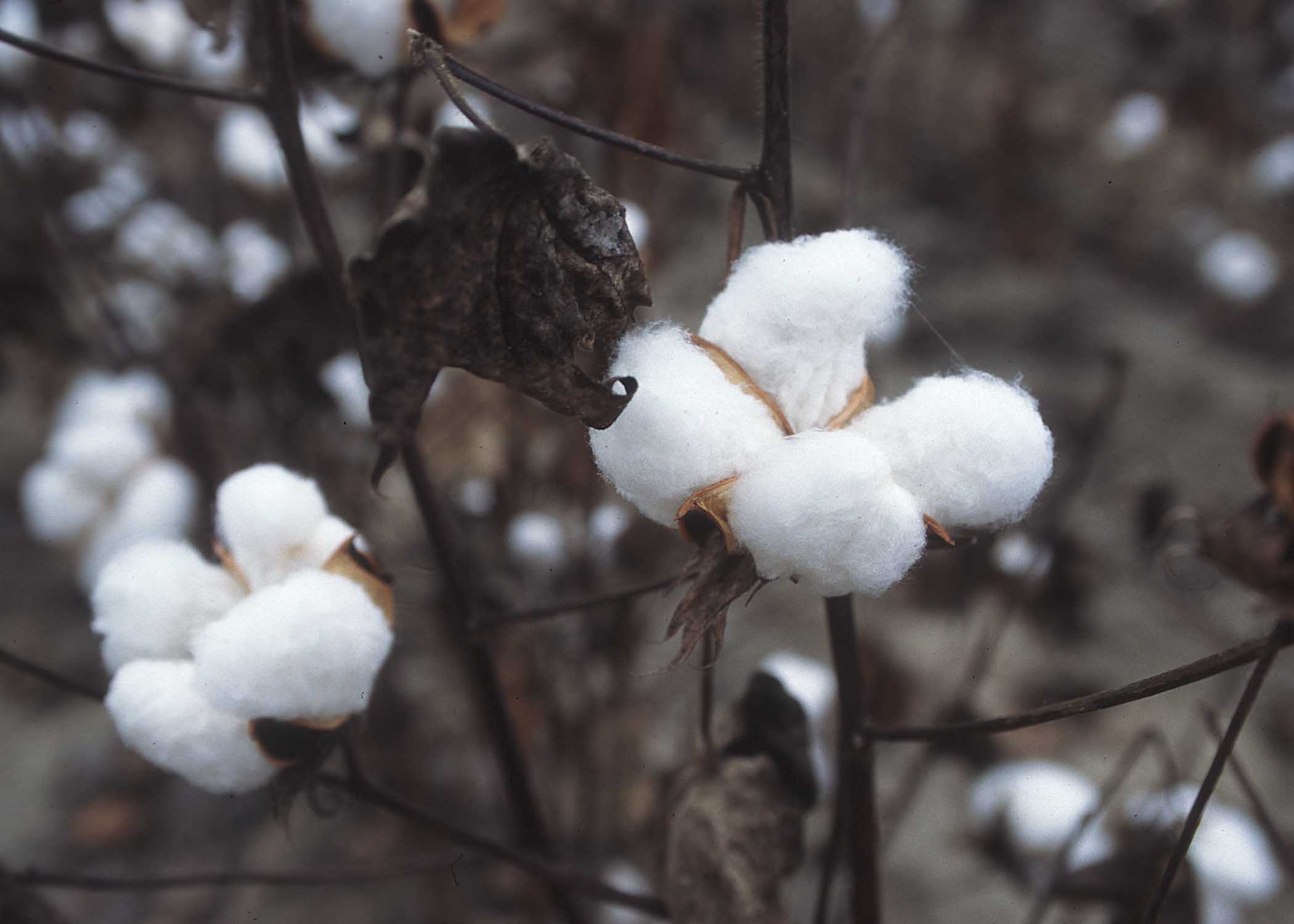
A cotton plant grows to about three or four feet tall. It has wide leaves and creamy yellow flowers. After a flower is pollinated, it grows into a green pod called a boll. Inside the boll, the seeds are wrapped in soft white fluff. When the boll dries and splits open, the fluff puffs out like a cloud. That fluff is the cotton fiber.
Each fiber is a single long cell from the seed coat. Under a microscope, the fiber looks like a flat, twisted ribbon. The twists help fibers grip each other when they are spun together. That is why cotton thread is strong even though one fiber alone could break easily.
People have grown cotton for a long time. Pieces of cotton cloth more than 7,000 years old have been found in Mexico and Pakistan. That is older than the pyramids of Egypt. For most of history, picking cotton and pulling out the seeds had to be done by hand. It was slow, painful work.
Cotton also has a hard history. In the 1700s and 1800s, plantations across the southern United States grew huge amounts of cotton. Most of that cotton was planted, picked, and cleaned by enslaved African and African American people. In 1793, an inventor named Eli Whitney built a machine called the cotton gin that pulled out the seeds quickly. The cotton gin made cotton more profitable, and slavery in the South grew instead of shrinking. Cotton from American plantations was shipped to factories in England, where it powered the Industrial Revolution.
Today, machines plant, pick, and clean almost all the cotton grown in rich countries. The world produces about 25 million tons of cotton fiber every year. Cotton uses a lot of water and a lot of bug spray, so scientists are working on kinds of cotton that need less of both. The shirt you are wearing may have started as a fluffy white boll on a farm halfway around the world.
Related
Last updated 2026-04-25