
British Empire
Credit: The Red Hat of Pat Ferrick · Public domain
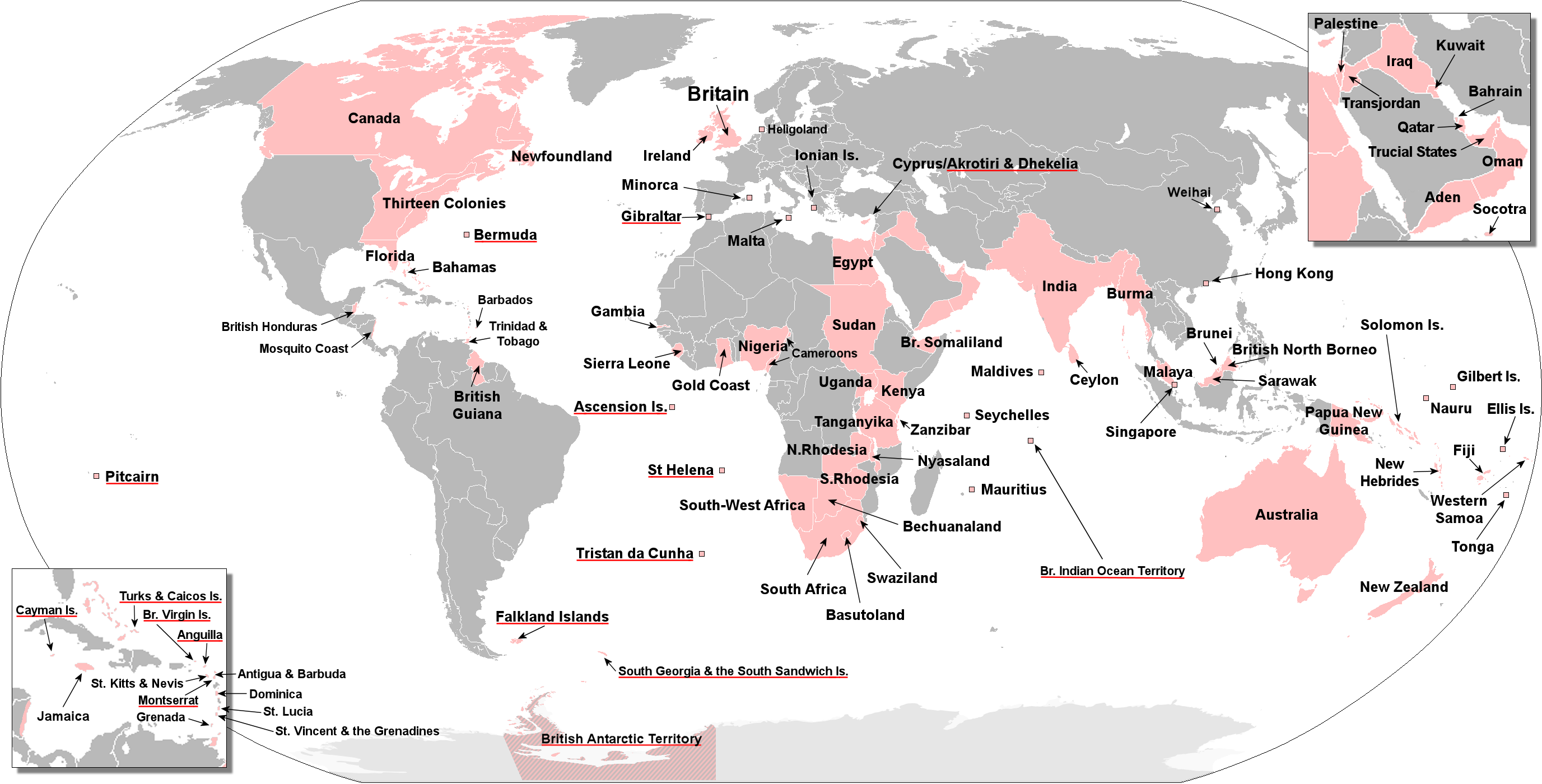
The British Empire was a group of countries, colonies, and territories ruled by Britain. It began in the late 1500s and lasted for about 400 years. At its largest, it stretched across every continent except Antarctica. People used to say "the sun never sets on the British Empire" because it was always daytime in some part of it.
Britain started building its empire by sailing across the oceans. English explorers and merchants set up small colonies in North America in the early 1600s. They also took control of islands in the Caribbean. On these islands, enslaved people from Africa were forced to grow sugar, tobacco, and cotton. The empire grew rich from this work. Britain became one of the biggest sellers of enslaved people in the trans-Atlantic slave trade before finally ending its part in it in 1807.
In the 1700s, Britain fought wars with France and Spain to win more land. It took over much of Canada and large parts of India. Then, in 1776, the thirteen American colonies declared independence. Britain lost the American Revolution and had to let them go. But the empire kept growing in other places. It added Australia, New Zealand, big pieces of Africa, and many islands across the Pacific.
The 1800s, when Queen Victoria ruled, are often called the height of the empire. Britain had the strongest navy in the world. Its factories made goods that were sold everywhere. Railways, telegraph lines, and the English language spread to every continent. By 1920, the empire covered about 13 million square miles, more than three times the size of the United States today.
Empire was not a gift to the people who were ruled. British soldiers and officials often took land, raised taxes, and punished people who fought back. Famines killed millions in India and Ireland while British leaders kept shipping food out for profit. Whole African kingdoms were broken apart. Historians today still argue about the empire's full record. Some focus on roads, schools, and laws it left behind. Others focus on the violence, the stolen wealth, and the cultures it tried to erase. Most historians agree both stories are true.
The empire fell apart in the middle of the 1900s. World War II left Britain weak and in debt. India won independence in 1947. Over the next 40 years, almost every other colony became its own country. Today, more than 50 of those countries belong to a friendly group called the Commonwealth. The empire is gone, but its borders, languages, and arguments still shape the world.
Related
Last updated 2026-04-26