
Giant Ground Sloth
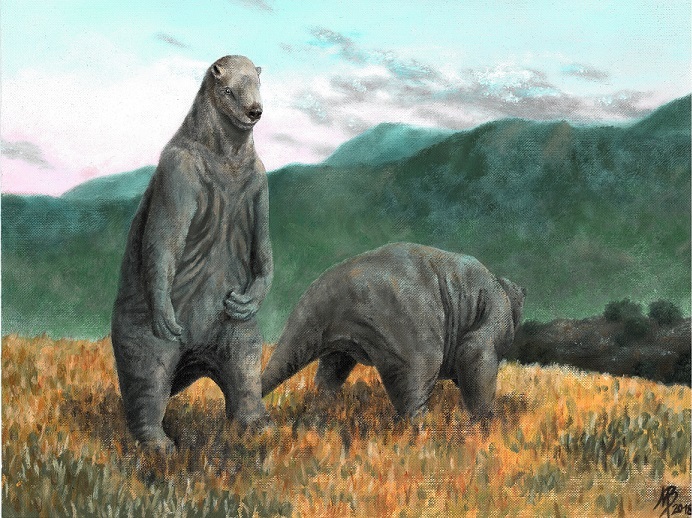
Credit: Marcus Burkhardt · CC BY 3.0
The giant ground sloth was a huge plant-eating mammal that lived in the Americas during the Ice Age. Unlike the small tree sloths of today, it walked on the ground. It lived from about 35 million years ago until roughly 10,000 years ago, when it went extinct. Several different kinds of giant ground sloths lived across North and South America.
The biggest kind was called Megatherium. It lived mostly in South America. A full-grown Megatherium could reach 20 feet from nose to tail and weigh up to 4 tons. That is about as heavy as a modern African elephant. When it stood on its back legs to reach leaves, it was as tall as a two-story house.
Ground sloths did not look much like their tree-climbing cousins. They had thick, powerful legs, a short neck, and a barrel-shaped body. Their front paws ended in long, curved claws. The claws were so big that ground sloths had to walk on the sides of their feet, with the claws curled inward. Their bones were covered in small, pebble-like pieces of armor just under the skin. This armor probably helped protect them from predators like saber-toothed cats.
Ground sloths ate plants. They used their claws to hook branches and pull leaves toward their mouths. Some kinds may have dug for roots. Scientists have even found huge burrows in South America that appear to have been dug by ground sloths. Some of these tunnels are wide enough for a person to walk through standing up.
Ground sloths disappeared at the end of the last Ice Age, around 10,000 years ago. Scientists still debate why. Some argue that a changing climate killed off the plants the sloths depended on. Others believe that early humans hunted them to extinction. Most researchers now think both things played a part. Humans arrived in the Americas around the same time the sloths vanished, and old campsites show cut marks on sloth bones.
Because ground sloths died out so recently, we know a lot about them. Scientists have found frozen dung, preserved skin, and even a few tufts of hair in dry caves in the American West and in South America. In one cave in Nevada, a ground sloth dropping was so well preserved that scientists could study exactly what the animal had eaten for its last meal. Modern tree sloths, the slow little animals that hang upside down in rainforests, are the only living relatives of these vanished giants.
Related
Last updated 2026-04-22